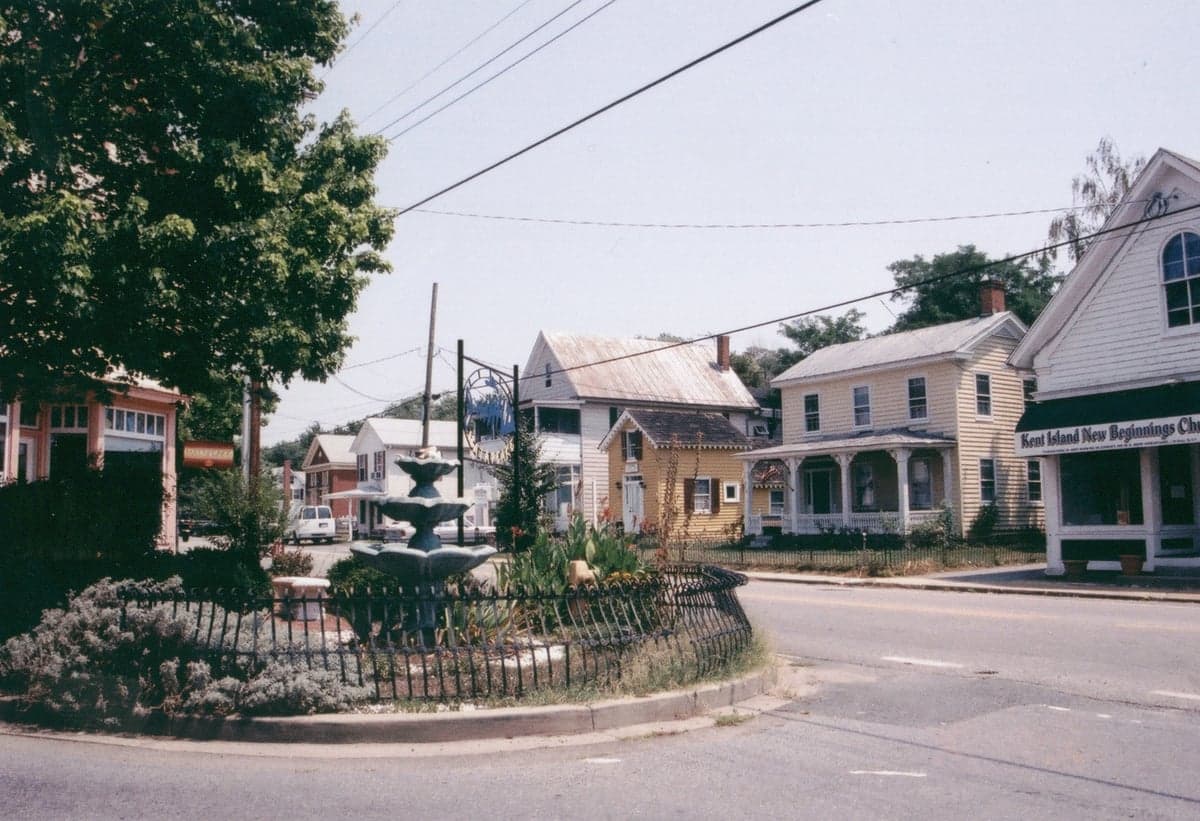
Photo: Wikipedia
Political ClimatePolitical Climate in Stevensville, MD
District shown is the primary district for this city’s centroid. Cities may span multiple districts.
Local Political AnalysisPolitical Analysis of Stevensville, MD
Stevensville, Maryland, is a reliably conservative pocket in a deeply blue state, carrying a Cook Partisan Voting Index of R+8. That’s a stark contrast to Maryland’s overall D+17 rating, meaning the town and surrounding Queen Anne’s County vote about 25 points more Republican than the state as a whole. In practice, this has been the case for decades, but the gap has widened in recent cycles as the Eastern Shore has held steady or shifted right while the D.C. suburbs and Baltimore have moved left. If you’re moving here from somewhere like Bethesda or Silver Spring, you’ll notice the difference almost immediately in yard signs, local news coverage, and casual conversation.
How it compares
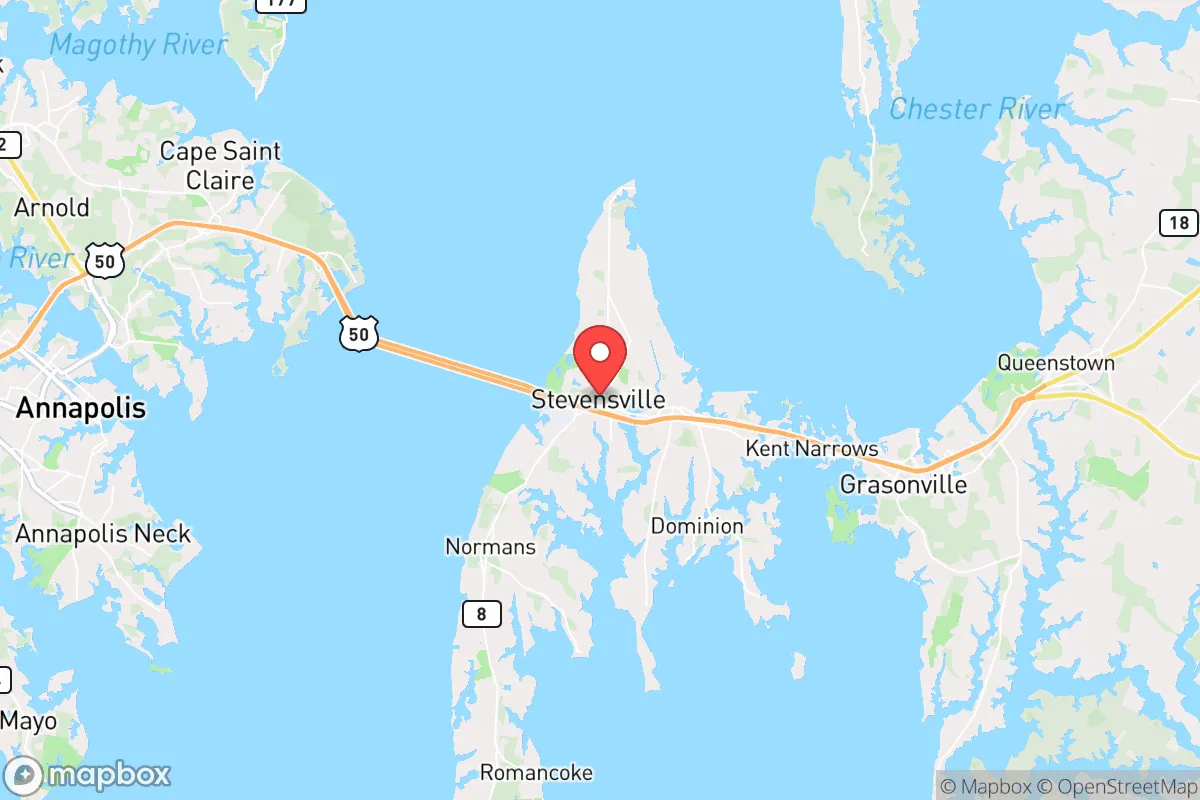
To understand Stevensville’s politics, you have to look at the whole Eastern Shore. The town sits at the western edge of Queen Anne’s County, just across the Chesapeake Bay Bridge from Annapolis, but it feels a world away politically. Neighboring towns like Chester and Grasonville lean similarly conservative, while the state capital of Annapolis, only 12 miles west, is a Democratic stronghold with a PVI around D+18. That bridge is a real dividing line: the Western Shore’s suburbs and Baltimore’s metro area drive Maryland’s blue rating, while the Shore’s rural and exurban communities vote red. In the 2022 gubernatorial race, Queen Anne’s County gave Republican Dan Cox 58% of the vote, even as Democrat Wes Moore won statewide by 32 points. That kind of split is typical here. The county has voted for the Republican presidential candidate in every election since 2000, often by double digits, while Maryland has gone blue by wide margins in the same period.
What this means for residents
For conservatives, Stevensville offers a place where their views are the local norm, not a minority. You’ll find active Republican clubs, conservative church communities, and a general skepticism of the state government in Annapolis. Local elections tend to be decided in Republican primaries, and the county commission has been GOP-controlled for years. For liberals, living here means being in the political minority, but it’s not hostile. Most people are neighborly and keep politics at the dinner table. You won’t see the same level of progressive organizing you’d find in Annapolis or Baltimore, but there are active Democratic clubs and a growing number of transplants from the Western Shore who bring more moderate or liberal views. The real friction comes on policy issues like development, taxes, and school funding, where the county’s conservative lean often clashes with state mandates from Annapolis.
Culturally, Stevensville feels more like a small Southern town than a Maryland suburb. Gun rights are taken seriously, church attendance is high, and the pace of life is slower. The local government tends to favor limited regulation and lower taxes, which keeps the area attractive to families and retirees looking for space. But that also means fewer public services and less investment in transit or affordable housing compared to the Western Shore. If you’re used to the amenities of a blue state, you’ll find them here, just dialed back and filtered through a local lens. The trajectory seems stable: the Shore will likely stay red as Maryland gets bluer, making Stevensville an increasingly distinct conservative enclave within a liberal state.

State Political ClimatePolitical Climate in Maryland
State Political AnalysisPolitical Environment in the State
Maryland is one of the most reliably Democratic states in the country, with a Cook Partisan Voting Index of D+17, meaning it votes about 17 points more Democratic than the national average in presidential elections. The state hasn't voted for a Republican presidential candidate since George H.W. Bush in 1988, and Democrats hold supermajorities in both chambers of the General Assembly. Over the last 10-20 years, the shift has been subtle but real — the Washington, D.C. suburbs have grown bluer as the federal workforce expanded, while the rural eastern and western edges have hardened into Republican strongholds, creating a state that feels like two different countries depending on which side of the Chesapeake Bay you're on.
Urban vs. rural divide
The political map of Maryland is a textbook case of the urban-rural split. The entire Democratic majority is generated by the Washington, D.C. suburbs — Montgomery County and Prince George's County alone account for nearly a third of the state's population and vote about 80% Democratic. Baltimore City is another deep-blue anchor, though its shrinking population has reduced its statewide influence. The Baltimore suburbs — Howard County and Baltimore County — lean Democratic but are more moderate, with Baltimore County actually flipping to Trump in 2016 before swinging back in 2020. The Eastern Shore, Western Maryland, and the southern counties like St. Mary's and Calvert are solidly Republican. Garrett County in the far west voted 70% for Trump in 2020, while Prince George's County voted 89% for Biden. The only real swing territory left is Anne Arundel County (home to Annapolis), which has trended Democratic in recent cycles but still elects Republicans locally. Frederick County, once a Republican stronghold, has been trending purple as D.C. commuters push into its housing market.
Policy environment
Maryland's policy environment reflects its Democratic supermajority, but with a pragmatic, business-friendly streak that surprises outsiders. The state has a progressive income tax structure with rates from 2% to 5.75%, plus local county taxes that push the combined top rate over 8% in Baltimore City and Montgomery County. Property taxes are moderate compared to neighboring states, but transfer taxes on real estate sales are high — a shock for new buyers. The regulatory posture is generally pro-environment and pro-labor, with a $15 minimum wage that took full effect in 2024. Education policy is dominated by the Blueprint for Maryland's Future, a massive funding reform that pumps billions into K-12 schools, with a focus on expanding pre-K and teacher salaries. Healthcare is heavily regulated, with a state-based insurance exchange and Medicaid expansion under the ACA. Election laws are among the most accessible in the country — no-excuse mail-in voting, same-day registration, and early voting are all standard. For a conservative relocator, the tax burden and regulatory density are the main friction points; for a liberal one, the safety net and public services are the draw.
Recent policy direction
The last five years have seen Maryland move decisively left on several fronts, though the pace is moderated by Governor Wes Moore, a Democrat who governs from the center-left. On gun and self-defense law, Maryland passed some of the nation's strictest restrictions in 2023 — a ban on carrying firearms in most public places, expanded background checks, and a requirement for a "good and substantial reason" for concealed carry permits (though this was partially blocked by federal courts). The state already had a ban on assault weapons and high-capacity magazines. On parental and education rights, the Blueprint for Maryland's Future has centralized control over school funding and curriculum, which has frustrated some local school boards and conservative parents who feel sidelined. On speech and privacy, Maryland passed a strong online data privacy law in 2024, giving residents control over how companies use their personal data. On medical and bodily autonomy, the state has codified abortion rights into law and expanded access to gender-affirming care for minors, making it a regional destination for families from more restrictive states. On property rights, the state's zoning and land-use regulations are tight, especially in the D.C. suburbs, where upzoning for density has been a contentious issue. On taxation, the trend is toward higher taxes on high earners — a proposed "millionaire's tax" surcharge was debated in 2024. On voting and ballot access, Maryland has expanded mail-in voting and automatic voter registration, with no signs of rolling back.
Civil unrest & political movements
Maryland has a history of visible political activism, though it rarely reaches the flashpoint levels of some other states. The 2015 Baltimore protests following the death of Freddie Gray were a major national event, leading to a state of emergency and National Guard deployment, and they reshaped local politics for years — Baltimore's state's attorney, Marilyn Mosby, was elected on a reform platform and later prosecuted for perjury. The Black Lives Matter movement remains active in Baltimore and Prince George's County, while the D.C. suburbs see regular protests on national issues like abortion rights and immigration. On the right, the "We the People" movement and Second Amendment advocacy groups are active in rural counties, and there have been periodic calls for Western Maryland to secede and join West Virginia — a fringe but persistent sentiment in Garrett and Allegany counties. Immigration politics are less heated than in border states, but Maryland is a sanctuary state, with a 2023 law limiting local law enforcement cooperation with federal immigration authorities. Election integrity controversies have been minimal compared to swing states, though some rural counties have complained about the dominance of mail-in voting. A new resident would notice the political divide most in the stark difference between a Montgomery County coffee shop and a Garrett County diner — the two worlds barely overlap.
Projection
Over the next 5-10 years, Maryland's Democratic lean is likely to deepen, not reverse. The D.C. suburbs continue to grow as the federal government expands and remote work allows more people to live farther out, pushing Frederick and even parts of the Eastern Shore bluer. Baltimore City's population decline will slightly reduce the Democratic margin, but not enough to offset suburban growth. The Republican Party in Maryland is increasingly confined to rural areas and the Eastern Shore, with little path back to statewide competitiveness unless national trends shift dramatically. The biggest wildcard is housing affordability — if the D.C. suburbs become too expensive, out-migration could slow the blue wave. For a conservative moving in now, expect to be in the minority politically, especially if you live near D.C. or Baltimore. For a liberal, expect your values to be reflected in state policy, but also to pay for it in taxes and cost of living. The state's trajectory is stable, not volatile — Maryland is not going to flip or become a battleground.
For a new resident, the bottom line is this: Maryland's political climate is deeply blue and getting bluer, but it's a pragmatic, establishment blue, not a radical one. Conservatives can live here comfortably if they choose a rural county like Carroll or Harford, but they will have little influence on state policy. Liberals will find a state that matches their values on most issues, with a strong safety net and accessible government. The practical trade-off is between high taxes and high-quality public services — Maryland consistently ranks near the top in education, healthcare, and infrastructure, but you pay for it. If you're moving for a job in the D.C. area, the politics come with the territory; if you're moving for lifestyle, pick your county carefully, because the difference between Montgomery and Garrett is as wide as the difference between two states.
* Values derived from national, state, county, city and local statistics and may differ in a specific area. Last updated: 2026-07-21T20:15:42.000Z
Narrative content on this page is AI-generated and may contain mistakes. Verify any details that matter before acting on them.
ReloMaps may earn a commission from affiliate links at no extra cost to you.

