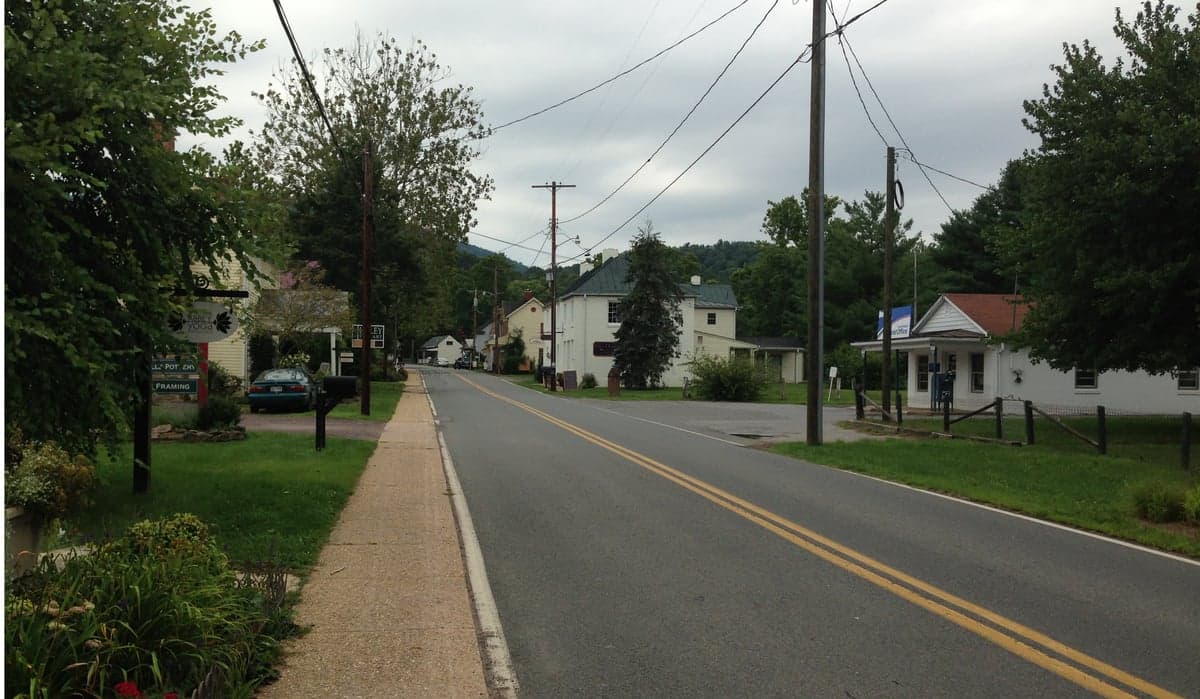
Photo: Wikipedia
Political ClimatePolitical Climate in Sperryville, VA
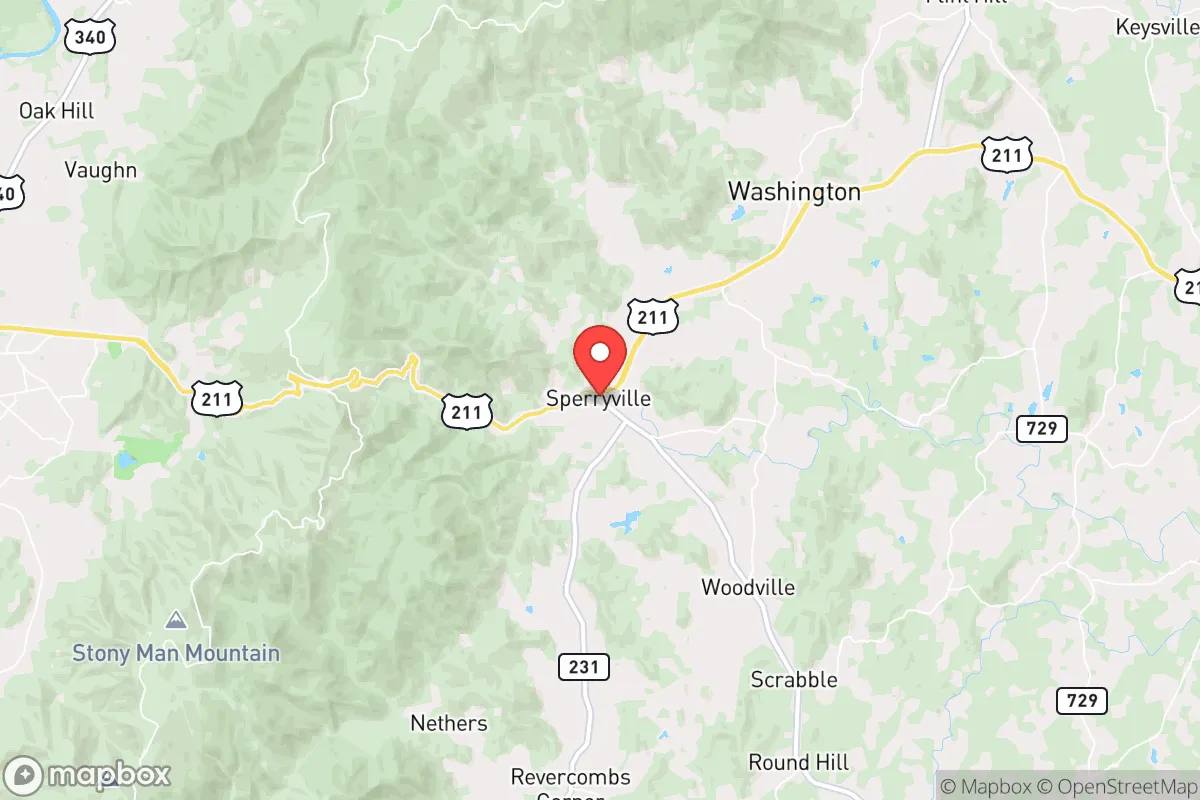
District shown is the primary district for this city’s centroid. Cities may span multiple districts.
Local Political AnalysisPolitical Analysis of Sperryville, VA
Sperryville, Virginia, leans solidly Democratic, with a Cook Partisan Voting Index (PVI) of D+6, making it noticeably more liberal than the state of Virginia as a whole, which sits at D+4. This isn’t a recent flip—it’s a deepening trend. Over the past decade, the influx of retirees, remote workers, and second-home owners from the D.C. metro area has steadily shifted the local electorate leftward, while the surrounding Rappahannock County remains a patchwork of deep-red rural precincts and blue-leaning village centers. If you’re looking at the long arc, Sperryville is becoming more like its neighbor Little Washington (also D-leaning) and less like the conservative strongholds of Flint Hill or Huntly to the east.
How it compares
Virginia’s statewide D+4 PVI reflects a purple state that has trended blue in presidential elections since 2008, driven by Northern Virginia and the Richmond suburbs. Sperryville’s D+6 is a full two points bluer, which is significant for a town of roughly 300 people in a county of 7,000. To put it in perspective: in the 2024 presidential race, Rappahannock County overall voted about 52% Democratic, but Sperryville’s precinct likely hit closer to 60%. That’s a stark contrast with nearby Culpeper County (R+12) or Warren County (R+16), where conservative voters dominate. The difference isn’t just about party registration—it’s about intensity. Sperryville’s Democratic lean is more consistent and less cross-pressured by local economic anxiety than in those neighboring counties, largely because the town’s economy is tied to tourism, wineries, and the arts, not manufacturing or agriculture.
What this means for residents
For liberal residents, Sperryville feels like a comfortable bubble. Local businesses, the farmers market, and community events like the Sperryville Music Festival tend to reflect progressive values, and you’ll see yard signs for Democratic candidates in most windows. Conservative residents, however, aren’t marginalized—they’re just outnumbered. The county board of supervisors and school board are still competitive, and many longtime families hold traditional views on gun rights and land use. In practice, this means a live-and-let-live atmosphere where you can have a Trump flag on your porch and a neighbor with a Harris sign, and both will wave hello. The real friction isn’t between neighbors—it’s between the town’s growth-oriented newcomers and the preservation-minded old guard, a tension that often cuts across party lines.
Culturally, Sperryville stands apart from much of rural Virginia. The town’s identity is shaped by its strong arts scene, farm-to-table restaurants, and craft beverage tourism, which attract a crowd that skews younger, wealthier, and more liberal than the surrounding countryside. Policy-wise, this means local debates often center on short-term rental regulations, broadband expansion, and conservation easements rather than the culture-war issues that dominate state politics. The county’s decision to keep a permissive approach to winery and brewery events reflects a pragmatic localism that both sides can get behind. Looking ahead, if the D.C. exodus continues, Sperryville’s D+6 lean could edge toward D+8 or D+10 within a decade, but the town’s small size and rural character will likely keep it from becoming as uniformly blue as, say, a Charlottesville suburb. For now, it’s a place where the political climate is blue but the social climate is still distinctly Virginian—polite, independent, and slow to change.

State Political ClimatePolitical Climate in Virginia
State Political AnalysisPolitical Environment in the State
Virginia is a genuine purple state that has drifted blue over the last two decades, carrying a Cook PVI of D+4, but the label flatters the Democratic edge—it’s a state where the margin of victory in the last three presidential elections has hovered between 5 and 10 points, and where a single suburban county can flip the entire balance of power. The dominant coalition is a classic urban-suburban alliance: the densely populated crescent from Northern Virginia down through Richmond to Hampton Roads, powered by federal workers, tech professionals, and a growing minority electorate, versus a deeply conservative rural and exurban west and south that votes like the Deep South. If you’re moving here, you’re not entering a monolith—you’re entering a state that has voted for the Democratic presidential nominee in every cycle since 2008, but which elected a Republican governor as recently as 2021 and has a statewide officeholder split down the middle right now.
Urban vs. rural divide
The political map of Virginia is essentially a story of three regions. Northern Virginia—specifically Fairfax, Loudoun, and Prince William counties—is the engine of the Democratic majority, with Fairfax alone casting more votes than the entire city of Richmond. Loudoun County, once a rural exurb, is now the poster child for demographic-driven political change: it went from a reliably Republican county to a 20-point Democratic margin in under a decade, driven by data-center workers, federal contractors, and families fleeing D.C. for better schools. Richmond and its surrounding counties (Henrico, Chesterfield) are a microcosm of the state’s split—Richmond city is overwhelmingly Democratic, while Chesterfield has been trending blue but still holds a Republican undercurrent. Hampton Roads, anchored by Virginia Beach and Norfolk, is a swing region within a swing state; Virginia Beach has a large military and veteran population that leans conservative on national security but has voted Democratic in recent statewide races. The rural west—places like Roanoke, Lynchburg, and the Shenandoah Valley—is solidly Republican, with margins of 30 to 40 points in counties like Augusta and Rockingham. The divide isn’t just urban versus rural; it’s the I-95 corridor versus everything west of the Blue Ridge, with the exurbs of Richmond and Hampton Roads serving as the true battlegrounds.
Policy environment
Virginia’s policy environment is a study in contrasts. The tax structure is moderate: a 5.75% flat income tax, a 4.3% state sales tax (with local add-ons pushing it to 6% in most cities), and property taxes set at the local level, which means Northern Virginia pays significantly more than the rural west. The regulatory posture is business-friendly relative to neighboring Maryland, but the state has adopted California-style emissions standards under the current Democratic administration, which has been a flashpoint for conservatives. Education policy is where the rubber meets the road: Virginia has a strong public school system, but the state’s Standards of Learning (SOL) tests have been a source of bipartisan frustration for years. The current governor, Glenn Youngkin, a Republican elected in 2021, made parental rights in education his signature issue, pushing for model policies on transgender student participation in sports and curriculum transparency. Healthcare is a mixed bag: Virginia expanded Medicaid under the Affordable Care Act in 2018, but the state still has a competitive private insurance market, and rural hospitals are struggling. Election laws are moderate—no voter ID law as strict as Georgia’s, but no same-day registration either; early voting is available, and mail-in voting is no-excuse.
Recent policy direction
The last five years have seen Virginia lurch between two very different policy visions. Under Governor Youngkin, the state has moved right on education and energy: he signed a law requiring parental notification for any changes to a student’s gender identity, banned mask mandates in schools, and pulled Virginia out of the Regional Greenhouse Gas Initiative (RGGI), a carbon cap-and-trade program. On guns, Virginia is a shall-issue state for concealed carry, and Youngkin signed a bill allowing permitless carry in 2024, a major win for Second Amendment advocates. However, the Democratic-controlled state Senate has blocked further conservative moves on abortion—Virginia remains one of the few Southern states where abortion is legal up to 26 weeks, and the state has codified protections for providers. On property rights, Virginia is a mixed bag: it has strong protections against eminent domain abuse, but local zoning battles in places like Loudoun County have become proxy wars over data-center development and housing density. On voting, the state has expanded access—no-excuse absentee voting, same-day voter registration, and automatic voter registration at the DMV—but Republicans have raised concerns about the integrity of the state’s voter rolls, which are cleaned regularly but still contain a significant number of inactive registrations. The overall direction is a tug-of-war: Youngkin has used his executive power to push right, but the legislature remains narrowly divided, and any future Democratic governor could reverse much of his agenda.
Civil unrest & political movements
Virginia has been a flashpoint for political movements on both sides. The most infamous moment was the 2017 Unite the Right rally in Charlottesville, where a counter-protester was killed, and the city has since become a symbol of the national debate over Confederate monuments—many of which have been removed or relocated across the state. The 2020 protests after George Floyd’s death were significant in Richmond, where the Robert E. Lee statue on Monument Avenue became a focal point; it was eventually removed in 2021. On the right, the movement has been more organized around school boards and parental rights, particularly in Loudoun County, where a 2021 sexual assault case involving a transgender student became a national conservative cause célèbre and helped propel Youngkin to victory. Immigration politics are relatively quiet compared to border states, but there is a visible sanctuary-city debate: Richmond and Alexandria have declared themselves sanctuary cities, while the state legislature has considered bills to ban such policies, none of which have passed. Election integrity has been a persistent issue: the 2020 election saw Virginia’s results certified without major controversy, but Republican activists have pushed for stricter voter roll maintenance, and the state’s removal of 6,000 non-citizens from the rolls in 2024 drew both praise and legal challenges. A new resident would notice the political energy most in Northern Virginia, where yard signs are ubiquitous and local races are fiercely contested, and in the rural west, where “Don’t Tread on Me” flags and Trump 2024 signs are common.
Projection
Over the next five to ten years, Virginia is likely to remain a lean-Democratic state, but the margin could narrow if current trends hold. The key demographic driver is Northern Virginia’s continued growth—Fairfax and Loudoun counties are adding tens of thousands of residents annually, most of whom are college-educated professionals who vote Democratic. However, there is a counter-trend: the exurbs of Richmond and Hampton Roads are seeing an influx of retirees and remote workers from higher-tax states like New York and New Jersey, many of whom are fiscally conservative and could shift the balance in swing districts. The 2025 gubernatorial race will be a bellwether—if a Republican wins, it would signal that Youngkin’s coalition is durable; if a Democrat wins, it would confirm the state’s blue trajectory. The wildcard is the federal workforce: if the federal government downsizes or relocates agencies out of D.C., Northern Virginia’s economy and political lean could shift. For a new resident, the realistic expectation is a state that remains competitive but with a slight Democratic edge, where control of the governorship and legislature will flip back and forth, and where the policy environment will continue to swing with each election cycle.
For a conservative moving to Virginia, the bottom line is that you’ll find a state where your vote matters—but you’ll be in the minority in the population centers, and you’ll need to be comfortable with a state government that is often at odds with your views on social issues. For a liberal, Virginia is a comfortable but not overwhelming blue state, with the caveat that rural areas are deeply conservative and that a Republican governor can still win statewide. The practical takeaway is to choose your locality carefully: if you want a conservative community, look at the Shenandoah Valley, the Richmond exurbs, or Virginia Beach; if you want a liberal environment, Northern Virginia and Richmond city are your best bets. The state’s political future is genuinely uncertain, which makes it one of the most interesting places in the country to live—and one where your vote, and your voice, can actually make a difference.
* Values derived from national, state, county, city and local statistics and may differ in a specific area. Last updated: 2026-09-14T21:51:44.000Z
Narrative content on this page is AI-generated and may contain mistakes. Verify any details that matter before acting on them.
ReloMaps may earn a commission from affiliate links at no extra cost to you.

