
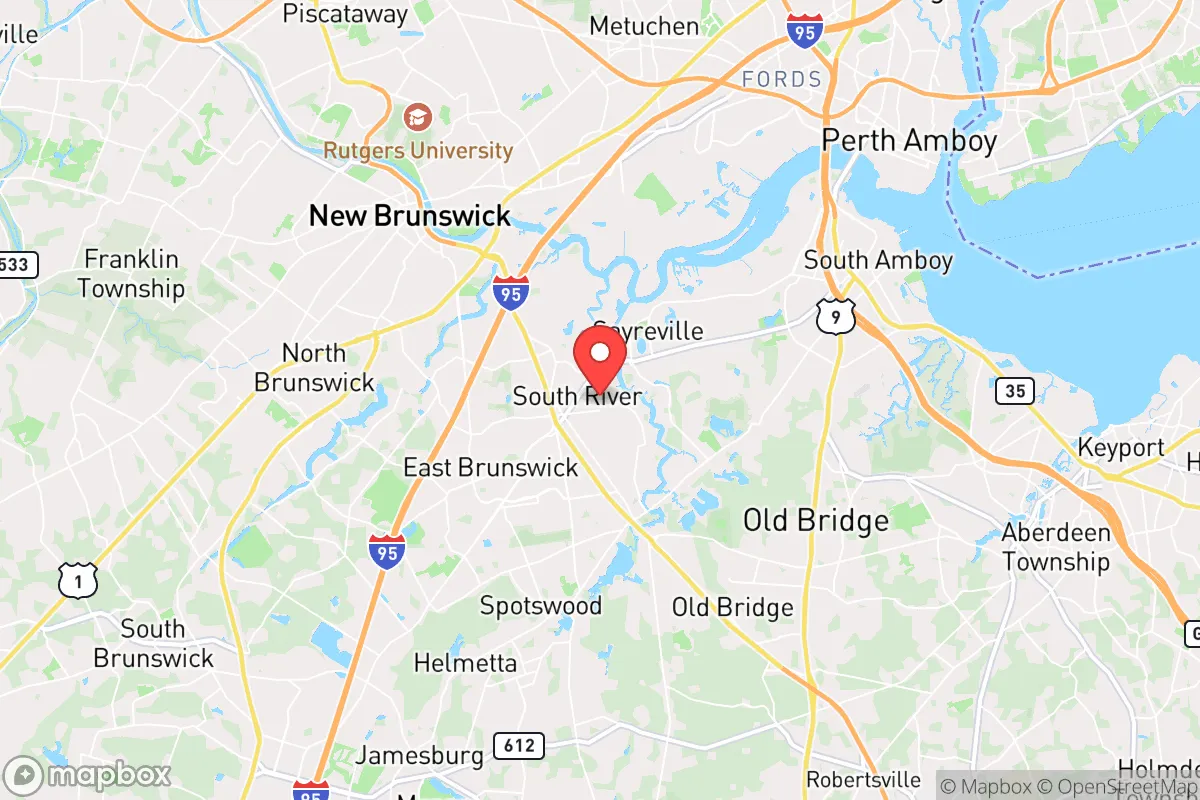
Photo: Wikipedia
Personal Sovereignty in South River, NJ
Viable for self-reliance. Generally workable, though some barriers may limit total independence.
What does Personal Sovereignty tell us?
Personal Sovereignty measures your capacity for self-reliance and independence with minimal government friction. Higher scores mean fewer barriers between you and the way you want to live... but it assumes you have the space you need and good neighbors.
What does this tell us?
Personal Sovereignty measures your capacity for self-reliance and independence with minimal government friction. Higher scores mean fewer barriers between you and the way you want to live... but it assumes you have the space you need and good neighbors.
State Policy
Energy independence: Importer (17% of energy produced in-state)
Personal Liberty
Homesteading

Personal Liberty Analysis
South River, New Jersey, sits in one of the most densely regulated and heavily taxed states in the country, which fundamentally shapes the personal sovereignty landscape here. For a relocation researcher, the honest headline is this: individual autonomy in South River is constrained by state-level mandates on firearms, property use, and taxation, though the borough itself operates with a relatively light municipal touch. If you are weighing personal freedom against proximity to the New York metro, the trade-off is stark and should be evaluated with clear eyes.
How the tax burden and regulatory posture affect your finances
New Jersey’s tax climate is the single largest drag on personal sovereignty in South River. The state’s effective property tax rate hovers near 2.3% of assessed home value, one of the highest in the nation, and South River’s municipal rate sits in line with Middlesex County averages. A $400,000 home in the borough will carry an annual property tax bill of roughly $9,200, a figure that directly reduces disposable income and, by extension, your capacity to save, invest, or self-fund independent projects. The state also imposes a progressive income tax topping out at 10.75% for high earners, which applies to wages earned anywhere in the state, and a sales tax of 6.625% that funds a sprawling state apparatus.
Regulatory posture at the state level is similarly heavy-handed. New Jersey enforces some of the strictest environmental and land-use rules in the country, including the Highlands Water Protection and Planning Act and the Flood Hazard Area Control Act, both of which can complicate even modest property modifications. The borough of South River itself, however, is a working-class community with a pragmatic municipal code; zoning is conventional, permits are processed predictably, and there is no local income tax or payroll tax. The practical effect is that your regulatory friction comes almost entirely from Trenton, not from the borough hall on Main Street.
Self-defense rights and gun law specifics in South River
If self-defense is a priority, New Jersey is among the most restrictive states in the country, and South River offers no local carve-out. The state requires a Firearms Purchaser Identification Card (FPID) for handgun purchases, a permit for each individual handgun transaction, and a separate permit to carry a handgun in public. The carry permit process, post-Bruen, is shall-issue in name but remains administratively burdensome: applicants must complete a training course, provide references, and undergo a background check that can take months. The state also bans "assault firearms" and standard-capacity magazines over 10 rounds, and there is no constitutional carry provision.
For the sovereignty-minded individual, this means defensive firearms are legally accessible but practically encumbered. A law-abiding resident can own a shotgun or rifle with an FPID, but carrying a concealed handgun for daily protection requires proactive planning and patience. The borough police department in South River processes applications locally, and anecdotal reports suggest wait times of 60 to 120 days for carry permits, depending on the volume of applications. Compare that to states like Pennsylvania, where a carry permit is issued in under 30 days, and the difference in personal security posture becomes obvious.
Self-reliance and homesteading viability: lot sizes, zoning, and off-grid feasibility
Homesteading in South River is a non-starter for most practical purposes. The borough is a fully built-out, suburban municipality with a population density of roughly 8,000 people per square mile, and the median lot size is under 0.15 acres. Zoning ordinances in the R-5 and R-7 residential districts require minimum frontage and setback distances that leave little room for substantial agricultural activity, and the borough code restricts keeping livestock to small fowl like chickens, with a permit and a cap of six birds. There is no allowance for goats, pigs, or cattle within borough limits, and the state’s Right to Farm Act does not apply to non-agricultural zones.
Off-grid feasibility is equally limited. New Jersey mandates grid connection for new construction and major renovations, and the state’s energy code requires specific insulation and appliance standards that make true self-sufficiency impractical. Solar panels are permitted, but net metering rules require a grid tie-in, and battery storage is expensive relative to the modest energy needs of a small home. Rainwater harvesting is restricted by state law to non-potable uses, and composting toilets are not recognized by the borough’s plumbing code. If self-reliance means growing your own food and generating your own power, South River is not the place; you would need to look to Hunterdon or Warren County, where lot sizes of 3 to 10 acres are common and agricultural zoning is more permissive.
Personal liberties: parental rights, medical autonomy, speech, and property
On personal liberties, New Jersey is a mixed bag that leans progressive. Parental rights are explicitly protected under state law for educational decisions, including the right to opt children out of sex education and to review instructional materials, but the state mandates vaccination for school attendance with no philosophical exemption — only medical and religious exemptions are recognized. Medical autonomy is similarly constrained: the state has no conscience clause for refusing COVID-19 vaccination, and employers can mandate shots as a condition of employment, a posture that has driven some freedom-minded residents to neighboring Pennsylvania.
Free speech is robustly protected in New Jersey, with state courts often extending broader protections than the federal baseline, and South River’s public spaces — including the Memorial Park and the waterfront along the South River — are open for expressive activity without a permit. Property rights, however, are the weakest link. New Jersey is one of the few states with no statewide preemption of local rent control, and while South River does not currently impose rent stabilization, the borough council could adopt it at any time. More significantly, the state’s eminent domain powers are broad, and the New Jersey Supreme Court has historically deferred to municipal redevelopment agencies, meaning your property is more vulnerable to condemnation than in most other states.
Overall, personal sovereignty in South River is a study in contrasts: the borough is administratively simple, but the state imposes a heavy tax and regulatory burden, restrictive gun laws, and limited homesteading options. For a single individual or family prioritizing autonomy, the calculus is unfavorable relative to states like New Hampshire, Texas, or even western Pennsylvania. South River works best for those who value transit access to New York and Philadelphia more than they value the freedom to carry a firearm, keep livestock, or minimize their tax footprint. If sovereignty is your primary relocation driver, this is a place to visit — not a place to settle.

* Values derived from national, state, county, city and local statistics and may differ in a specific area. Last updated: 2026-11-13T09:04:19.000Z
Narrative content on this page is AI-generated and may contain mistakes. Verify any details that matter before acting on them.
ReloMaps may earn a commission from affiliate links at no extra cost to you.

