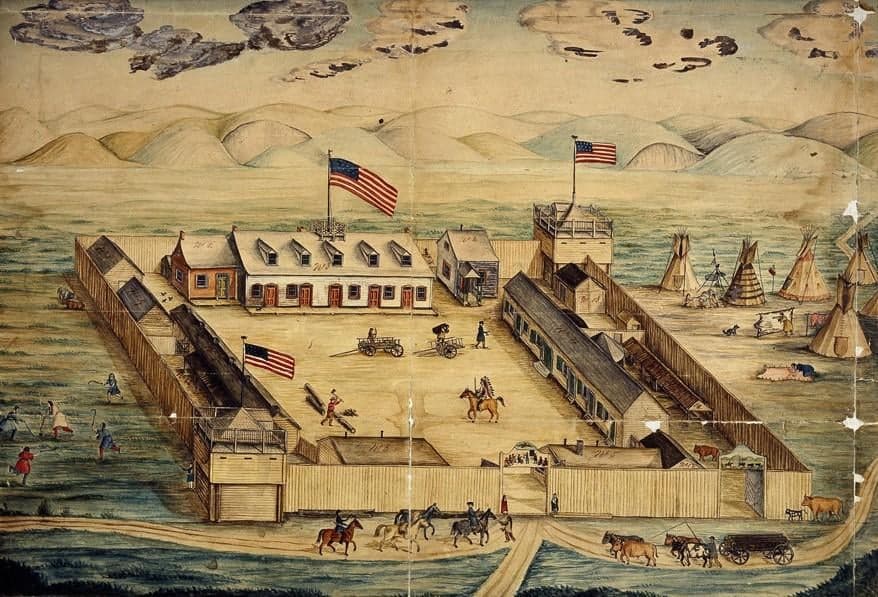
Photo: Wikipedia
Demographics of Stanley County
Affluence Level in Stanley County
A middle-class area roughly in line with national averages across income, home values, education, and employment.
People of Stanley County
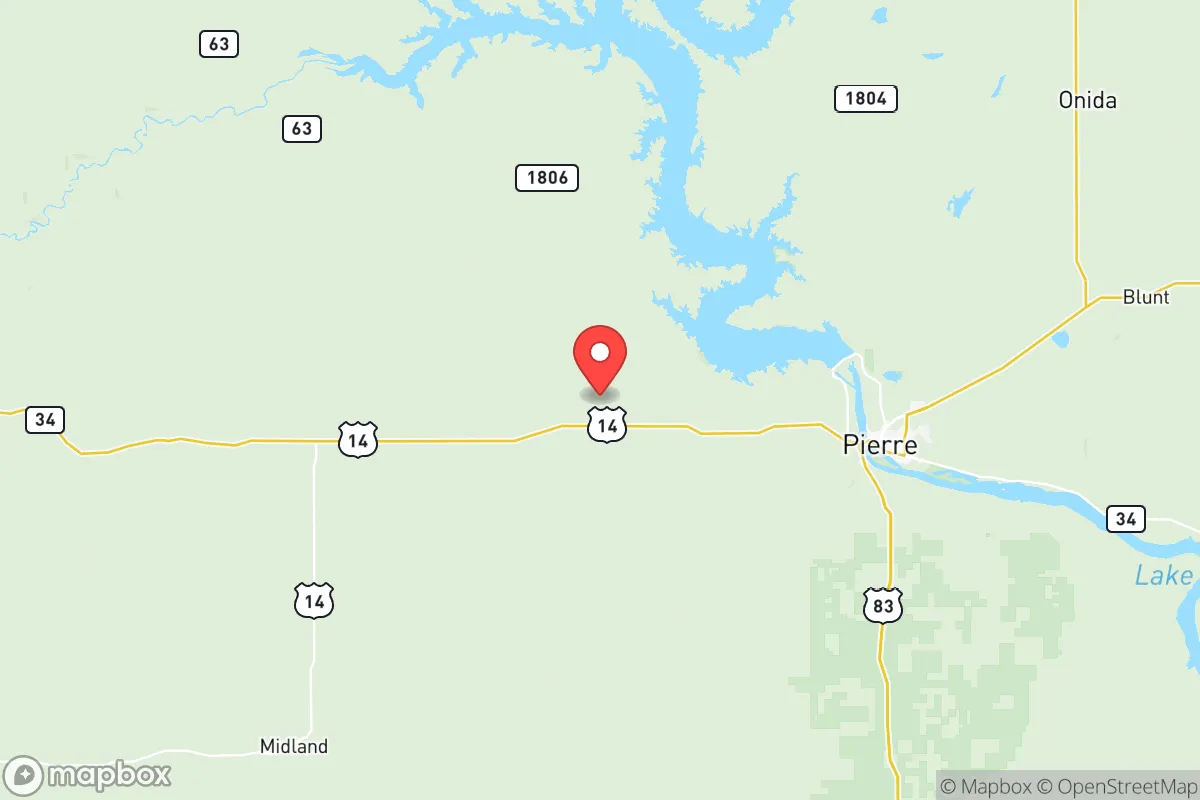
The people of Stanley County, South Dakota today number just over 3,000, making it one of the state's least densely populated counties. The population is overwhelmingly white (90.0%) with a small Hispanic minority (2.0%) and virtually no foreign-born residents (0.0%). A quarter of adults hold a college degree (25.4%), and the county's character is defined by its rural, agricultural roots, with the Missouri River and the county seat of Fort Pierre serving as the historic and commercial heart of the community.
Settlement & growth (pre-1960)
Long before European settlement, the area that is now Stanley County was part of the vast hunting grounds of the Lakota Sioux, particularly the Sicangu and Oglala bands. The Missouri River provided a vital corridor for trade and seasonal movement. The first non-Native presence came with French fur trappers and traders in the 18th century, but permanent American settlement did not begin until after the 1868 Treaty of Fort Laramie, which initially guaranteed the land to the Lakota. The discovery of gold in the Black Hills in 1874 and the subsequent U.S. military campaigns broke Lakota control, opening the region to homesteaders.
The key event for Stanley County was the founding of Fort Pierre in 1880 as a railroad terminus and river port. Named after Pierre Chouteau Jr., a prominent fur trader, the town became the county seat in 1883. The railroad's arrival spurred a wave of homesteaders, primarily of German, Scandinavian (Norwegian and Swedish), and Irish descent, who arrived between 1880 and 1910. They were drawn by the promise of 160-acre plots under the Homestead Act and the opportunity to farm the rolling prairies. These settlers established small farming communities like Hayes (founded 1907) and Mission Ridge, which served as grain-shipping points and social hubs. The town of Wendte, named after a local rancher, also grew as a stop on the railroad line. The county's population peaked at around 4,500 in the 1920s, supported by cattle ranching and dryland wheat farming.
The Dust Bowl and Great Depression of the 1930s hit Stanley County hard, causing a significant out-migration of families who had failed to make a living on marginal land. The construction of the Oahe Dam on the Missouri River in the 1950s and 1960s brought a temporary influx of construction workers and engineers, many of whom stayed in the area. This project also permanently altered the landscape, flooding some bottomlands and creating Lake Oahe, which would later become a key recreational asset. By 1960, the population had stabilized at around 2,500, a figure that would remain relatively flat for decades.
Modern era (post-1965)
The post-1965 era, shaped by the Hart-Cellar Act, had virtually no direct impact on Stanley County's demographics. The county's foreign-born population remains at 0.0%, and there are no established immigrant enclaves. The demographic story of the last 60 years is instead one of domestic consolidation and aging. Young adults have consistently left for larger cities like Pierre (across the river), Rapid City, or Sioux Falls for education and employment, while the county has attracted some retirees and second-home owners drawn to the hunting and fishing opportunities along Lake Oahe.
The most significant modern shift has been the gradual decline of the small farming hamlets. Hayes, once a bustling town of several hundred, now has a population of around 20. Mission Ridge and Wendte are largely ghost towns, with only a few scattered homes and abandoned grain elevators. Population has concentrated almost entirely in Fort Pierre, which has grown modestly to about 2,000 residents, and along the Missouri River corridor. The county's Hispanic population, while small at 2.0%, has grown slightly in recent decades, primarily through a few families working in the cattle and hog operations that dominate the local agricultural economy. There has been no significant Black, Asian, or Indian subcontinent migration.
The county's racial and ethnic makeup has remained remarkably stable. The white population share has declined only slightly from the 98% recorded in 1990, largely due to the small Hispanic influx. The college-educated share (25.4%) is below the state average, reflecting the county's blue-collar, agricultural employment base. The economy is now a mix of ranching, farming, government jobs (related to the Oahe Dam and state services), and tourism centered on hunting, fishing, and the annual Fort Pierre Rodeo.
The future
Stanley County's population is projected to remain stable or decline slightly over the next 10 to 20 years. The county is not homogenizing or tribalizing into distinct enclaves; rather, it is slowly consolidating into a single, aging, and predominantly white community centered on Fort Pierre. The small Hispanic population is likely to grow incrementally as agricultural labor needs persist, but it will remain a small minority, largely assimilated into the broader rural culture.
The primary demographic pressure is out-migration of young adults. Without a major economic shift—such as a large-scale energy project or a significant expansion of tourism infrastructure—the county will continue to see a slow aging of its population. The cultural identity of Stanley County is deeply rooted in its ranching and hunting heritage, and new in-migrants (typically retirees or remote workers seeking a low-cost, rural lifestyle) are generally absorbed into this existing identity rather than changing it. The county is not a destination for the kind of rapid, diversifying growth seen in South Dakota's eastern cities.
For someone moving in now, Stanley County offers a stable, predictable, and culturally homogeneous rural environment. The population is not growing, but it is not collapsing either. The community is tight-knit, with a strong sense of local history and self-reliance. The future points toward a continuation of the present: a small, white, aging population concentrated in Fort Pierre, with the surrounding countryside returning to open range and the small towns of Hayes and Mission Ridge fading further into memory. A move here is a choice for quiet, space, and a way of life that has changed little in a century.

* Values derived from national, state, county, city and local statistics and may differ in a specific area. Last updated: 2026-05-28T01:33:28.000Z
Narrative content on this page is AI-generated and may contain mistakes. Verify any details that matter before acting on them.
ReloMaps may earn a commission from affiliate links at no extra cost to you.

