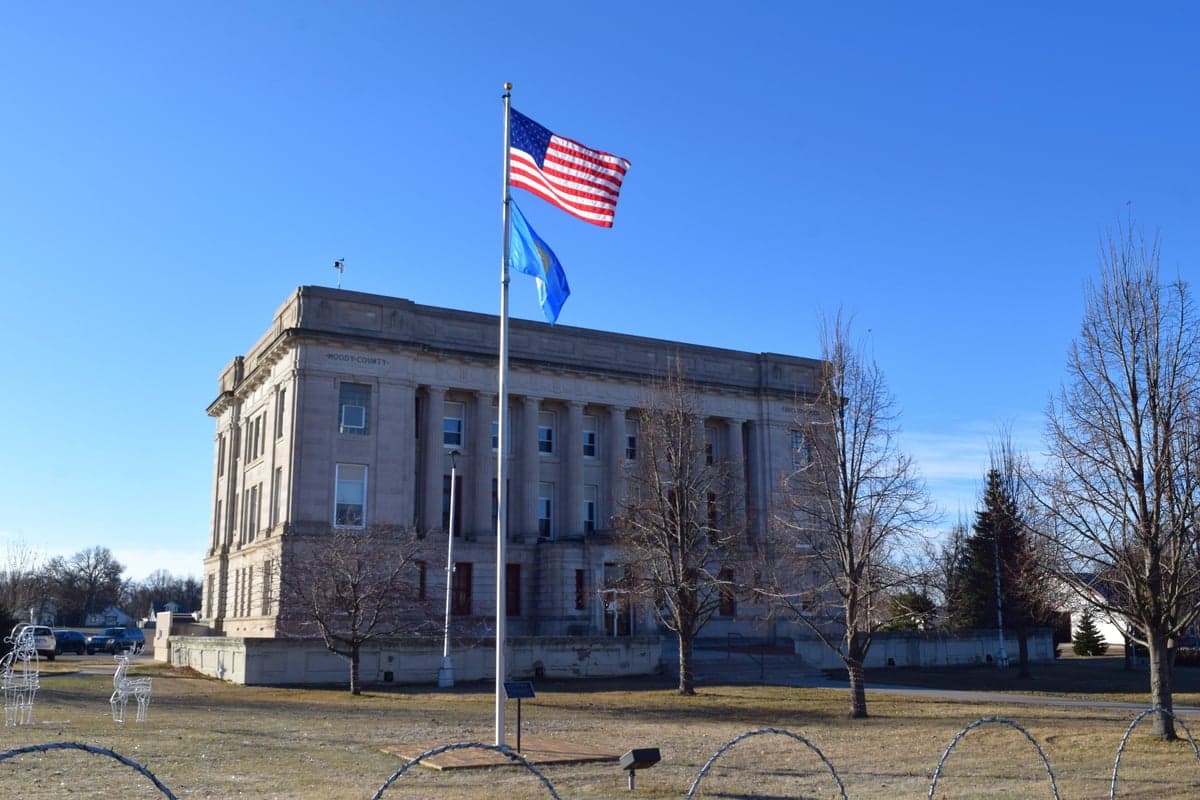
Photo: Wikipedia
Political ClimatePolitical Climate in Moody County
Showing state-level results — no local-only data available.
Local Political AnalysisPolitical Analysis of Moody County
Moody County, South Dakota, is a reliably Republican area with a Cook Partisan Voting Index (PVI) of R+15, meaning it votes about 15 points more Republican than the national average. In the 2024 presidential election, the county backed Donald Trump with roughly 68% of the vote, a margin that has widened slightly from 2020. The county’s political trajectory is steady red, but local precincts show meaningful variation, especially between the county seat of Flandreau and the smaller farming communities like Colman and Egan.
How it compares
Moody County’s R+15 PVI places it squarely in the conservative column, but it’s actually a bit less Republican than some neighboring counties like Lake (R+18) or Minnehaha (R+16). The biggest contrast is within the county itself: Flandreau, home to the Flandreau Santee Sioux Tribe and a small liberal arts college, tends to be the most moderate precinct, occasionally swinging within 5-10 points of the county average. In contrast, Colman and Egan are deeply red, often voting 75% or more Republican. The unincorporated area around Trent and Ward shows the most consistent conservative turnout, with little variation from election to election. Compared to South Dakota as a whole—which has a PVI of roughly R+16—Moody County is a near mirror of the state’s overall lean, though it lacks the deep-blue pockets found in Rapid City or Sioux Falls.
What this means for residents
For conservative residents, Moody County feels like home: local government, school boards, and county commissions are almost uniformly Republican, and policy debates tend to focus on agricultural issues, property taxes, and Second Amendment rights. Liberal residents, particularly in Flandreau, often find themselves in the minority but not isolated—there’s a small but active Democratic-leaning community centered around the tribal government and a handful of local activists. Practical impacts include limited public transit and a heavy reliance on personal vehicles, as well as a school system that emphasizes vocational and agricultural education. The county’s low population density (about 8 people per square mile) means most political engagement happens at town hall meetings or over coffee at the Flandreau Bakery, where even heated disagreements tend to stay civil.
Culturally, Moody County is defined by its strong ties to farming and the Flandreau Santee Sioux Tribe, which operates the Royal River Casino and Hotel. This creates a unique dynamic: the tribe is a major employer and political force, but its sovereignty and casino operations occasionally spark tension with non-tribal residents over issues like law enforcement jurisdiction and land use. Policy-wise, the county leans toward low taxes and limited regulation, but there’s a pragmatic streak—voters here have supported local bond measures for school upgrades and road improvements, even when those meant modest tax increases. For anyone moving here, the political climate is straightforward: you’ll find a conservative majority that values independence and community, with a small but resilient liberal minority that keeps things interesting in Flandreau.

State Political ClimatePolitical Climate in South Dakota
State Political AnalysisPolitical Environment in the State
South Dakota has been a reliably Republican state for decades, but the nature of that conservatism has shifted noticeably since the mid-2010s. The state’s overall partisan lean is deep red — Donald Trump won it by 26 points in 2020 and by over 30 points in 2024 — but the coalition driving that majority has changed. Traditional, chamber-of-commerce Republicans who dominated the 1990s and early 2000s have been increasingly challenged by a more populist, culturally conservative wing that now controls the state legislature and governor’s office. Over the last 10-20 years, the political center of gravity has moved from a low-tax, business-friendly pragmatism toward a more aggressive posture on cultural issues, gun rights, and federal defiance, while the state’s small but growing urban centers have become the only real counterweight to an overwhelmingly rural, conservative electorate.
Urban vs. rural divide
The political map of South Dakota is defined by a stark urban-rural split, but the urban side is small. Sioux Falls, home to nearly 20% of the state’s population, is the only real blue-leaning area — Minnehaha County has voted Democratic in several recent gubernatorial and Senate races, though it still went for Trump in 2020. Rapid City and Pennington County are more conservative but less reliably so than the surrounding ranch country; they occasionally produce competitive local races. Brookings, home to South Dakota State University, and Vermillion, home to the University of South Dakota, are small liberal islands in otherwise deep-red counties. The rest of the state — the vast majority of its landmass — is overwhelmingly Republican. Counties like Harding, Perkins, and Jones routinely deliver 85-90% of their votes to GOP candidates. The divide isn’t just geographic; it’s cultural. Sioux Falls residents are more likely to prioritize economic growth and social services, while rural voters are focused on agriculture policy, gun rights, and opposition to federal land management. This tension plays out in Pierre every session, with rural legislators often viewing Sioux Falls as a liberal threat to the state’s traditional character.
Policy environment
South Dakota’s policy environment is defined by its absence of an income tax — no personal or corporate income tax — which is the state’s primary economic draw. The sales tax rate is 4.5%, but local municipalities can add up to 2%, so effective rates vary. Property taxes are moderate but have been rising with home values, especially in Sioux Falls and the Black Hills. The regulatory posture is light: no state-level occupational licensing for many trades, minimal environmental regulation, and a right-to-work law that keeps union influence weak. Education policy is a mixed bag. The state has a school choice program via tax-credit scholarships, but no broad voucher system. Public school funding is a perennial issue, with teacher pay ranking near the bottom nationally. Healthcare policy is limited; the state did expand Medicaid in 2023 via a ballot initiative, overriding years of legislative resistance. Election laws are among the most accessible in the country — no voter ID requirement for most elections, same-day registration, and widespread mail voting — which is unusual for a deep-red state. This reflects a longstanding populist streak that values convenience over restriction, though recent sessions have seen bills to tighten rules, none of which have passed.
Recent policy direction
The last five years have seen South Dakota move aggressively on cultural and Second Amendment issues. In 2021, Governor Kristi Noem signed a permitless carry law, allowing any adult who can legally possess a firearm to carry it concealed without a permit. The same year, the state passed a "critical race theory" ban for K-12 schools, though it was largely symbolic. In 2023, the legislature passed a near-total abortion ban, triggered by the Dobbs decision, with exceptions only to save the mother’s life — no rape or incest exceptions. On education, the state enacted a "parents’ bill of rights" in 2022, requiring schools to notify parents of curriculum changes and allowing them to opt children out of certain materials. Property rights saw a boost with the 2020 passage of a law limiting eminent domain for carbon pipelines, a direct response to the Summit Carbon Solutions project. On voting, the state has resisted the national trend toward restriction; no voter ID law has passed, and mail voting remains universal. On privacy and surveillance, South Dakota has no broad data privacy law, but it did ban TikTok on state devices in 2023. The overall direction is toward maximizing individual liberty on guns and education while restricting abortion and maintaining a low-tax, low-service state model.
Civil unrest & political movements
South Dakota is not a hotbed of civil unrest, but it has had its flashpoints. The most visible in recent years has been the Keystone XL pipeline protests, which drew national attention in 2016-2017, with activists clashing with law enforcement in the western part of the state. More recently, the Summit Carbon Solutions pipeline has become a major political battleground, with landowners and environmental groups fighting the project through lawsuits and county-level ordinances. The state has also seen organized opposition to COVID-19 mandates, with the legislature passing a ban on vaccine mandates in 2022. On the left, the South Dakota Democratic Party is small but active, primarily in Sioux Falls and on college campuses. Immigration politics are relatively quiet, as the state has a very small foreign-born population, but there have been local controversies over refugee resettlement in Sioux Falls. Election integrity has not been a major issue here; the state’s decentralized, low-tech voting system has not produced the kind of disputes seen in other states. A new resident would notice that political activism is more localized and issue-specific than in many states — pipeline fights, school board battles, and county commission decisions are where the energy is, not mass protests in the capital.
Projection
Over the next 5-10 years, South Dakota’s political trajectory points toward continued Republican dominance, but with growing internal tension between the populist and traditionalist wings. The state’s population is growing slowly — about 1% per year — driven by in-migration to Sioux Falls and the Black Hills. These newcomers tend to be more moderate, often coming from blue states for the tax and lifestyle advantages. If that trend continues, Sioux Falls and Rapid City could become more competitive, potentially flipping a few legislative seats. However, the rural areas are not shrinking as fast as in some Plains states, thanks to a stable agricultural economy and the draw of outdoor recreation. The biggest wildcard is the state’s fiscal model: without an income tax, revenue growth depends on sales tax and federal funds, and a recession could force hard choices. The cultural wars will likely intensify, especially around education and abortion, as the legislature continues to push conservative bills that the governor signs. A new resident moving in now should expect a state that remains deeply conservative but is not monolithic — the urban-rural divide will widen, and the political conversation will increasingly be about how to balance individual liberty with the needs of a growing, diversifying population.
For someone choosing South Dakota, the practical takeaway is straightforward: if you value low taxes, minimal regulation, and a government that stays out of your personal life on most issues, you’ll find a lot to like. If you’re a conservative, you’ll feel at home almost anywhere outside of downtown Sioux Falls. If you’re a liberal, you’ll find your community in the cities and college towns, but you’ll be in a clear minority at the state level. The state’s politics are stable but not static — the pipeline fights and school board battles show that real power is often local. Pay attention to county commission races and school board elections; that’s where the decisions that affect your daily life are actually made.
* Values derived from national, state, county, city and local statistics and may differ in a specific area. Last updated: 2026-07-02T18:21:56.000Z
Narrative content on this page is AI-generated and may contain mistakes. Verify any details that matter before acting on them.
ReloMaps may earn a commission from affiliate links at no extra cost to you.

