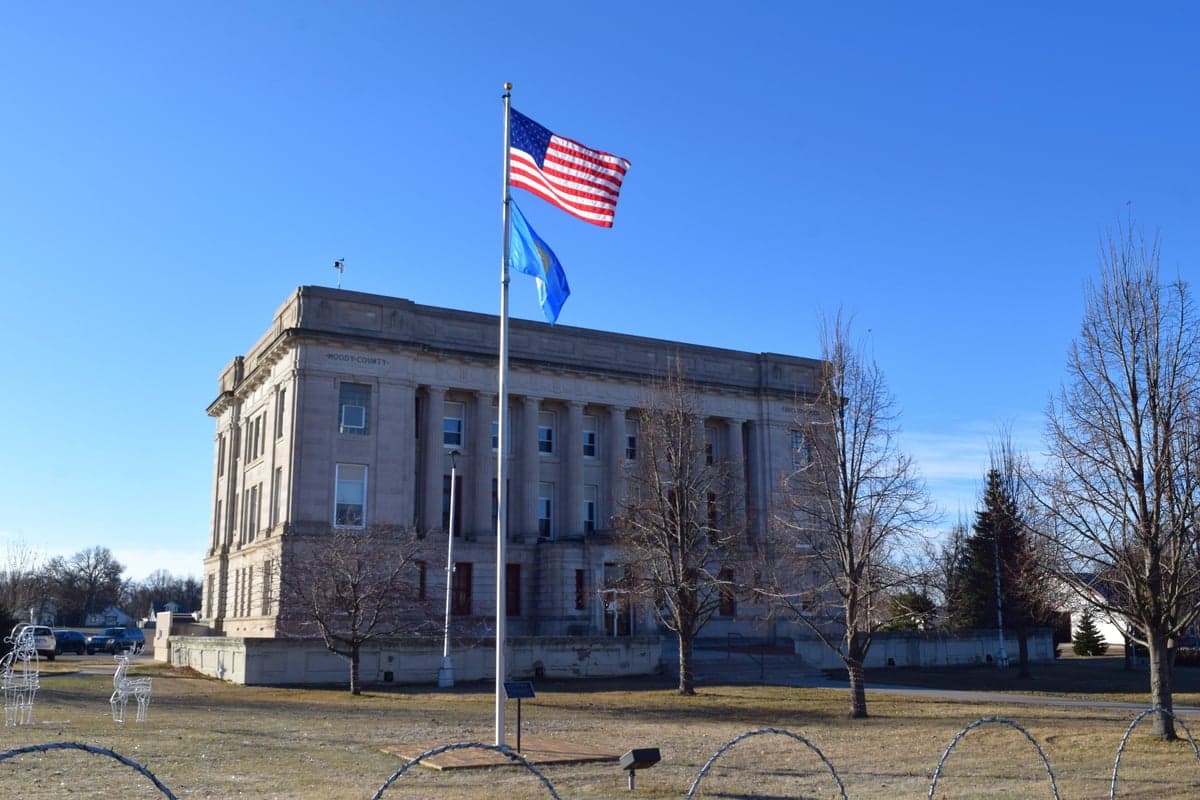
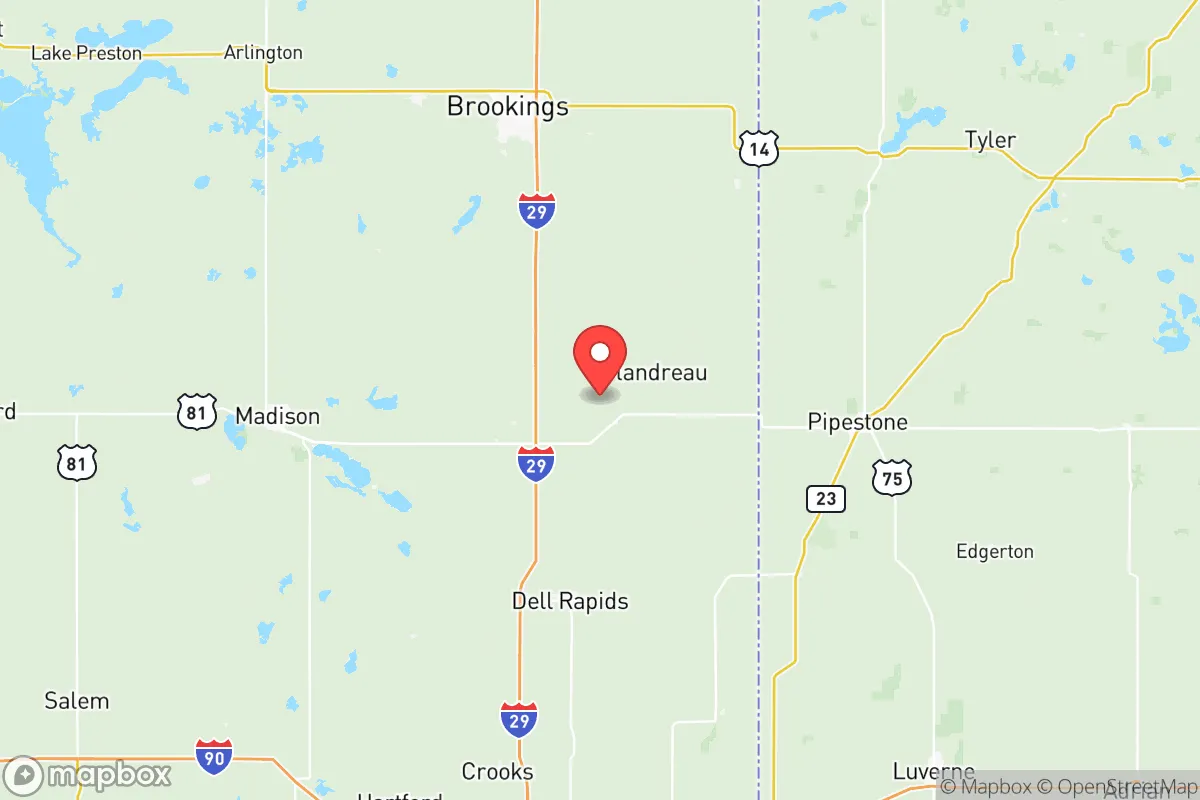
Photo: Wikipedia
Demographics of Moody County
Affluence Level in Moody County
A middle-class area roughly in line with national averages across income, home values, education, and employment.
People of Moody County
Moody County, South Dakota, is home to 6,371 residents, a population that remains predominantly white (74.9%) with a small but growing Hispanic community (5.4%) and a foreign-born share of just 2.4%. The county's character is shaped by its rural, agricultural roots and a handful of small towns—Flandreau, Colman, Egan, and Trent—where family farms and a quiet, self-reliant lifestyle still define daily life. With 31.0% of adults holding a college degree, the county leans practical and community-oriented, reflecting a population that values stability, land, and local ties over rapid change.
Settlement & growth (pre-1960)
Before European settlement, the area now known as Moody County was part of the traditional territory of the Dakota Sioux, particularly the Mdewakanton and Wahpekute bands, who lived along the Big Sioux River and its tributaries. The 1851 Treaty of Traverse des Sioux and subsequent land cessions opened the region to Euro-American settlement, though the U.S.-Dakota War of 1862 and the forced removal of Dakota people from Minnesota reshaped the landscape dramatically. By the time Moody County was formally organized in 1873, the Native population had been largely displaced onto reservations, including the nearby Flandreau Santee Sioux Reservation, which remains a distinct community within the county today.
The first major wave of Euro-American settlers arrived in the 1870s and 1880s, drawn by the Homestead Act of 1862, which offered 160 acres of land to anyone willing to farm it for five years. These early pioneers were overwhelmingly of Northern European stock—Norwegians, Swedes, Germans, and Irish—who came from the Upper Midwest or directly from Europe seeking affordable farmland. The town of Flandreau, named after the fur trader Charles Eugene Flandreau, became the county seat and the primary hub for these settlers, with its location on the Big Sioux River providing water power for mills and a natural transportation corridor. Norwegian immigrants clustered around Colman and Egan, where Lutheran churches and Norwegian-language newspapers sustained their cultural identity well into the 20th century.
A second, smaller wave arrived in the 1890s and early 1900s, as the railroad extended its reach through the county. The Chicago, Milwaukee, St. Paul and Pacific Railroad laid tracks through Trent and Ward, turning these hamlets into grain-shipping points and general-store crossroads. This period also brought a handful of German-Russian families, who had previously settled in the Dakotas' James River Valley, to the county's western townships. By 1910, Moody County's population had peaked at roughly 8,700, supported by wheat farming, cattle grazing, and the early mechanization of agriculture.
The Dust Bowl and the Great Depression of the 1930s hit the county hard, as drought and falling commodity prices drove many families off the land. Population declined steadily through the 1940s and 1950s, as younger generations left for factory jobs in Sioux Falls, Watertown, and the Twin Cities. The post-World War II era saw little new settlement; instead, the county's population continued to shrink, falling below 7,000 by 1960, as farm consolidation reduced the number of family operations and the small towns that served them.
Modern era (post-1965)
The 1965 Hart-Cellar Act, which ended national-origin quotas and opened immigration from Asia and Latin America, had a modest but measurable effect on Moody County. Unlike urban centers or Sun Belt boomtowns, the county did not experience a large influx of new immigrant groups. Instead, the most significant demographic shift since 1965 has been the growth of the Hispanic population, which now stands at 5.4% of the county's residents. This community is concentrated in and around Flandreau, where many families work in meatpacking, dairy operations, and agricultural processing—industries that have drawn migrant and immigrant labor from Mexico and Central America since the 1990s. A smaller number of East/Southeast Asian residents (1.7%) have also settled in the county, primarily in Flandreau and Colman, often employed in manufacturing or as professionals in healthcare and education.
Domestic migration patterns have been more influential than international immigration. The county has seen a slow but steady outflow of young adults to Sioux Falls and other regional job centers, balanced by a modest inflow of retirees and remote workers seeking lower property taxes and a quieter pace of life. The Black population remains very small at 1.1%, and the Indian-subcontinent population is negligible at 0.0%. The Flandreau Santee Sioux Reservation, which lies partly within the county's boundaries, has maintained a stable population of several hundred residents, with the tribal community centered around the Flandreau area and the Royal River Casino serving as an economic anchor.
Suburbanization has been limited in Moody County. Unlike counties closer to Sioux Falls, which have seen rapid exurban development, Moody County's towns remain small and agricultural in character. Colman (population roughly 600) and Egan (population roughly 270) have seen little new housing construction, while Trent and Ward have lost population and commercial services. The county's overall population has hovered between 6,300 and 6,500 since 2000, reflecting a demographic equilibrium that is neither growing nor shrinking dramatically.
The future
Moody County is likely to remain a predominantly white, rural, and agriculturally based community for the next 10 to 20 years. The Hispanic share of the population is expected to grow slowly, as families already in the county have children and as meatpacking and dairy operations continue to attract workers from Latin America. However, the county's foreign-born share (2.4%) is far below the national average, and there is no indication of a rapid diversification trend. The East/Southeast Asian population may increase slightly if manufacturing or healthcare employers recruit internationally, but the county lacks the urban infrastructure and ethnic enclaves that drive larger-scale immigration.
The most significant demographic pressure will come from domestic migration. As Sioux Falls continues to grow and housing prices rise, some families and remote workers may look to Moody County's lower-cost towns—particularly Flandreau and Colman—as affordable alternatives within commuting distance. This could bring a modest influx of younger, more educated residents, potentially raising the college-attainment rate above its current 31.0%. At the same time, the county's population is aging, and without sustained in-migration, natural decrease (more deaths than births) could begin to shrink the population within a decade.
Culturally, Moody County is likely to remain conservative and community-oriented, with a strong emphasis on local schools, churches, and agricultural traditions. The Flandreau Santee Sioux community will continue to be a distinct and important part of the county's identity, while the growing Hispanic population may gradually reshape the cultural landscape of Flandreau and the surrounding farm country. The county's small towns will face ongoing challenges in retaining young people and maintaining services, but those that adapt—by welcoming new residents and investing in broadband, housing, and schools—may find a stable, if modest, future.
For someone moving in now, Moody County offers a low-cost, low-crime, and deeply rooted rural lifestyle, where neighbors know each other and the pace of life is dictated by the seasons. It is not a place of rapid change or high diversity, but it is a place where community ties remain strong and where the land—and the people who work it—still define the county's character. The population is stable, the schools are small, and the future, while not booming, is steady.

* Values derived from national, state, county, city and local statistics and may differ in a specific area. Last updated: 2026-07-02T18:21:56.000Z
Narrative content on this page is AI-generated and may contain mistakes. Verify any details that matter before acting on them.
ReloMaps may earn a commission from affiliate links at no extra cost to you.

