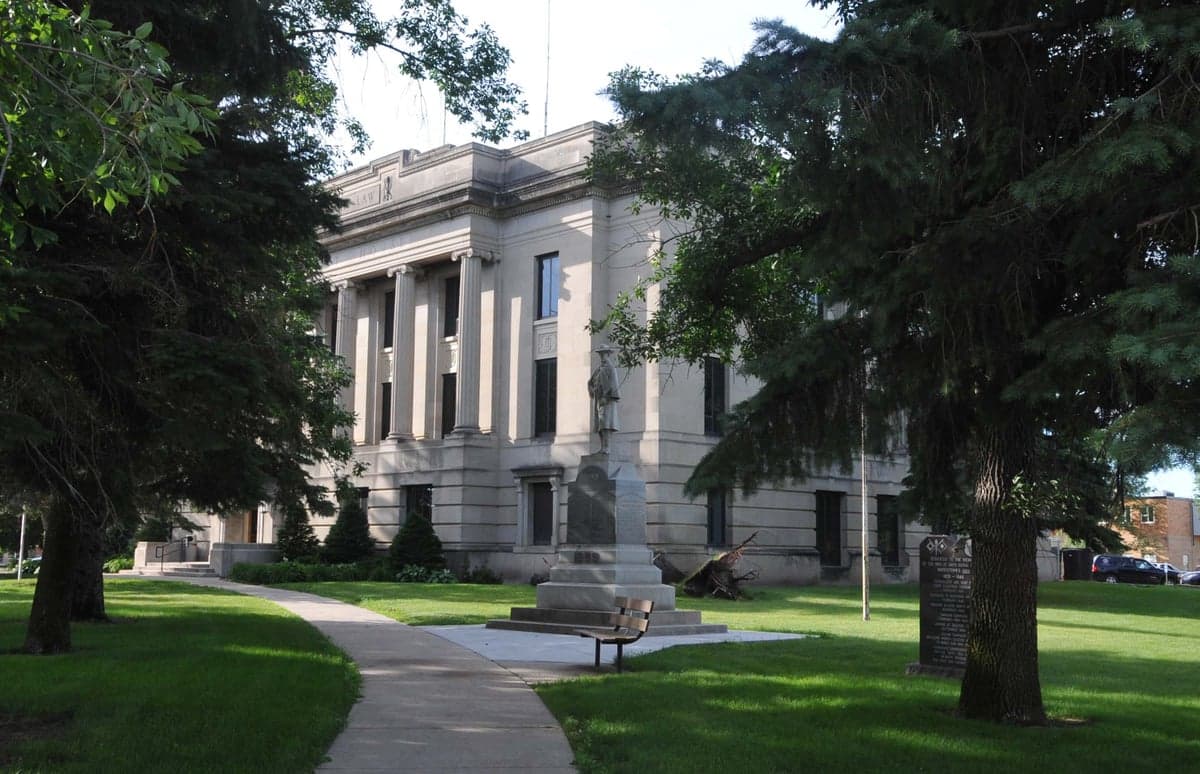
Photo: Wikipedia
Demographics of Codington County
Affluence Level in Codington County
A middle-class area roughly in line with national averages across income, home values, education, and employment.
People of Codington County
Codington County, South Dakota, is home to roughly 28,600 residents, a population that remains overwhelmingly white (90.9%) and native-born (only 0.8% foreign-born), with a small but growing Hispanic community (3.0%). The county’s character is shaped by its agricultural roots, its role as a regional trade hub centered on Watertown, and a cultural identity that blends Upper Midwestern reserve with a conservative, self-reliant ethos. With a college attainment rate of just 20.9%, the workforce is heavily tilted toward blue-collar, manufacturing, and service-sector jobs, giving the area a practical, family-oriented feel rather than a cosmopolitan one.
Settlement & growth (pre-1960)
Before American settlement, the land that is now Codington County was part of the traditional territory of the Dakota (Sioux) people, specifically the Sisseton and Wahpeton bands. The 1858 Treaty of Traverse des Sioux and subsequent land cessions opened the area to Euro-American settlement, though significant displacement of Native peoples continued through the 1860s and 1870s. The county itself was organized in 1877, named after the Reverend George S. Codington, a Methodist minister and early Dakota Territory legislator.
The first major wave of settlers arrived in the 1870s and 1880s, drawn by the Homestead Act of 1862, which offered 160 acres of land for a small filing fee. These early pioneers were overwhelmingly of Northern European stock—Yankees from New England and New York, along with German and Norwegian immigrants seeking cheap farmland. The city of Watertown, founded in 1879 as a railroad town on the Chicago & North Western line, became the county’s population anchor. The railroad’s arrival transformed Watertown into a grain-shipping and supply center, attracting merchants, millers, and laborers. Smaller farming communities like Kranzburg (settled by German Catholics in the 1880s) and Florence (a railroad stop for wheat farmers) grew as ethnic enclaves where German and Norwegian languages were spoken in homes and churches well into the 20th century.
The second wave came during the early 1900s, as the county’s agricultural economy matured. Dairy farming, hog production, and corn and wheat cultivation dominated. The town of South Shore, on the eastern edge of the county along the Big Sioux River, grew as a service center for lake-country farms. Henry, a small hamlet in the county’s northwest, was platted in 1886 and became a shipping point for local grain. The Dust Bowl and Great Depression of the 1930s hit the region hard, causing a population decline as some farm families left for the West Coast. However, World War II and the post-war boom brought a modest recovery, with Watertown’s manufacturing sector—including the Watertown Arsenal (a military munitions plant) and later the 3M plant—providing stable industrial jobs that kept the county’s population steady through the 1950s.
Modern era (post-1965)
The 1965 Hart-Cellar Act had minimal direct impact on Codington County, as the area never attracted significant international immigration. The foreign-born population remains under 1%, and the county’s racial composition has shifted only slightly in the past 60 years. The most notable demographic change has been the growth of the Hispanic population, which rose from near zero in 1990 to 3.0% today. This growth is driven primarily by Mexican-American families moving from other parts of South Dakota or the Upper Midwest for work in Watertown’s meatpacking plants (such as the DemKota Ranch Beef facility) and in agricultural labor. These families have concentrated in Watertown, particularly in the city’s north and east sides, where affordable housing and proximity to industrial jobs exist.
Domestic migration has been more consequential. Since the 1980s, Codington County has experienced a slow but steady outflow of young adults seeking education and urban jobs in Sioux Falls, Minneapolis, or Denver. This “brain drain” is reflected in the low college attainment rate (20.9%). However, the county has also attracted some domestic in-migration from rural Minnesota and Iowa, as well as from other parts of South Dakota, driven by Watertown’s role as a regional retail and healthcare hub. The Prairie Lakes Healthcare System and the Watertown School District are major employers, drawing families from surrounding counties. The unincorporated community of Rauville and the village of Wallace have seen slight population gains as exurban spillover from Watertown, though they remain tiny.
Suburbanization within the county has been modest. Watertown itself has annexed land to the west and south, creating newer subdivisions like the Lake Kampeska area, which attracts retirees and second-home owners. The county’s Black population (0.7%) and East/Southeast Asian population (0.6%) are very small and largely consist of professionals (engineers, medical staff) recruited to work at Watertown’s hospitals and manufacturing plants, as well as a small number of refugees resettled through Lutheran Social Services. The Indian-subcontinent population is effectively zero.
The future
Codington County is projected to remain overwhelmingly white and native-born for the foreseeable future. The Hispanic share may continue to grow slowly, possibly reaching 5-6% by 2040, driven by natural increase and continued labor demand in meatpacking and agriculture. The county’s overall population is expected to grow modestly—perhaps 5-10% over the next two decades—as Watertown continues to attract retirees and remote workers from more expensive parts of the Midwest. However, the county will not become a diverse, multicultural destination. The East/Southeast Asian and Black populations will likely remain below 2% each, concentrated in professional niches.
The cultural identity of the county is likely to remain rooted in its Scandinavian and German heritage, with a strong conservative political tilt. The biggest demographic challenge will be retaining young adults: without a significant expansion of higher education or high-tech employment, the county will continue to see its college-bound youth leave. New residential development will concentrate in Watertown’s southern and western edges, with the Lake Kampeska area becoming more of a retirement and recreation zone. The smaller towns—Kranzburg, Florence, Henry, South Shore—will likely continue to shrink slowly as their aging populations decline and young families move to Watertown or leave the county entirely.
For someone moving to Codington County today, the area offers a stable, safe, and affordable environment with a strong sense of community, but it is not a place of rapid demographic change or cultural diversity. The population is aging, white, and rooted in agricultural and industrial traditions, and the county’s future will be one of slow, incremental growth rather than transformation. New residents will find a welcoming but homogeneous community where fitting in means embracing a slower pace and a shared Midwestern identity.

* Values derived from national, state, county, city and local statistics and may differ in a specific area. Last updated: 2026-07-14T12:11:18.000Z
Narrative content on this page is AI-generated and may contain mistakes. Verify any details that matter before acting on them.
ReloMaps may earn a commission from affiliate links at no extra cost to you.

