
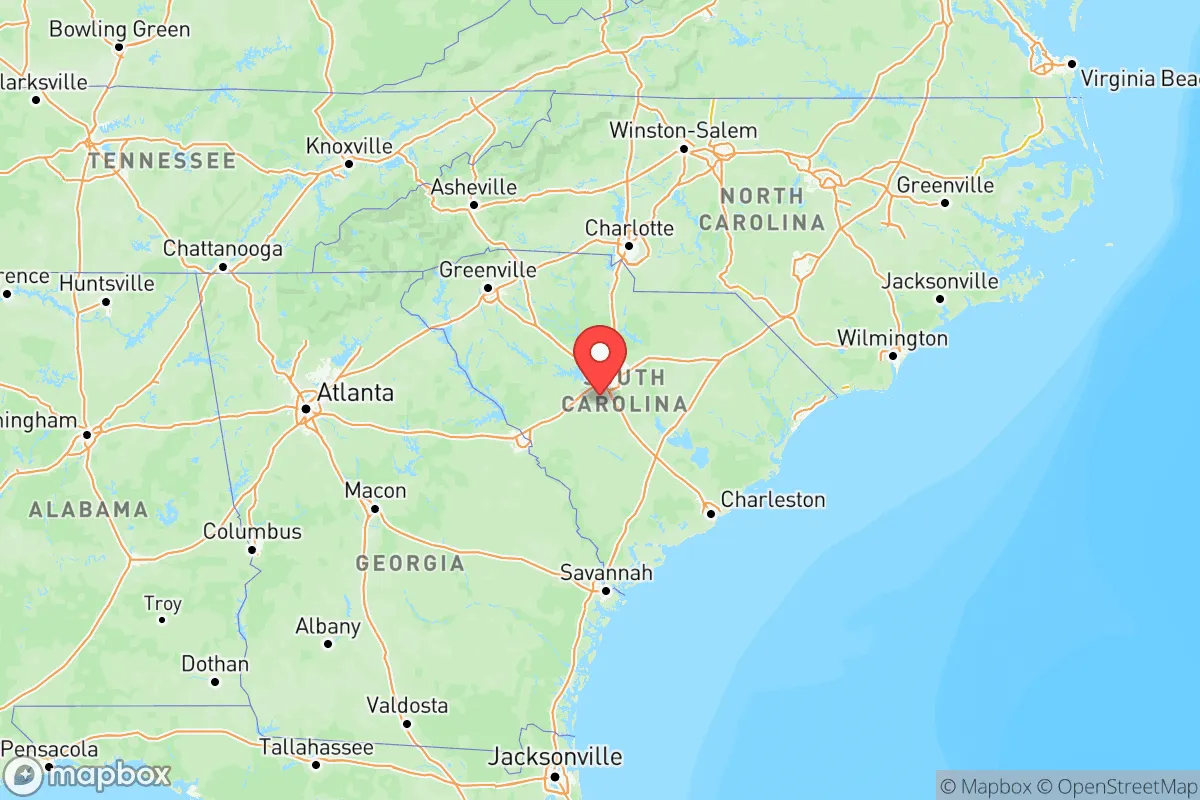
Photo: Wikipedia
Personal Sovereignty in South Carolina
Viable for self-reliance. Generally workable, though some barriers may limit total independence.
What does Personal Sovereignty tell us?
Personal Sovereignty measures your capacity for self-reliance and independence with minimal government friction. Higher scores mean fewer barriers between you and the way you want to live... but it assumes you have the space you need and good neighbors.
What does this tell us?
Personal Sovereignty measures your capacity for self-reliance and independence with minimal government friction. Higher scores mean fewer barriers between you and the way you want to live... but it assumes you have the space you need and good neighbors.
State Policy
Energy independence: Importer (25% of energy produced in-state)
Personal Liberty
Homesteading

Personal Liberty Analysis
South Carolina offers one of the strongest personal sovereignty environments in the Southeast, with a state-level legal framework that consistently prioritizes individual autonomy over government overreach. The state’s constitutional carry law, low property tax burden, and expansive parental rights statutes create a foundation where residents can live largely free from the regulatory creep that plagues states like California or New York. For those approaching relocation from a survivalist or prepper mindset, South Carolina’s combination of permissive gun laws, homestead-friendly zoning in rural counties, and a state government that actively resists federal overreach makes it a strategic choice for anyone seeking to maximize personal liberty while maintaining access to coastal and mountain resources.
Tax burden and regulatory posture: how South Carolina compares to high-tax states
South Carolina’s tax structure is deliberately designed to reward self-reliance rather than penalize it. The state imposes a flat income tax rate of 6.4% on most income, but the real advantage lies in property taxes. The state’s owner-occupied property tax assessment ratio is just 4% of fair market value, with a $50,000 exemption for primary residences, meaning a $300,000 home is taxed on only $10,000 of assessed value. This is dramatically lower than states like Texas (where effective rates often exceed 2%) or New York (where combined rates can hit 3%). Regulatory posture varies by county: Greenville and Charleston have more stringent building codes and environmental restrictions, while Abbeville, McCormick, and Allendale counties operate with minimal zoning enforcement, allowing residents to build workshops, root cellars, or off-grid structures without endless permitting battles. The state’s right-to-farm laws further protect agricultural activities from nuisance lawsuits, a critical factor for anyone planning to raise livestock or grow food for long-term resilience.
Self-defense and gun law specifics: constitutional carry and castle doctrine
South Carolina is one of the strongest Second Amendment states in the country, and the legal framework reflects a presumption that law-abiding citizens are the first line of defense. Since 2021, the state has allowed constitutional carry for anyone 18 or older who can legally possess a firearm, meaning no permit is required for open or concealed carry. The castle doctrine is codified in state law with no duty to retreat in one’s home, vehicle, or place of business, and the “stand your ground” statute extends that right to any place where the person has a legal right to be. For preppers, this means you can keep a loaded rifle in your truck or a pistol on your hip while running errands in Spartanburg or Florence without worrying about “sensitive places” restrictions that plague states like Colorado or Washington. The state also preempts local gun ordinances, so you won’t find city councils in Columbia or Myrtle Beach passing their own magazine bans or waiting periods—the law is uniform statewide. One practical consideration: while the state does not require background checks for private sales, it does maintain a state-level database for firearm purchases from dealers, so buying from a friend or at a gun show remains frictionless.
Self-reliance and homesteading viability: lot sizes, zoning, and off-grid feasibility
South Carolina’s rural counties are a haven for those seeking to live off-grid or semi-off-grid, but the feasibility varies dramatically by location. In McCormick County, along the Savannah River, you can find undeveloped parcels for under $2,000 per acre with no zoning restrictions on tiny homes, shipping container structures, or composting toilets. Abbeville County is similarly permissive, with many properties allowing rainwater collection, solar panel installation, and even small-scale livestock without permits. In contrast, Greenville County has adopted suburban-style zoning in its unincorporated areas, requiring minimum lot sizes of 1-2 acres and mandating septic system approvals that can make off-grid living difficult. The state’s building code is based on the International Residential Code, but enforcement is lax in counties with fewer than 10,000 residents—Allendale and Hampton counties essentially operate on an honor system for owner-built structures. For those serious about self-reliance, the key is to buy land in a county with no zoning ordinance at all; the South Carolina Association of Counties maintains a list, but a quick drive through Bamberg or Barnwell counties reveals properties where you can legally live in a yurt or a converted school bus without government interference. The state also has generous laws for rainwater harvesting (no permit needed for systems under 10,000 gallons) and solar net metering, though the latter is capped at 20% of a utility’s peak demand.
Personal liberties: parental rights, medical autonomy, speech, and property
South Carolina has become a battleground for parental rights, and the state legislature has consistently sided with families over government or school boards. The Parental Bill of Rights, passed in 2023, explicitly grants parents the right to direct their child’s education, medical care, and religious upbringing, and requires schools to obtain parental consent before administering any mental health screening or survey. This means you can opt your child out of controversial curriculum or gender ideology instruction without legal pushback. Medical autonomy is more nuanced: the state has no vaccine mandate for adults, but some employers (particularly hospitals in Charleston and Columbia) still require COVID-19 shots. The state’s medical freedom law prohibits discrimination based on vaccination status for state services, but private businesses can still impose their own rules. Free speech protections are robust, with no hate speech laws or social media censorship mandates, and the state has a strong anti-SLAPP statute to protect citizens from frivolous lawsuits over public commentary. Property rights are protected by the state’s eminent domain restrictions, which prohibit taking land for private economic development—a direct response to the Kelo v. New London Supreme Court decision. This means your land in Oconee or Pickens County cannot be seized for a private developer’s shopping center, a protection that doesn’t exist in many other states.
Overall, South Carolina ranks among the top 10 states for personal sovereignty, particularly for those who value self-defense, minimal taxation, and the ability to live off-grid without government interference. The state’s legal framework is consistently pro-liberty, but the practical experience varies by county—McCormick and Abbeville offer near-total freedom, while Greenville and Charleston impose more suburban-style restrictions. For a prepper or survivalist, the strategic move is to buy land in a rural, low-regulation county while maintaining access to the state’s major medical and supply hubs. South Carolina is not a libertarian utopia—it still has property taxes, a state income tax, and some federal overreach—but it provides a legal environment where a determined individual can build a self-reliant life with far less friction than in most other parts of the country.

Top Cities for Personal Sovereignty in South Carolina
 1B+
1B+ 2B+
2B+ 3B+
3B+ 4B+
4B+ 5B+
5B+ 6B+
6B+ 7B+
7B+ 8B+
8B+ 9B+
9B+ 10B+
10B+* Values derived from national, state, county, city and local statistics and may differ in a specific area. Last updated: 2026-04-19T01:41:00.000Z
Narrative content on this page is AI-generated and may contain mistakes. Verify any details that matter before acting on them.
ReloMaps may earn a commission from affiliate links at no extra cost to you.

