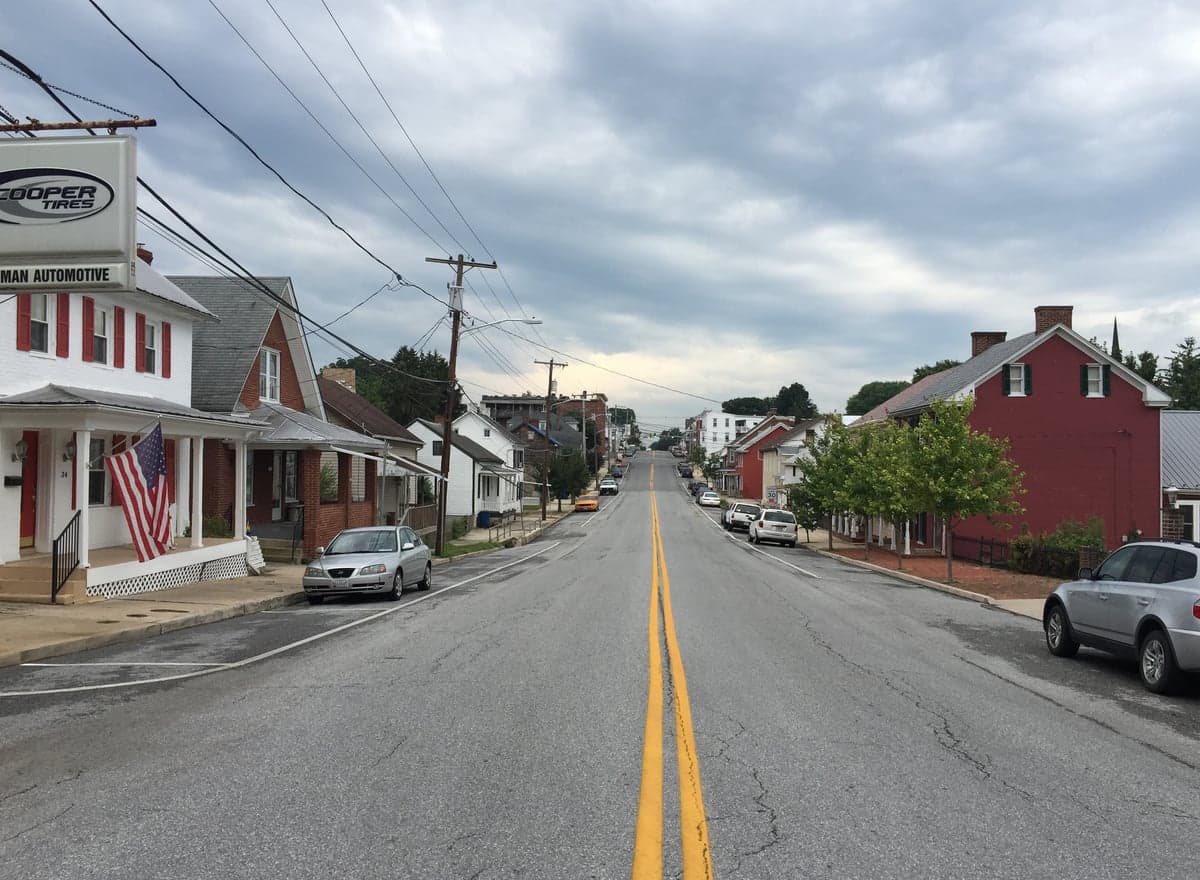
Photo: Wikipedia
Political ClimatePolitical Climate in Smithsburg, MD
District shown is the primary district for this city’s centroid. Cities may span multiple districts.
Inherited from parent county — no local data available.
* Lean and PVI are calculated from Smithsburg, MD’s own 2020 presidential results (precinct returns summed to the city), with 2024 estimated from the surrounding county’s 2020–2024 shift, Cook-style. Sources: state election offices; VEST 2020 precinct results (CC BY 4.0).
Political rankings in Maryland
- Most Conservative Cities in Maryland
- Most Liberal Cities in Maryland
- Best Conservative-Leaning Towns in the Mid-Atlantic
- Safest Liberal-Leaning Towns on the East Coast
- Safest Conservative-Leaning Towns on the East Coast
- Affordable Small Towns for Conservatives
- Most Affordable Liberal-Leaning Small Towns in the U.S.
- Safest Liberal-Leaning Cities in the U.S.
- Most Conservative Counties in Maryland
- Most Liberal Counties in Maryland
Local Political AnalysisPolitical Analysis of Smithsburg, MD
Smithsburg, Maryland, is a solidly conservative pocket in a deeply blue state, with a Cook Partisan Voting Index of R+12 that puts it in stark contrast to Maryland’s overall D+17 lean. This isn’t a recent shift—locals will tell you the town has been reliably Republican for decades, with the surrounding Washington County voting red in every presidential election since 1988. The trajectory here is steady: while the state’s urban centers like Baltimore and Montgomery County have pulled Maryland further left, Smithsburg’s rural character and close-knit community have kept its politics stable, with no signs of a major swing in either direction on the horizon.
How it compares
The gap between Smithsburg and the rest of Maryland is about as wide as it gets in the state. While Maryland as a whole votes D+17—meaning it’s 17 points more Democratic than the national average—Smithsburg’s R+12 rating means it’s 12 points more Republican. That’s a 29-point chasm. Drive 15 minutes east to Hagerstown, and you’ll find a more mixed political landscape, with the city leaning slightly Democratic in recent cycles thanks to a growing working-class and minority population. Head 30 minutes south to Frederick, and you’re in a purple-to-blue area that’s been trending left as commuters from D.C. and Baltimore move in. Smithsburg, by contrast, feels like a different world—more akin to rural Pennsylvania or West Virginia than the rest of Maryland. The town’s politics align closely with the broader Washington County, which voted +24 for Trump in 2024, but stand out sharply against the state’s Democratic strongholds like Prince George’s County (D+40) or Baltimore City (D+40).
What this means for residents
For conservative residents, Smithsburg is a comfortable place to live politically. Local elections are dominated by Republicans, and the county commission, sheriff’s office, and school board all lean right. You’ll see Trump signs in yards year-round, and the local gun culture is strong, with few restrictions beyond state law. For liberal residents, the reality is more isolating. You’ll be in the minority at town meetings and likely feel out of step with neighbors on issues like abortion, taxes, and environmental policy. That said, the community is generally polite—people don’t argue politics at the grocery store—and the state’s blue laws (like stricter gun regulations and a higher minimum wage) still apply, so you’re not cut off from progressive policies entirely. The practical effect is that Smithsburg feels like a red island in a blue sea: local life is conservative, but state-level decisions from Annapolis often override local sentiment, especially on education funding and health care.
Culturally, Smithsburg stands apart from the rest of Maryland in ways that go beyond voting. The town’s annual Smithsburg Pride Day is a low-key, family affair with a parade and barbecue, not a political rally. There’s no major university or tech hub nearby, so the pace of life is slower and more agricultural than the D.C. suburbs. Policy-wise, the biggest distinction is on land use and development: Smithsburg residents tend to favor limited growth and property rights, while state-level Democrats push for denser housing and environmental protections. This tension plays out in debates over septic systems, farmland preservation, and highway expansions. Looking ahead, the political divide is likely to persist—Smithsburg isn’t gentrifying like Frederick, and its rural identity is deeply rooted. For anyone moving here, the key takeaway is that you’ll get a conservative community with a strong sense of place, but you’ll still be living under a blue state government that often feels miles away.

State Political ClimatePolitical Climate in Maryland
State Political AnalysisPolitical Environment in the State
Maryland is a deeply blue state with a Cook Partisan Voting Index of D+17, making it one of the most reliably Democratic states in the nation. The dominant coalition is built on the massive population centers of the Washington, D.C. suburbs and Baltimore, which together deliver overwhelming Democratic margins that swamp the rest of the state. Over the past 20 years, the state has shifted further left, driven by rapid suburbanization and demographic change, though the 2024 election saw a slight rightward tick in some exurban and rural areas that didn't change the overall calculus.
Urban vs. rural divide
The political map of Maryland is a classic tale of two states. The urban core — Baltimore City and the D.C. suburbs of Montgomery County and Prince George's County — vote 75-85% Democratic. These three jurisdictions alone cast roughly 40% of the state's votes. In contrast, the rural Eastern Shore and western Maryland are solidly Republican. Garrett County in the far west voted +40 for Trump in 2024, while Carroll County northwest of Baltimore is a GOP stronghold. The swing counties are the fast-growing exurbs like Frederick County and Harford County, which have trended rightward as new residents move in from more expensive areas. Anne Arundel County, home to Annapolis, is a bellwether — it voted for Biden in 2020 but shifted right in 2024, reflecting suburban discontent with crime and education policy.
Policy environment
Maryland's policy environment is distinctly progressive. The state has a graduated income tax with a top rate of 5.75%, plus county-level piggyback taxes that push the effective top rate over 9% in Baltimore City and Montgomery County. Property taxes are high, especially in the D.C. suburbs. The regulatory posture is business-friendly in some sectors (biotech, cybersecurity) but heavily restrictive on energy, housing, and land use. Education policy is centralized: the state funds schools through a formula that favors poorer districts, but Baltimore City schools remain chronically underfunded and underperforming. Healthcare is heavily regulated, with a strong Medicaid expansion and a state-based health insurance exchange. Election laws are among the most accessible in the country: no-excuse mail-in voting, same-day registration, and automatic voter registration are all in place.
Recent policy direction
Recent legislation shows a clear progressive trajectory. On gun law, Maryland passed the Firearm Safety Act of 2013 (one of the strictest in the nation) and in 2024 expanded the "red flag" law to allow police to petition for removal without a family member. Self-defense rights are limited — the state does not recognize permitless carry and has a "good and substantial reason" standard that was only loosened after the Bruen decision. On education, the Blueprint for Maryland's Future (2021) pours billions into early childhood, teacher pay, and career programs, but has been criticized for unfunded mandates on counties. Parental rights are weaker than in red states — the state has a strong LGBTQ-inclusive curriculum mandate and no "Don't Say Gay" law. On speech, Maryland has a strict anti-SLAPP law protecting critics, but also a law against "electioneering" near polling places that has been challenged. Privacy and surveillance: the state passed the Maryland Online Data Privacy Act in 2024, giving residents control over data collection, but also expanded police use of automated license plate readers. Medical autonomy is strong — abortion is codified into law, and the state funds gender-affirming care for Medicaid recipients. Property rights are constrained by strict zoning in the D.C. suburbs, but the Maryland Housing and Community Development agency has pushed for more density near transit. Voting access has been expanded: in 2024, the state implemented automatic voter registration at the DMV and expanded early voting to 10 days.
Civil unrest & political movements
Maryland has a history of visible political activism. The 2020 George Floyd protests in Baltimore were large and occasionally violent, leading to a state police reform package. On the right, the Maryland Shall Issue gun rights group is active and has successfully sued to loosen carry restrictions. Immigration politics are a flashpoint: Maryland is a sanctuary state, with a 2017 law barring state and local police from cooperating with federal immigration enforcement. This has led to tensions in Frederick County, where the sheriff has publicly resisted. Election integrity controversies flared in 2020 and 2024, with Republican activists in Carroll County and the Eastern Shore alleging irregularities, though no major fraud was found. The Maryland Citizens Redistricting Commission was created in 2024 to address gerrymandering complaints, but the state's congressional map remains heavily Democratic-leaning. A new resident would notice the ubiquity of political yard signs — blue in the suburbs, red in the exurbs — and the occasional protest at the State House in Annapolis.
Projection
Over the next 5-10 years, Maryland will likely remain solidly Democratic, but the margin may narrow slightly. The D.C. suburbs are still growing, but they are also becoming more expensive, pushing moderate and conservative families to Frederick, Harford, and even Hagerstown. These exurban areas are trending right, and if they continue to gain population, the statewide Democratic margin could shrink from D+17 to D+12 or D+10 by 2032. The Blueprint for Maryland's Future will either succeed in improving schools (keeping suburban families) or fail (accelerating flight to private schools or out of state). The state's tax burden is a persistent issue — if neighboring Virginia or Pennsylvania cut taxes, Maryland could lose high-earning residents. On the left, the push for a single-payer healthcare system and rent control will keep the policy environment moving left, but the state's fiscal constraints (a structural deficit projected for 2026) may slow things down. A conservative moving in now should expect to live in a state where their vote is a minority, but where local control in exurban counties offers some buffer. A liberal moving in will find a state that largely aligns with their values, but with high costs and occasional friction with rural counties.
For a new resident, the bottom line is this: Maryland offers a high-quality, progressive policy environment with strong public services, but at a high cost. Conservatives will find their views are a minority in state government, but can find like-minded communities in the exurbs and rural areas. Liberals will find a state that is actively expanding rights and services, but may struggle with the cost of living and the slow pace of change in some areas. The state's trajectory is stable blue, with a slight rightward drift in the exurbs that won't flip the state but will keep the political conversation lively.
* Values derived from national, state, county, city and local statistics and may differ in a specific area. Last updated: 2026-11-22T00:36:18.000Z
Narrative content on this page is AI-generated and may contain mistakes. Verify any details that matter before acting on them.
ReloMaps may earn a commission from affiliate links at no extra cost to you.

