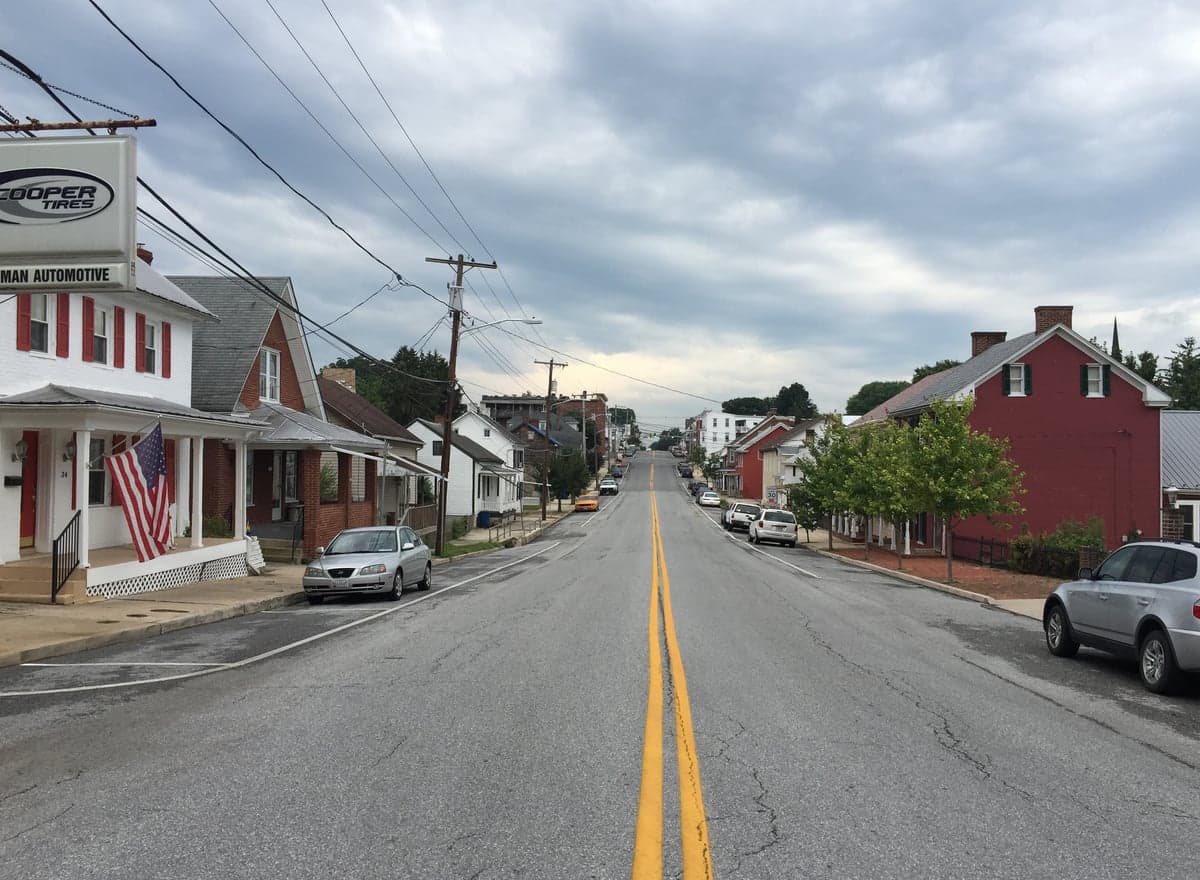
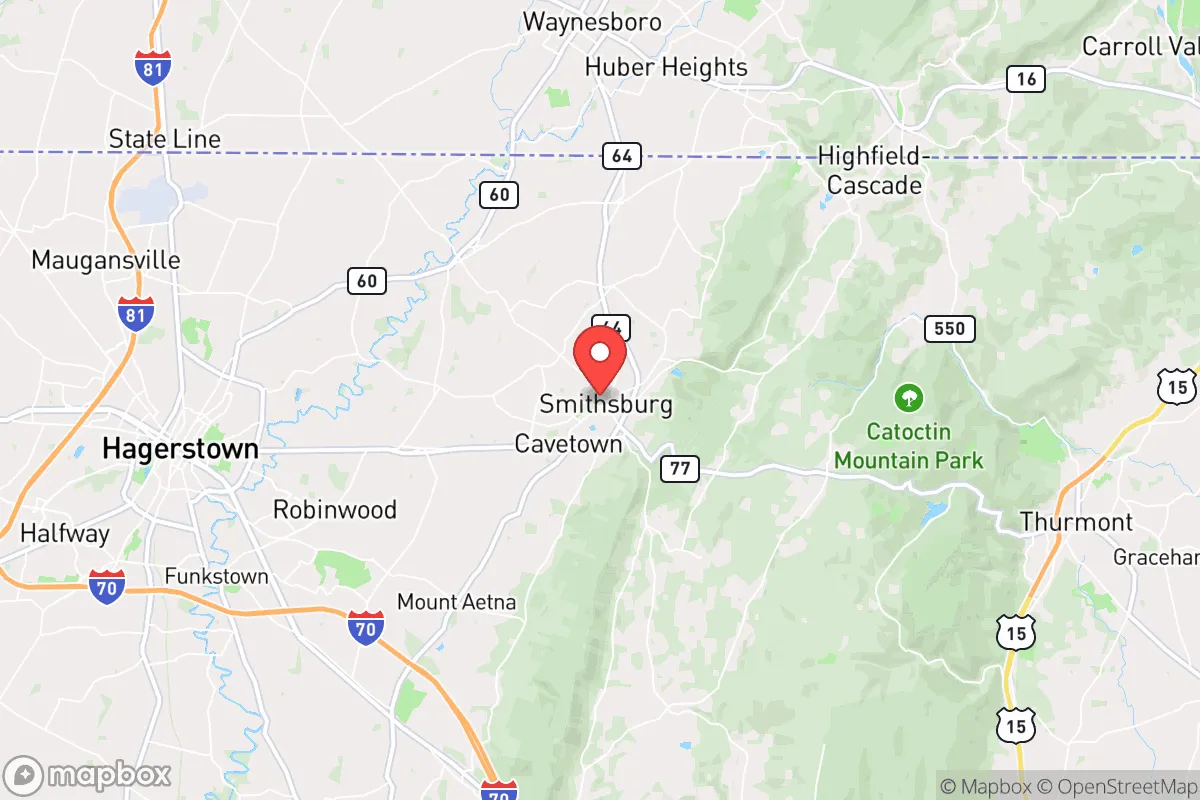
Photo: Wikipedia
Personal Sovereignty in Smithsburg, MD
Viable for self-reliance. Generally workable, though some barriers may limit total independence.
What does Personal Sovereignty tell us?
Personal Sovereignty measures your capacity for self-reliance and independence with minimal government friction. Higher scores mean fewer barriers between you and the way you want to live... but it assumes you have the space you need and good neighbors.
What does this tell us?
Personal Sovereignty measures your capacity for self-reliance and independence with minimal government friction. Higher scores mean fewer barriers between you and the way you want to live... but it assumes you have the space you need and good neighbors.
State Policy
Energy independence: Importer (18% of energy produced in-state)
Personal Liberty
Homesteading

Personal Liberty Analysis
Smithsburg, Maryland, offers a nuanced personal sovereignty environment that balances the state's generally progressive regulatory framework with the practical realities of a small, rural Washington County community. For individuals and families prioritizing autonomy, the town provides meaningful opportunities for self-reliance in housing and land use, while navigating a state-level tax burden and gun law landscape that is notably more restrictive than neighboring Pennsylvania or West Virginia. The key to maximizing personal freedom here lies in understanding which levers of control are local and which are preempted by Annapolis.
Tax burden and regulatory posture: How Maryland's state-level policies affect Smithsburg
Maryland's overall tax burden is among the highest in the nation, and Smithsburg residents are subject to that reality. The state levies a progressive income tax with rates from 2% to 5.75%, and Washington County adds a local income tax of 2.8% (the county rate, not a separate municipal tax for Smithsburg itself). Property taxes in Washington County are moderate compared to the Baltimore-Washington corridor, with a county rate of roughly $1.044 per $100 of assessed value, plus a small fire and ambulance tax. There is no separate municipal property tax in Smithsburg, which keeps the combined rate competitive for the region. The regulatory posture at the state level is decidedly heavy-touch on business and environmental matters, with Maryland requiring extensive permitting for construction, septic systems, and well drilling. However, Washington County's planning and zoning department is generally pragmatic, and Smithsburg's small-town character means many residential projects proceed without the delays common in more urbanized Maryland counties. For a reader seeking lower taxes, the trade-off is clear: Smithsburg offers a lower-cost entry point than Frederick or Montgomery counties, but the state's income and estate taxes remain a permanent factor.
Self-defense and gun law specifics: Navigating Maryland's firearm regulations in a rural setting
Maryland's gun laws are among the most restrictive in the nation, and this directly impacts personal sovereignty in Smithsburg. The state requires a Handgun Qualification License (HQL) to purchase a handgun, which involves a training course, fingerprinting, and a background check. Additionally, Maryland has a "may issue" concealed carry permit system that, following the Bruen decision, has shifted to "shall issue" in practice, but the application process remains burdensome with a 16-hour training requirement and a 90-day processing window. The state also bans so-called "assault weapons" and limits magazine capacity to 10 rounds. For Smithsburg residents, these laws create a significant barrier to the immediate exercise of self-defense rights that would be taken for granted in nearby Pennsylvania or West Virginia. On the positive side, Washington County's Sheriff's Office is known for being relatively supportive of Second Amendment rights, and the rural nature of the area means that lawful firearm ownership for hunting and sport shooting is common and socially accepted. Open carry of a handgun is technically legal without a permit, but it is rarely practiced and may attract unwanted attention. For the self-defense-minded reader, the bottom line is that Smithsburg is a gun-friendly community operating under a gun-restrictive state regime, requiring proactive compliance with state licensing and registration requirements.
Self-reliance and homesteading viability: Lot sizes, zoning, and off-grid feasibility in Smithsburg
Smithsburg's rural zoning and land availability make it a strong candidate for those seeking a self-reliant lifestyle. The town itself is small, but the surrounding Washington County Agricultural and Rural Residential zones allow for lot sizes as small as 1 to 2 acres for residential use, with larger parcels of 5 to 20 acres common for more serious homesteading. Zoning permits the keeping of chickens, goats, and other small livestock on residential lots, though pigs and cattle typically require larger acreage and a more formal agricultural designation. Off-grid feasibility is mixed: Maryland's building code requires connection to the electrical grid for new construction, but solar panels with battery backup are permitted and increasingly common. Well water and septic systems are standard for rural properties, and the county health department has clear, workable guidelines for both. Rainwater collection is legal for non-potable uses, and composting is unrestricted. The primary regulatory hurdle for full off-grid living is the state's requirement for a minimum habitable dwelling that meets code, which effectively prohibits primitive cabins or tiny houses on wheels as primary residences. For the homesteader, Smithsburg offers a realistic middle ground: you can raise much of your own food, generate your own power, and manage your own water and waste, but you will need to work within a conventional building framework.
Personal liberties: Parental rights, medical autonomy, speech, and property in practice
In the realm of personal liberties, Smithsburg reflects a mix of local conservatism and state-level progressivism. Parental rights in education are a live issue: Washington County Public Schools have generally maintained a traditional curriculum, and the school board has resisted some of the more controversial state mandates around gender identity and critical race theory, though parents remain vigilant. Maryland law does not require parental consent for a minor to receive certain medical treatments, including reproductive health services, which is a concern for some families. Medical autonomy more broadly is constrained by Maryland's status as a state with a robust public health apparatus; vaccine mandates for school attendance and healthcare workers are enforced, and the state maintains a prescription drug monitoring program. Free speech and assembly are protected under the First Amendment, and Smithsburg's small-town atmosphere means that political expression, including yard signs and public meetings, is generally unimpeded. Property rights are relatively strong: Washington County does not have a countywide zoning overlay that restricts land use on rural parcels, and the eminent domain process is standard. However, Maryland's environmental regulations, particularly around the Chesapeake Bay watershed, can impose restrictions on development near streams and wetlands. For the liberty-minded reader, Smithsburg offers a community where traditional values are the norm, but state-level preemption on healthcare and education requires active engagement and, in some cases, legal advocacy.
Overall, Smithsburg represents a strategic compromise for the sovereignty-focused individual. It is not a libertarian enclave like parts of Idaho or New Hampshire, nor is it as restrictive as the inner suburbs of Washington, D.C. The town's personal sovereignty profile is best described as high local autonomy within a moderately restrictive state framework. The tax burden is real but manageable, the gun laws are burdensome but navigable, and the homesteading potential is genuine. For the reader who values independence and is willing to invest effort in understanding and complying with state regulations, Smithsburg offers a solid foundation for a self-reliant life in a community that largely shares those values.

* Values derived from national, state, county, city and local statistics and may differ in a specific area. Last updated: 2026-11-22T00:36:18.000Z
Narrative content on this page is AI-generated and may contain mistakes. Verify any details that matter before acting on them.
ReloMaps may earn a commission from affiliate links at no extra cost to you.

