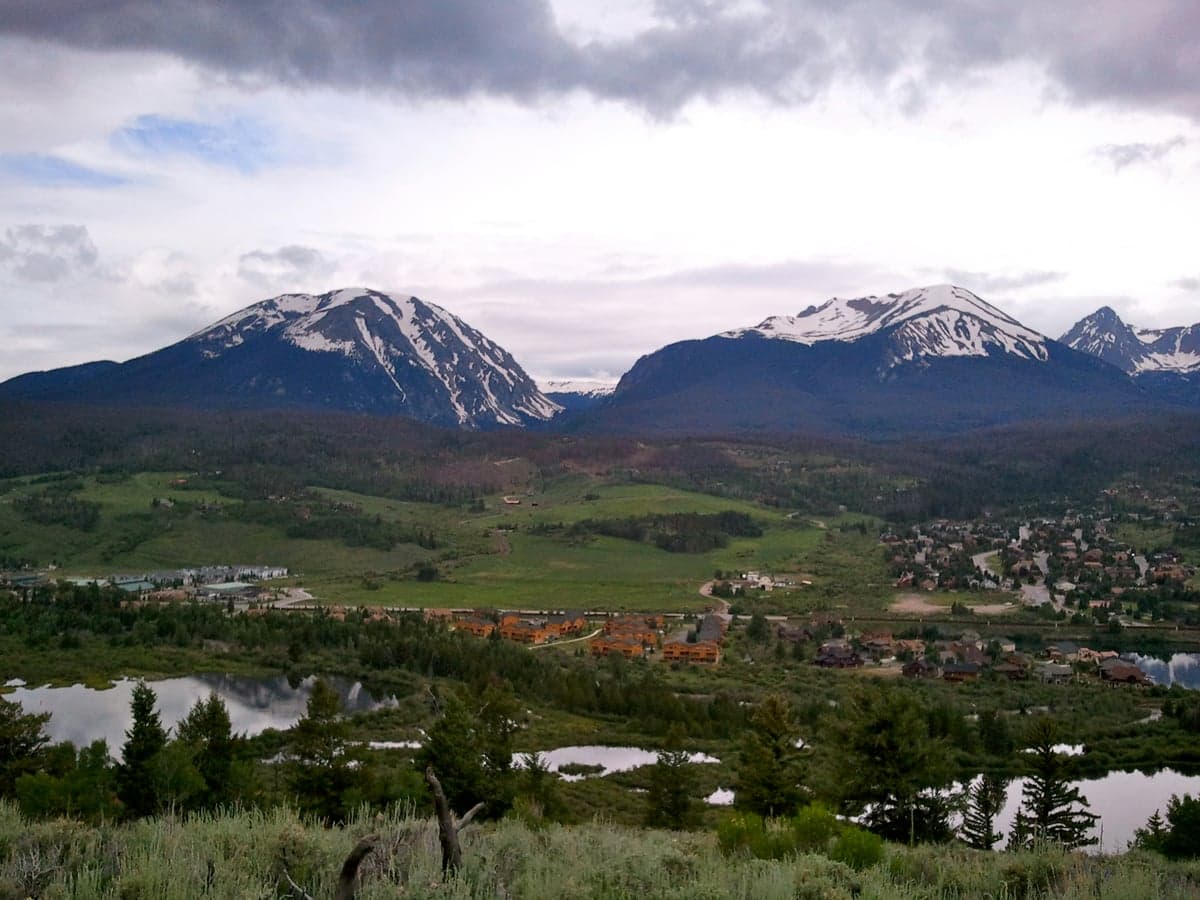
Photo: Wikipedia
Demographics of Silverthorne, CO
Affluence Level in Silverthorne, CO
An upper-middle-class area. Household wealth, education levels, and homeownership run ahead of national benchmarks.
People of Silverthorne, CO
The people of Silverthorne, Colorado today number 4,657, forming a compact, predominantly white and Hispanic community with a notably high college attainment rate of 48.5%. The city’s character is defined by its dual identity as both a working-class service hub for Summit County’s ski resorts and an increasingly attractive relocation destination for remote workers and outdoor enthusiasts. With a foreign-born population of 15.5%—nearly all of whom are Hispanic—Silverthorne has a visible, growing Latino workforce that contrasts with the more transient, affluent populations of neighboring resort towns like Breckenridge and Vail.
How the city was settled and grew
Silverthorne was not a historic mining camp like many Colorado mountain towns. It was founded in the 1960s as a planned community to serve the burgeoning Interstate 70 corridor and the nearby ski resorts. The land was originally part of a large ranch owned by the Silverthorne family, and the city was incorporated in 1967. The first major wave of residents were construction workers, highway laborers, and early resort employees—mostly white, working-class families from other parts of Colorado and the Midwest. These initial settlers built homes in the original Silverthorne core, the area around Adams Avenue and the Blue River Parkway, which remains the city’s most established residential neighborhood. A smaller, second wave in the 1970s and 1980s brought Hispanic laborers, primarily from northern New Mexico and southern Colorado, drawn by construction and hospitality jobs. They settled in the Hamilton Creek area and along the Blue River corridor, forming the foundation of the city’s present-day Latino community.
Modern era (post-1965)
The post-1965 era in Silverthorne is less about immigration reform and more about domestic migration and the expansion of the resort economy. The city’s population grew steadily through the 1990s and 2000s as Summit County’s ski industry boomed. The Hispanic share of the population rose from roughly 8% in 1990 to 21.0% today, driven by ongoing demand for service and construction workers. These newer Hispanic arrivals—many from Mexico and Central America—have concentrated in the Ravenwood and Ptarmigan neighborhoods, which offer more affordable housing stock and closer proximity to the industrial and commercial zones along Highway 9. Meanwhile, the white population has become more transient and affluent, with many newcomers being second-home owners or remote workers who purchase in the Silverthorne Estates and Angler Mountain Ranch subdivisions. The city’s Black, Asian, and Indian populations remain at 0.0%, reflecting the broader lack of racial diversity in Colorado’s high-country resort communities. The college-educated share of 48.5% is high for a mountain town of this size, driven by the influx of professional remote workers since 2020.
The future
Silverthorne’s population is heading toward greater Hispanic representation and a more bifurcated economic structure. The Hispanic share is likely to continue rising, as the service and construction sectors remain the primary employment base for working-class families, while affordable housing in the county becomes scarcer. The white population is becoming more transient and more affluent, with many newcomers using Silverthorne as a base for remote work or as a second-home location. The Ravenwood and Ptarmigan neighborhoods will likely see continued Hispanic concentration, while Angler Mountain Ranch and Silverthorne Estates will attract higher-income, mostly white professionals. The city’s cultural identity is evolving from a purely working-class service hub into a more stratified community where long-term Latino families coexist with a rotating cast of wealthy newcomers. The Black, Asian, and Indian populations are expected to remain negligible, as Silverthorne lacks the urban amenities and diversity infrastructure that attract those groups to larger Colorado cities like Denver or Aurora.
For someone moving in now, Silverthorne offers a stable, family-oriented mountain community with a strong sense of local identity, but one that is increasingly divided between a rooted Hispanic working class and a transient white professional class. The city is becoming more diverse in the sense of Hispanic growth, but not in the broader multi-ethnic sense seen in urban Colorado. New residents should expect a place where community ties are strong but where economic and cultural divides are becoming more pronounced.

* Values derived from national, state, county, city and local statistics and may differ in a specific area. Last updated: 2026-08-03T16:05:47.000Z
Narrative content on this page is AI-generated and may contain mistakes. Verify any details that matter before acting on them.
ReloMaps may earn a commission from affiliate links at no extra cost to you.

