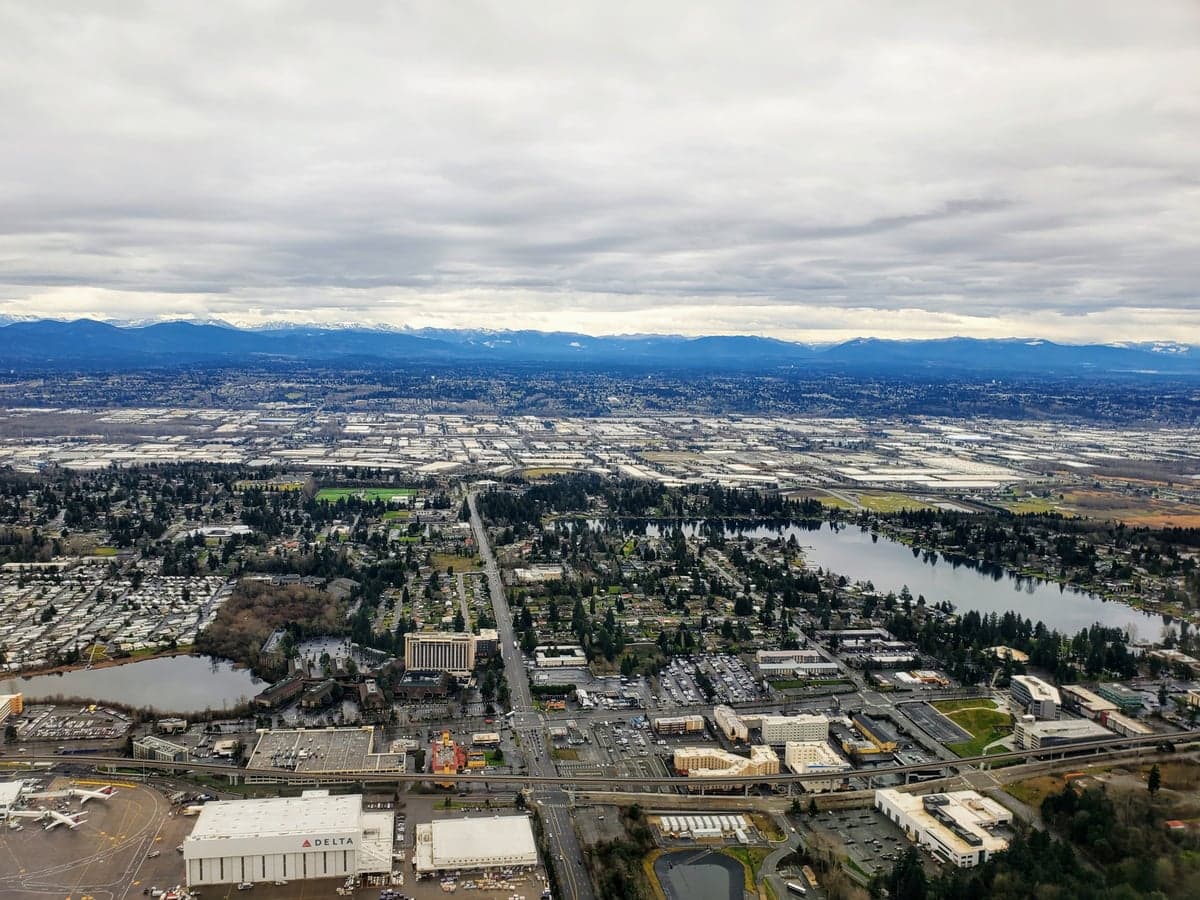
Photo: Wikipedia
Political ClimatePolitical Climate in Seatac, WA
District shown is the primary district for this city’s centroid. Cities may span multiple districts.
Local Political AnalysisPolitical Analysis of Seatac, WA
Seatac, Washington, is about as deep blue as it gets in the region, with a Cook Partisan Voting Index of D+22. That means it leans Democratic by a massive 22 points compared to the national average. If you’ve lived here for a while, you’ve watched the political pendulum swing hard left over the last decade, and it’s not showing any signs of swinging back. The city council and local leadership have steadily embraced progressive policies, and the general vibe is one of active, often aggressive, government involvement in daily life.
How it compares
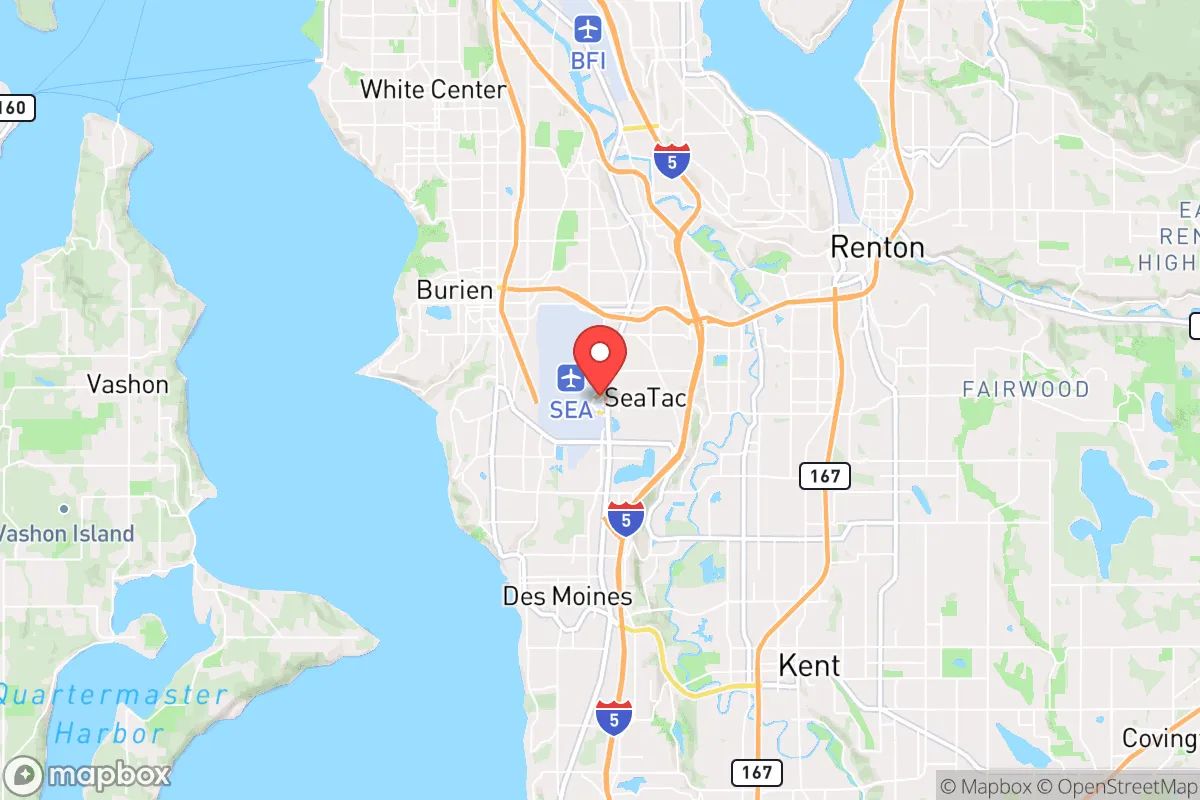
To really understand Seatac’s politics, you have to look at the neighbors. Drive 15 minutes north into Burien, and you’ll find a similar progressive streak, though maybe a notch less intense. But head east toward Kent or Covington, and the political landscape shifts noticeably—those areas still lean blue, but with a much more moderate, sometimes even purple, feel. The real contrast is just a half-hour south in Auburn or the more rural pockets of Pierce County, where you’ll hear a lot more talk about property rights, gun freedoms, and pushing back on state mandates. Seatac, by comparison, feels like a laboratory for top-down social experiments. The city has been a leader in things like rent control discussions and sanctuary city policies, which sound good on paper but often mean more bureaucracy and less personal choice for residents.
What this means for residents
For the average person living here, the political climate translates into a lot of rules and regulations that can feel suffocating. Want to run a small business out of your garage? Good luck with the permitting and zoning hurdles that have gotten stricter every year. Concerned about rising crime? The local approach has been heavy on social programs and light on enforcement, which leaves many neighbors feeling like they’re on their own when it comes to safety. Property taxes and fees keep climbing to fund new initiatives, and there’s a growing sense that the government sees itself as a caretaker rather than a servant. If you value the freedom to make your own choices—whether it’s about your kids’ education, your healthcare decisions, or how you use your land—Seatac’s trajectory is a real concern. The long-term trend points toward even more centralized control, not less.
What daily life is like for families
On a day-to-day level, the political leanings show up in the schools and local services. The school district has embraced progressive curriculum changes and social-emotional learning programs that some parents feel push a specific worldview rather than focusing on academics. City-funded programs often prioritize equity initiatives over basic infrastructure like road maintenance or park safety. It’s not all bad—there’s a strong sense of community among like-minded folks—but if you’re not on board with the prevailing ideology, you can feel like an outsider in your own town. The cultural distinction here is that Seatac wears its politics on its sleeve, with city-sponsored events and public messaging that reinforce the progressive agenda. For a conservative-leaning resident, it’s a place where you learn to keep your head down or get involved in the fight, because the status quo isn’t going to change on its own.

State Political ClimatePolitical Climate in Washington
State Political AnalysisPolitical Environment in the State
Washington State has shifted from a reliably purple swing state to a solidly Democratic stronghold over the past two decades, with Democrats now holding every statewide office and commanding supermajorities in both legislative chambers. The state hasn't voted for a Republican presidential candidate since 1984, and in 2024, Kamala Harris carried it by roughly 19 points. However, this blue veneer masks a deeply divided political landscape—King County (Seattle) alone casts about a third of all votes, while vast rural and exurban areas vote Republican by margins of 30-40 points. For a conservative considering relocation, the key takeaway is that Washington is a state where your local political experience depends almost entirely on which county you choose to live in.
Urban vs. rural divide
The political map of Washington is essentially a story of three regions. The I-5 corridor from Seattle through Tacoma to Olympia is the Democratic engine, with King County delivering margins of +40 to +50 points in statewide races. Seattle, Bellevue, and Redmond are the core of this coalition—tech workers, government employees, and progressive activists who drive the state's leftward tilt. The Puget Sound region as a whole accounts for roughly 60% of the state's population, meaning rural votes are almost always swamped. On the other side, Spokane County (eastern Washington's largest population center) has trended redder over the past decade, flipping from a swing county to reliably Republican—Trump won it by 12 points in 2024. Yakima County in central Washington is a fascinating battleground: historically Democratic due to agricultural labor unions, it has shifted right as Hispanic voters there have moved toward the GOP on cultural and economic issues. The true red strongholds are the rural counties east of the Cascades—Grant, Douglas, and Okanogan counties routinely vote 65-70% Republican. The Olympic Peninsula (Clallam, Jefferson, Grays Harbor) is more mixed, with libertarian-leaning independents and a fading timber industry base that still votes Republican but with less enthusiasm than eastern Washington.
Policy environment
Washington's policy environment is aggressively progressive at the state level, with a tax structure that uniquely burdens high earners and businesses. There is no state income tax, but the state relies heavily on a regressive sales tax (9.5-10.5% in most areas) and a new capital gains tax on profits over $250,000 that was upheld by the state Supreme Court in 2023. Property taxes are moderate but rising fast—Seattle-area homeowners have seen 30-40% increases over five years. The regulatory posture is among the most stringent in the nation: the state has a strict plastic bag ban, a ban on natural gas in new construction (effective 2026 for large buildings), and the nation's most aggressive electric vehicle mandate (all new cars must be zero-emission by 2035). Education policy is dominated by teachers' unions, with the state spending over $18,000 per student (top 10 nationally) but producing mediocre outcomes—only 50% of students meet math standards. Healthcare is heavily regulated, with a state-run insurance exchange and some of the nation's strictest abortion protections (codified into law in 2023). Election laws are among the most convenient for voters—universal mail-in voting since 2011, same-day registration, and no voter ID requirement—which conservatives argue undermines election integrity. The state also has a "sanctuary" law (2019's Keep Washington Working Act) that limits local law enforcement cooperation with federal immigration authorities.
Trajectory & freedom
On the freedom index, Washington is clearly trending downward for conservatives. The most significant recent contraction of personal liberty came in 2023 with the passage of HB 1240, which banned the sale, manufacture, and import of over 50 specific firearm models (including AR-15s) and magazines over 10 rounds. This was followed by HB 1903 (2024), which requires a 10-day waiting period and mandatory firearms training for all purchases. The state also passed SB 5599 (2023), which allows minors to receive gender-affirming care without parental consent—a direct blow to parental rights. On the medical autonomy front, Washington was one of the first states to mandate COVID-19 vaccines for healthcare workers and state employees, and those mandates remain in effect for many positions. Property rights have been eroded by the state's Growth Management Act, which severely limits rural development and has driven up housing costs. On the positive side for liberty, the state has no income tax, no right-to-work law (meaning union membership can be required for employment), and no stand-your-ground law. The Washington State Supreme Court has been a reliable engine of progressive policy, striking down voter-approved initiatives on charter schools (2015), carbon pricing (2016), and police reform (2021).
Civil unrest & political movements
Washington has been a flashpoint for political violence and unrest. The CHOP/CHAZ zone in Seattle's Capitol Hill neighborhood during summer 2020—where protesters occupied six city blocks for weeks, resulting in two deaths—remains a national symbol of progressive governance gone awry. The city's response (or lack thereof) led to a recall movement against then-Mayor Jenny Durkan and a shift in city council elections toward more moderate candidates. On the right, the Washington State Republican Party has been riven by internal divisions between establishment conservatives and more populist, Trump-aligned factions. The Spokane County area has seen growing "constitutional sheriff" movements, with local officials refusing to enforce certain state gun laws. Immigration politics are tense: the sanctuary law has led to friction between state and federal authorities, with ICE detainers routinely ignored. Election integrity remains a hot-button issue—Washington's all-mail system saw a 2022 incident in Yakima County where 400 ballots were found in a discarded mailbox, though no fraud was proven. The secession movement for a "State of Liberty" (eastern Washington breaking away) has gained some online traction but no serious political momentum.
Projection
Over the next 5-10 years, Washington will likely become more progressive, not less. The tech industry's continued growth in the Seattle metro area is importing a highly educated, left-leaning workforce. The state's Democratic supermajorities are likely to push for a state income tax (currently blocked by a 2/3 legislative vote requirement, but that could be amended), further gun restrictions, and a single-payer healthcare system. The rural exodus to Idaho and Montana is accelerating—Spokane County is losing population to Coeur d'Alene, Idaho, while Clark County (Vancouver) is seeing an influx of Oregonians fleeing Portland's problems, which may slightly moderate the state's politics. The wild card is the Hispanic vote in central Washington—if that bloc continues trending right, it could make Yakima and Benton counties competitive for Republicans in state legislative races. But the overall trajectory is clear: Washington is becoming a one-party state where conservative voices have little influence at the state level.
For a conservative moving to Washington, the practical takeaway is this: choose your county carefully. If you want a political environment that aligns with your values, look at Spokane County (eastern Washington's conservative hub), Grant County (rural, agricultural, deeply red), or Clark County (purple but trending red). Avoid King County and the I-5 corridor unless you're prepared to live in a progressive bubble. You'll have no state income tax, which is a real benefit, but you'll pay for it through high sales taxes, property taxes, and a regulatory environment that makes everything from building a house to buying a gun more difficult. The state's natural beauty and outdoor recreation are unmatched, but the political climate is increasingly hostile to traditional conservative values. If you're willing to be a political minority at the state level while enjoying local control in a red county, Washington can still work—but don't expect the state government to have your back.
* Values derived from national, state, county, city and local statistics and may differ in a specific area. Last updated: 2026-04-21T11:15:05.000Z
Narrative content on this page is AI-generated and may contain mistakes. Verify any details that matter before acting on them.
ReloMaps may earn a commission from affiliate links at no extra cost to you.

