Photo: Wikipedia
Strategic Assessment of Scottsbluff, NE
Strong survivability profile. Good buffer from population centers, with manageable environmental and tactical risks.
What does the Strategic Assessment tell us?
Our Strategic Assessment grades tactical survivability of an area. Major population centers, military targets, fallout zones, natural disasters, and border exposure all drive risk — lower exposure means a more defensible position in a crisis.
This is heavily inspired by Joel Skousen's Strategic Relocation book. Highly recommended you checkout the book ($)What does this tell us?
Our Strategic Assessment grades tactical survivability of an area. Major population centers, military targets, fallout zones, natural disasters, and border exposure all drive risk — lower exposure means a more defensible position in a crisis.
This is heavily inspired by Joel Skousen's Strategic Relocation book. Highly recommended you checkout the book ($)Strategic Pillars

Key Distances
Regional Safe Places
Below is our recommended "safe zones" in Nebraska and the surrounding area based on our strategic heuristics. For most people, it's unrealistic to live in a “safe zone” full-time due to work, family or other personal reasons. They tend to be more rural. However, many of these areas are perfect for second homes and retreat properties that double as a vacation home or even a short-term rental.
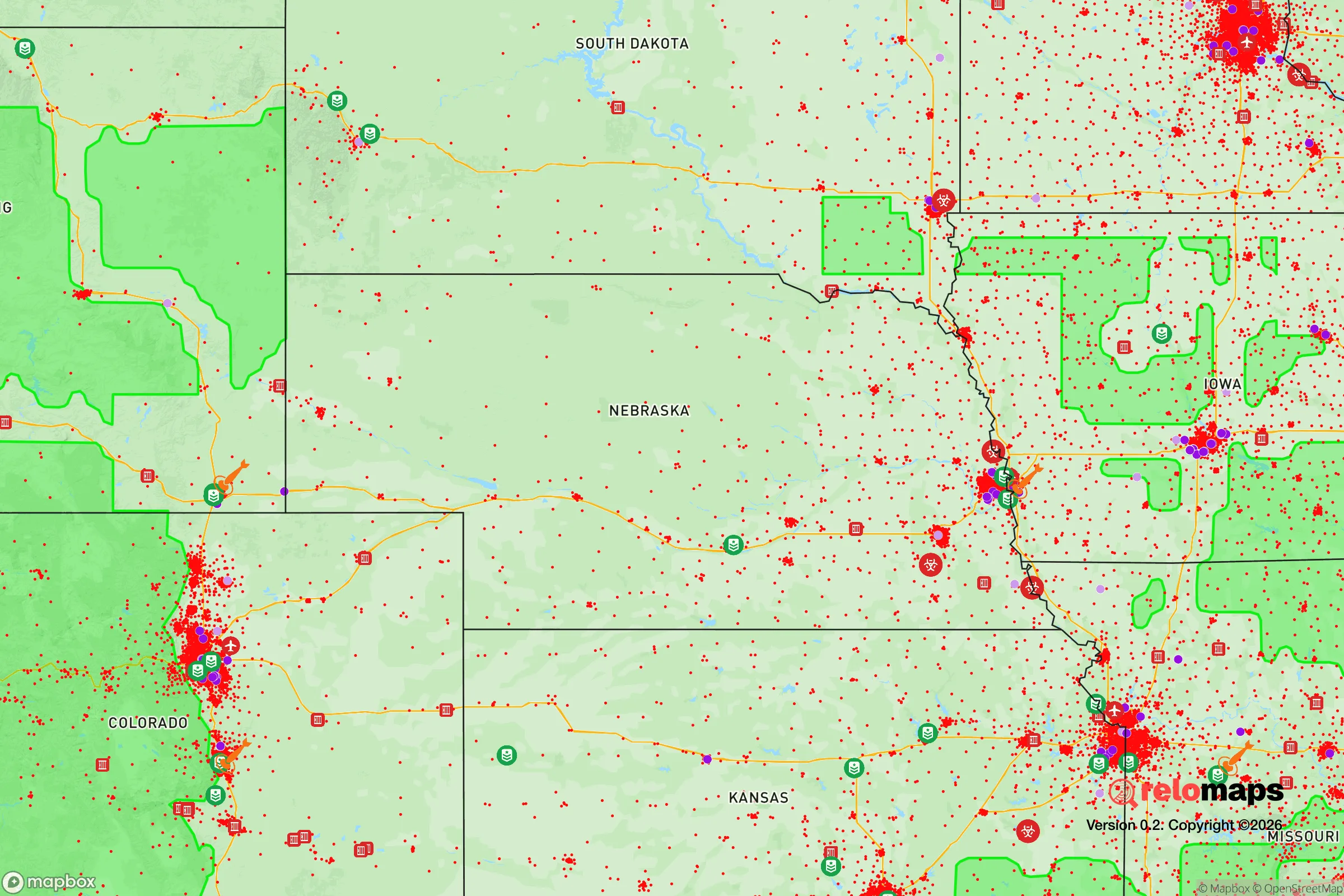
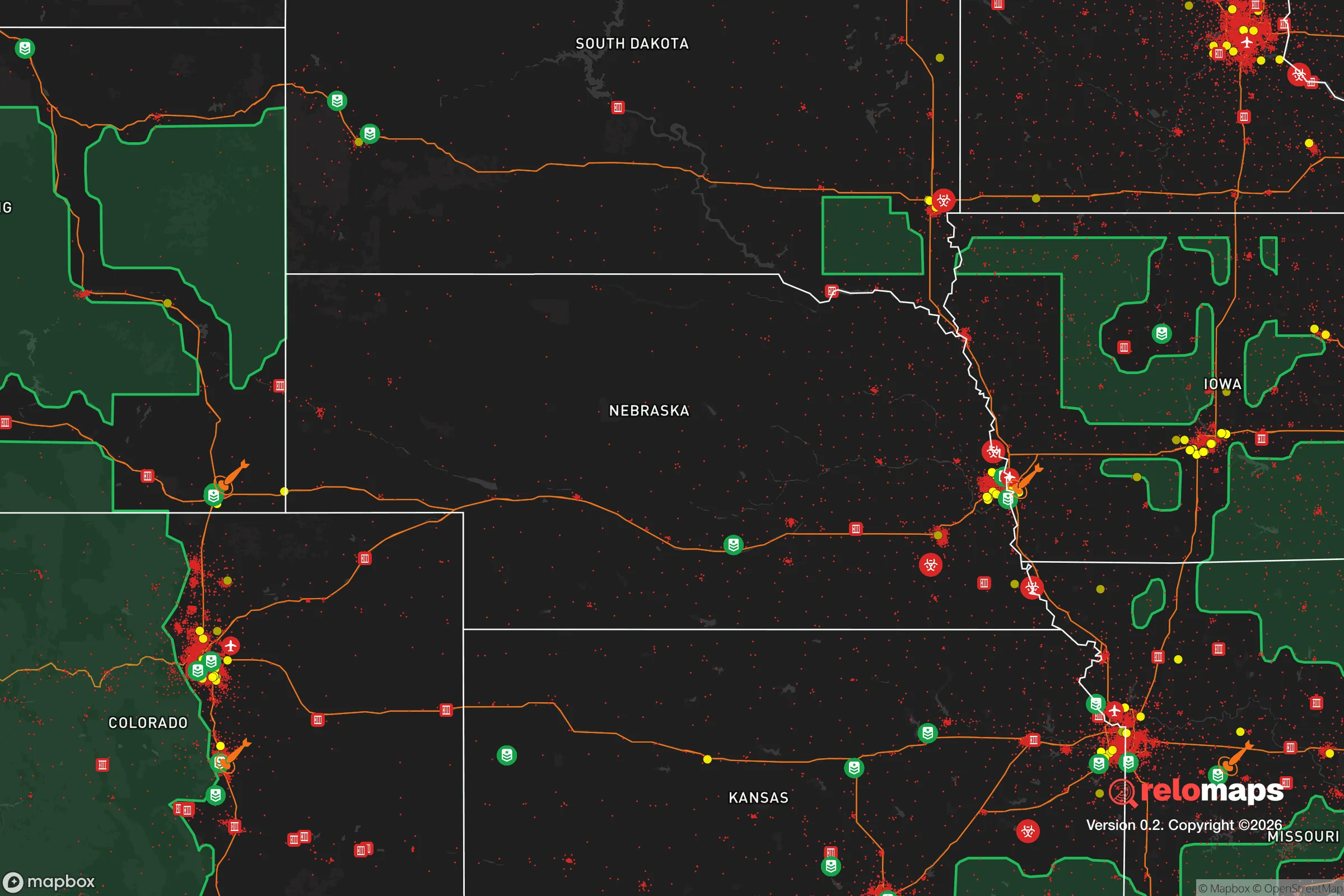


Important Note: For informational purposes only. This does not mean nothing bad ever happens in the green zones. Please use common sense. This is based on public data and modeled with AI. We tried to take a conservative approach but mistakes happen. We update this regularly as new information becomes available.
Solar Generator Recommendations
Backup power matters more here than in safer locations. We've picked three solar generators across budgets and capacity tiers — start with the budget unit if you only need a few essentials, or step up if you want to run a fridge and HVAC for days at a time.

Jackery Portable Power Station Explorer 300
Budget OptionPower on the Go: Weighing only 11 lbs, it's convenient to set up and store with book-sized foldable solar panels

BLUETTI Portable Power Station AC180
Designed for both indoor and outdoor scenarios, AC180 is highly capable as it has a robost capacity and continuous output power.

EF ECOFLOW DELTA Pro Ultra Power Station
Upgraded PickEcoFlow DELTA Pro Ultra is a whole-home energy system designed to grow with your family. Integrated with the Smart Home Panel 2, it scales to meet your evolving energy needs — keeping your home powered, intelligent, and secure through every stage of life.
We earn a commission, at no additional cost to you.
Strategic Assessment Analysis
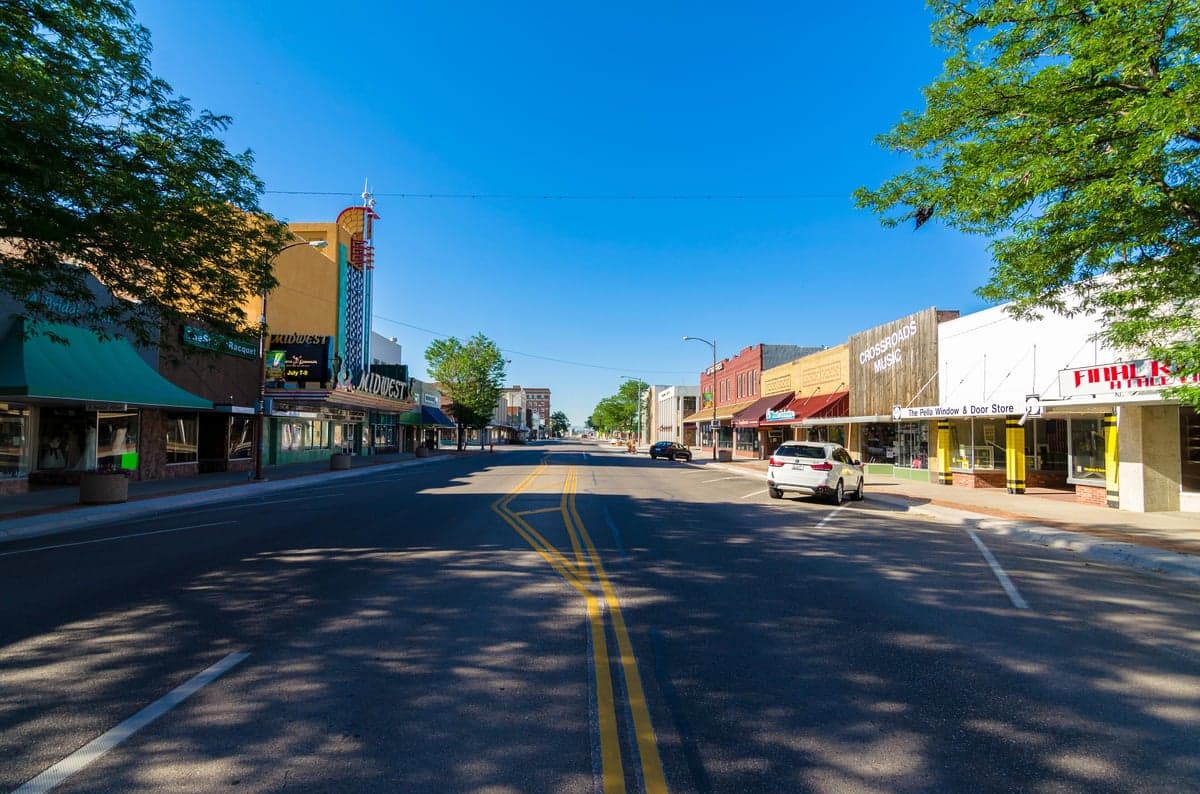
Scottsbluff, Nebraska, sits as a quiet outlier in the Great Plains—a place where the land itself offers a form of strategic insulation that few other towns can match. For the conservative-minded relocator who sees the writing on the wall regarding civic unrest, supply chain fragility, and the concentration of risk in coastal megacities, this western Nebraska hub presents a compelling mix of geographic isolation, agricultural self-sufficiency, and low-key infrastructure. It’s not flashy, and it’s not for everyone, but if your priority is a defensible, resilient base that can weather both natural and man-made storms, Scottsbluff deserves a hard look. The town’s population hovers around 15,000, with the broader Scotts Bluff County adding another 20,000—small enough to avoid the chaos of a metro area, but large enough to support a hospital, a community college, and a regional airport. The key question isn’t whether Scottsbluff is comfortable—it’s whether it can keep you and your family alive and functional when the grid flickers or the cities burn.
Geographic position and natural advantages for long-term survival
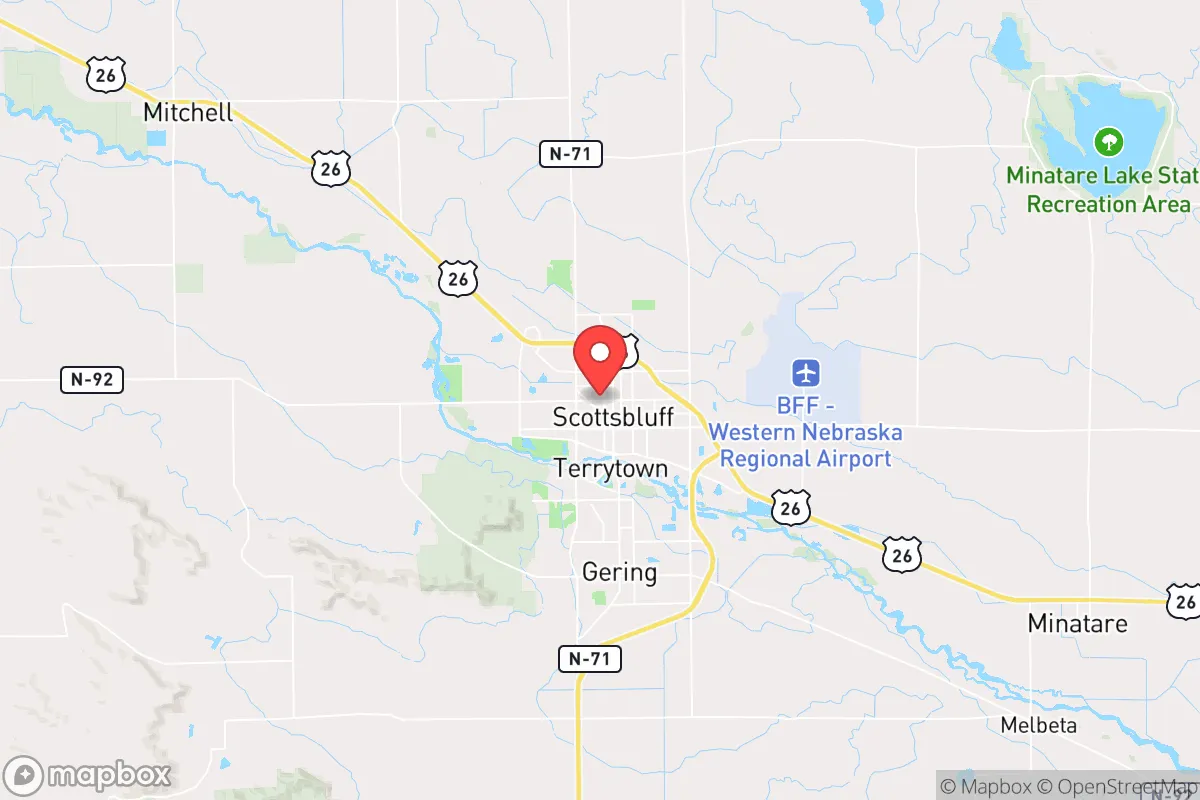
Scottsbluff’s location is its single greatest asset. It sits in the North Platte River Valley, roughly 20 miles east of the Wyoming border and 100 miles north of the Colorado line. That puts it squarely in the middle of the High Plains—far from the seismic, hurricane, and wildfire zones that plague the coasts and the West. The area is dry, with about 15 inches of annual precipitation, but the North Platte River provides a reliable surface water source that doesn’t depend on fickle aquifers. The surrounding terrain is a mix of irrigated farmland, rangeland, and the iconic Scotts Bluff National Monument—a 800-foot sandstone bluff that offers natural elevation and line-of-sight advantages. For a prepper, that bluff isn’t just a tourist attraction; it’s a potential observation post and a natural barrier against approach from the east. The region’s low population density—roughly 10 people per square mile in the county—means that even a modest retreat has significant buffer space. You’re not going to be overrun by a mob from the next town over; the nearest city of any size is Cheyenne, Wyoming, 90 miles west, and Denver is 200 miles southwest. That distance is your friend when the power goes out and the highways become chokepoints.
Risks, exposures, and proximity to fallout-relevant landmarks
No location is a fortress, and Scottsbluff has its vulnerabilities. The most obvious risk is its proximity to the Union Pacific mainline and Interstate 80, both of which run about 30 miles south of town. In a national emergency—whether a grid collapse, a pandemic, or a civil conflict—those corridors will become vectors for refugees, looters, and military movements. The town itself is not a primary target, but it sits within 150 miles of the U.S. Strategic Command at Offutt Air Force Base near Omaha, and within 200 miles of the Minuteman III missile fields in western Nebraska and eastern Wyoming. In a nuclear exchange, those are high-value targets, and fallout patterns could drift eastward depending on wind. The good news: Scottsbluff is far enough west that prevailing winds would carry fallout from the missile fields away from the town, but you’d want a basement or a shielded room regardless. The other risk is water contamination: the North Platte River is fed by snowmelt from the Rockies, but upstream agricultural runoff and potential industrial spills from the rail line could compromise it in a crisis. You’d need a good filtration system and a backup well. Tornadoes are a real threat—the area sits in the western edge of Tornado Alley—but the open terrain means you’ll see them coming from miles away. The bigger concern is winter blizzards, which can drop three feet of snow and shut down roads for days. That’s a survivable inconvenience if you’re stocked, but a death sentence if you’re not.
Practical resilience for a relocator: food, water, energy, and defensibility
This is where Scottsbluff shines. The town is the commercial hub of the Nebraska Panhandle, surrounded by some of the most productive irrigated farmland in the country. Corn, sugar beets, dry beans, and alfalfa are the staples, and the local economy is built around agriculture—meaning that even if the grocery store shelves go bare, the knowledge and infrastructure for local food production are already in place. The Scottsbluff area is home to the University of Nebraska’s Panhandle Research and Extension Center, which means there’s a pool of agronomists and soil scientists who can help you grow your own food. Water is less of a concern than in the desert Southwest: the North Platte River is a perennial stream, and the Ogallala Aquifer lies beneath the region, though it’s being drawn down faster than it recharges. A private well with a hand pump is a smart investment. Energy is a mixed bag: the local grid is served by Nebraska Public Power District, which relies heavily on coal and natural gas, but the area has excellent wind resources. A small wind turbine or solar array with battery storage can keep your lights on when the grid goes down. Defensibility is decent but not perfect. The town is laid out on a grid, with the bluff providing a natural high ground to the east. The surrounding farmland is open, meaning any approach is visible for miles. But the town itself is not walled or gated—you’d need to harden your own property. The local law enforcement presence is small: the Scottsbluff Police Department has about 30 officers, and the county sheriff’s office covers the rest. In a major crisis, you’re largely on your own. That’s not a bug—it’s a feature for those who prefer self-reliance over government dependency.
The overall strategic picture for Scottsbluff is one of calculated trade-offs. You trade away the amenities of a big city—the restaurants, the concerts, the career opportunities—for a piece of ground that can sustain you when the world goes sideways. The town’s isolation is its shield, but it’s also its weakness: if you need specialized medical care, you’re looking at a 90-minute drive to Cheyenne or a 3-hour drive to Denver. The local hospital, Regional West Medical Center, is a Level II trauma center and the largest in the region, but it’s not a major academic medical center. For the conservative prepper, the calculus is simple: Scottsbluff offers a low-profile, agriculturally self-sufficient base with good water, decent energy potential, and a community that still values neighborly self-reliance. It’s not a bunker—it’s a working town where you can live a normal life while quietly building your resilience. The risks are real—tornadoes, blizzards, and the long shadow of the missile fields—but they’re manageable with preparation. If your goal is to be out of the blast radius, away from the mobs, and within striking distance of food and water, Scottsbluff is a solid bet. Just bring a good shovel, a water filter, and a willingness to mind your own business. That’s the Nebraska way.

* Values derived from national, state, county, city and local statistics and may differ in a specific area. Last updated: 2026-05-03T20:32:02.000Z
Narrative content on this page is AI-generated and may contain mistakes. Verify any details that matter before acting on them.
ReloMaps may earn a commission from affiliate links at no extra cost to you.

