Photo: Wikipedia
Political ClimatePolitical Climate in San Clemente, CA
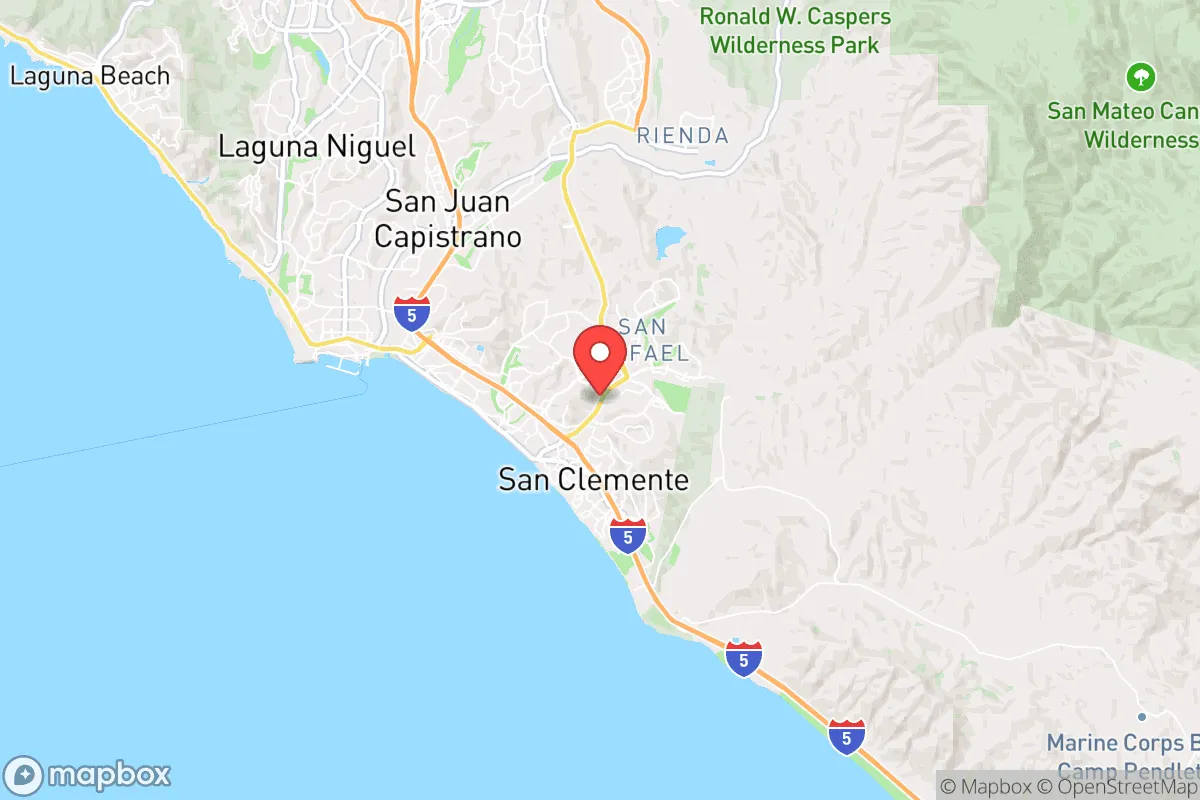
District shown is the primary district for this city’s centroid. Cities may span multiple districts.
Local Political AnalysisPolitical Analysis of San Clemente, CA
San Clemente has long been a political outlier in Orange County, leaning more conservative than its coastal neighbors but shifting leftward in recent cycles. The city’s Cook Partisan Voting Index (PVI) of D+4 means it’s about 8 points more Republican than California as a whole (D+12), but that gap has narrowed considerably since the 2010s, when the area was a reliable GOP stronghold. In the 2024 presidential election, San Clemente voted for Kamala Harris by a slim margin, mirroring the broader Orange County trend where suburban voters have drifted away from the GOP. The real story here is the trajectory: the city is becoming more Democratic with each election, though it still retains a noticeable conservative undercurrent that you won’t find in, say, Laguna Beach or Irvine.
How it compares
San Clemente’s D+4 PVI places it squarely in the middle of Orange County’s political spectrum. To the north, Dana Point and San Juan Capistrano are similarly purple, with Dana Point leaning slightly more Democratic (D+6) and San Juan Capistrano slightly more Republican (R+2). Drive a few miles inland to Mission Viejo or Ladera Ranch, and you’ll hit R+8 territory—areas where Trump still won comfortably in 2024. Compare that to the state average of D+12, which is pulled heavily by deep-blue Los Angeles and the Bay Area. San Clemente’s politics feel more like a microcosm of the national swing suburbs than the rest of California. The city’s voter registration is roughly 35% Republican, 34% Democratic, and 31% independent, a near-even split that makes local elections highly competitive. In contrast, the state as a whole is about 47% Democratic, 24% Republican, and 23% independent, giving Democrats a much firmer grip on policy.
What this means for residents
For conservative residents, San Clemente offers a more comfortable environment than most of coastal California. You’ll still find plenty of Trump flags on pickup trucks along El Camino Real, and the local Republican club is active. But the days of the city being a safe GOP seat are over—the city council now has a 3-2 Democratic majority, and ballot measures on housing density and rent control have passed with liberal support. For liberal residents, the upside is that your vote actually matters more here than in a deep-blue city like Santa Monica. Local elections are often decided by a few hundred votes, so grassroots organizing has real impact. The downside is that you’ll still encounter vocal opposition on issues like coastal development and school curriculum. Practically, this means the city’s politics are a constant negotiation: the city council debates everything from short-term rental regulations to beach access fees with a level of intensity you don’t see in more homogeneous areas.
Culturally, San Clemente’s political split shows up in everyday life. The local farmers market has both organic kombucha vendors and booths selling “Don’t Tread on Me” gear. The school board has been a battleground over critical race theory and LGBTQ+ inclusive materials, with meetings drawing packed crowds on both sides. The city’s identity as a surf town with a military presence (Camp Pendleton is just south) creates a unique blend: you’ll see Priuses with “Coexist” stickers next to lifted trucks with “Thin Blue Line” decals. Looking ahead, the trajectory is clear—San Clemente will continue to trend blue, but it’s likely to remain a purple city for at least another decade, making it one of the few places in California where both sides can still feel heard, if not always happy.

State Political ClimatePolitical Climate in California
State Political AnalysisPolitical Environment in the State
California is a solidly Democratic state with a Cook Partisan Voting Index of D+12, meaning it votes about 12 points more Democratic than the national average in presidential elections. Over the past 20 years, the state has shifted from a competitive purple state—where Republicans held the governorship and controlled the legislature as recently as the mid-1990s—to a deeply blue stronghold, driven largely by demographic change, urbanization, and the GOP’s declining appeal among the state’s growing Latino and Asian American populations. While the coastal metros dominate the political landscape, the Central Valley and inland regions remain reliably red, creating one of the sharpest urban-rural divides in the country.
Urban vs. rural divide
The political map of California is essentially a battle between the densely populated coastal corridor and the vast interior. The San Francisco Bay Area—including San Francisco, Oakland, and San Jose—is the state’s most liberal region, routinely delivering 80-90% of the vote to Democratic candidates. Los Angeles County, home to over 10 million people, is the state’s Democratic anchor, though its suburbs like Orange County have flipped from red to purple to blue over the past decade—Orange County voted for Hillary Clinton in 2016 and Joe Biden in 2020 after decades of Republican dominance. In contrast, the Central Valley—places like Bakersfield, Fresno, and Redding—votes heavily Republican, often by margins of 20-30 points. The state’s rural north, including Shasta County and Modoc County, is among the most conservative territory in the nation, with some precincts voting 80% Republican. The divide isn’t just about population density; it’s cultural, economic, and increasingly racial, with white voters in rural areas feeling alienated from the multicultural, progressive coastal elite.
Policy environment
California’s policy environment is defined by high taxes, heavy regulation, and expansive government services. The state has a progressive income tax with rates up to 13.3%, the highest in the nation, and a state sales tax that can exceed 10% in some cities. Property taxes are capped at 1% of assessed value under Proposition 13, but reassessments upon sale can still sting. The regulatory posture is among the most aggressive in the country, particularly on environmental issues—California has its own cap-and-trade system, strict vehicle emissions standards, and a goal of 100% clean electricity by 2045. Education policy is dominated by the California Teachers Association, a powerful union, and the state spends over $20,000 per pupil annually, though outcomes vary widely. Healthcare is heavily regulated, with the state running its own insurance exchange (Covered California) and expanding Medi-Cal to cover all low-income residents regardless of immigration status. Election laws are among the most liberal: all registered voters receive a mail-in ballot, same-day registration is available, and felons on parole can vote. The state also has a top-two primary system, which often locks out third-party candidates.
Recent policy direction
Over the past five years, California has moved decisively left on a range of issues. On gun and self-defense law, the state has some of the strictest regulations in the nation: a 10-day waiting period, an assault weapons ban, a ban on high-capacity magazines, and a requirement for a Firearm Safety Certificate. In 2023, the legislature passed a law allowing private citizens to sue gun manufacturers for negligence, modeled after Texas’s abortion law. On parental and education rights, the state has moved in the opposite direction of many red states: it prohibits school districts from requiring parental notification when a child changes their gender identity, and it mandates that schools provide LGBTQ+ inclusive curriculum. On speech and privacy, California has a strong shield law for journalists and a strict data privacy law (CCPA), but it also restricts certain types of speech, such as “hate speech” in public schools and disinformation in election ads. On medical and bodily autonomy, the state is a sanctuary for abortion access, with laws protecting providers and patients from out-of-state lawsuits, and it has legalized physician-assisted suicide. On property rights, the state’s rent control laws are among the strongest, and a 2024 ballot measure (Proposition 33) expanded local rent control authority. On taxation, the trend is toward higher taxes on the wealthy, with a “wealth tax” proposal gaining traction in the legislature. On voting and ballot access, the state has expanded mail-in voting and automatic voter registration, but critics argue that the system is vulnerable to fraud, though evidence of widespread fraud is lacking.
Civil unrest & political movements
California has a long history of political activism, from the 1960s Free Speech Movement at UC Berkeley to the 2020 George Floyd protests, which were among the largest and most destructive in the state, particularly in Los Angeles and Oakland. The state is home to a vibrant progressive activist ecosystem, including groups like the ACLU of California, the California Environmental Voters, and the California Nurses Association. On the right, the state has a smaller but vocal conservative movement, centered in places like Bakersfield and Orange County, with groups like the California Republican Assembly and the Tea Party. Immigration politics are a constant flashpoint: California is a “sanctuary state” under SB 54, which limits local law enforcement cooperation with federal immigration authorities. This has led to tensions with the Trump administration and periodic protests from both sides. Secession rhetoric—the “Calexit” movement—surfaced after Trump’s 2016 election but has faded, as the state’s Democratic majority has little incentive to leave the union. Election integrity controversies are less pronounced than in states like Arizona or Georgia, but conservative activists have raised concerns about mail-in ballot security and voter roll maintenance, though no major scandals have emerged.
Projection
Over the next 5-10 years, California’s political trajectory is likely to remain firmly Democratic, but with some interesting shifts. The state’s population has been declining since 2020, driven by high housing costs and taxes, and the people leaving are disproportionately middle-income and conservative-leaning. This out-migration is accelerating the state’s blue shift, as the remaining population becomes more urban, more diverse, and more progressive. However, the state’s growing Latino population, while still heavily Democratic, is showing signs of drift toward the GOP on economic and cultural issues, particularly among younger men. If that trend continues, it could moderate the state’s leftward march. The biggest wild card is housing: if the state fails to build enough housing, the exodus of moderate voters could continue, making the state even more liberal. A new resident moving in now should expect to find a state where Democratic dominance is baked in, but where internal tensions between coastal progressives and inland conservatives will remain sharp. The policy environment will likely continue to move left on climate, healthcare, and social issues, but with growing pushback from business interests and moderate Democrats on taxes and regulation.
For a new resident, the bottom line is this: if you lean conservative, you will be in a distinct minority in most of the state’s population centers, but you will find like-minded communities in the Central Valley, the Inland Empire, and parts of Orange County. You will pay high taxes and deal with heavy regulation, but you will also benefit from strong public services, a robust economy, and a climate that is hard to beat. If you lean liberal, you will find a state that largely aligns with your values, but you will also encounter high costs, traffic, and a political culture that can be insular and self-congratulatory. Either way, California is not a place for the politically indifferent—its politics are as big and complicated as the state itself.
* Values derived from national, state, county, city and local statistics and may differ in a specific area. Last updated: 2026-06-08T04:46:24.000Z
Narrative content on this page is AI-generated and may contain mistakes. Verify any details that matter before acting on them.
ReloMaps may earn a commission from affiliate links at no extra cost to you.

