Photo: Wikipedia
Demographics of San Clemente, CA
Affluence Level in San Clemente, CA
An upper-middle-class area. Household wealth, education levels, and homeownership run ahead of national benchmarks.
People of San Clemente, CA
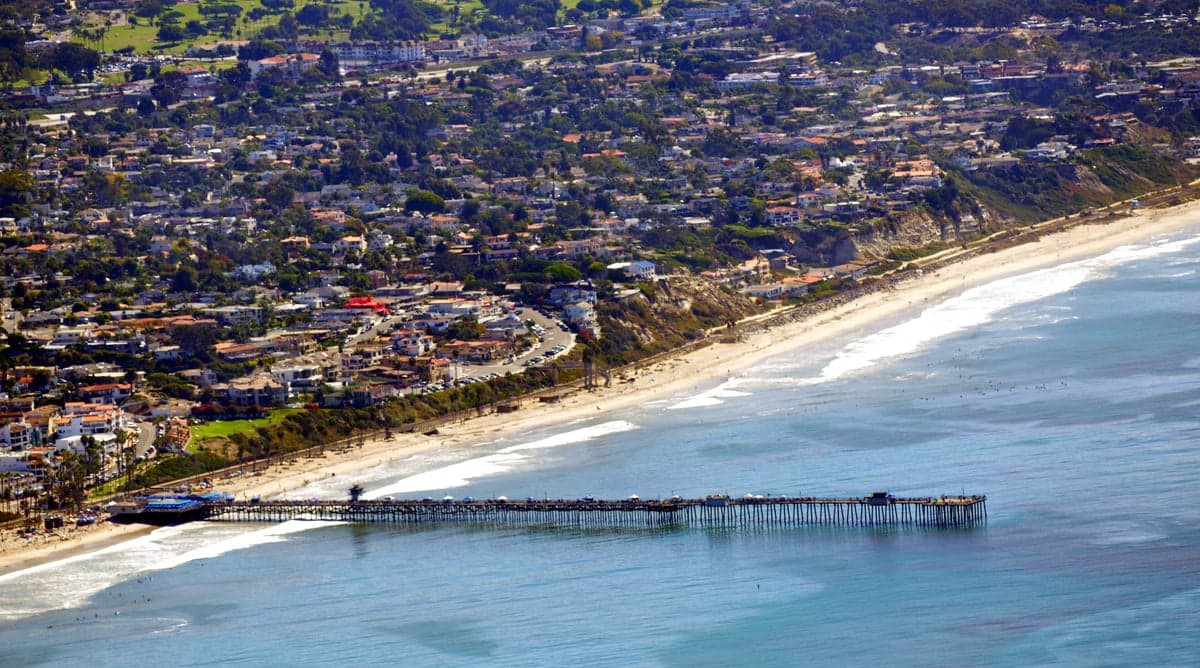
The people of San Clemente, California, today number roughly 63,510, forming a predominantly white (71.1%) and college-educated (51.7%) community with a notable Hispanic minority (17.8%) and small but growing East/Southeast Asian (3.1%) and Indian (1.4%) populations. The city’s character is defined by its low foreign-born share (3.6%)—roughly half the national average—and a strong military and surfing culture anchored by the nearby Camp Pendleton Marine Corps base and the historic San Clemente Pier. Residents often describe the city as a “Spanish Village by the Sea,” a nickname that reflects both its founding aesthetic and its present-day identity as an affluent, family-oriented beach town with a conservative-leaning political tilt.
How the city was settled and grew
San Clemente was not a product of Spanish or Mexican land grants; it was a planned community founded in 1925 by real estate developer Ole Hanson, who envisioned a Mediterranean-style resort town. The original population was drawn by Hanson’s marketing of a “climate-proof” seaside retreat, with early settlers arriving from the Midwest and the Los Angeles basin. The first wave built homes in the Los Molinos and Marblehead neighborhoods, where Spanish Colonial Revival architecture still dominates. The city’s early economy relied on tourism and small-scale agriculture, but the 1942 opening of Camp Pendleton transformed San Clemente into a bedroom community for military families. By the 1950s, the North Beach area had become a hub for active-duty Marines and their families, while the Forster Ranch subdivision began attracting white-collar commuters from Orange County’s growing aerospace and tech sectors. The city incorporated in 1928 and remained overwhelmingly white (over 95%) through the 1960s, with a small Hispanic population concentrated in the La Costa neighborhood near the old railroad depot.
Modern era (post-1965)
The 1965 Immigration and Nationality Act had a muted effect on San Clemente compared to inland California cities. The foreign-born share never exceeded 10%, and the city’s demographic shifts came primarily from domestic in-migration. The 1970s and 1980s saw an influx of upper-middle-class families from Los Angeles and Orange County, drawn by the city’s reputation for safety and oceanfront property. These new residents concentrated in the Talega master-planned community, which opened in 1999 and now houses roughly 8,000 residents, predominantly white and Asian. The Hispanic population grew from 8% in 1990 to 17.8% today, with many families settling in the Las Palmas neighborhood and the older San Clemente Heights area, where service-industry workers found affordable housing. The East/Southeast Asian community (3.1%) is largely concentrated in Talega and the newer Sea Summit development, while the Indian population (1.4%) is dispersed across the city, with no single ethnic enclave. The Black population remains very small at 1.5%, reflecting the city’s historical lack of industrial employment that drew Black migrants to other parts of Orange County.
The future
San Clemente’s population is projected to grow slowly, reaching roughly 68,000 by 2040, constrained by coastal land scarcity and strict zoning. The city is becoming slightly more diverse: the Hispanic share is expected to rise to 22-24% by 2040, driven by second-generation families aging into homeownership, while the white share will likely decline to 65-67%. The East/Southeast Asian and Indian populations are growing from a small base, primarily through professional in-migration to Talega and Sea Summit, but the city’s high home prices (median over $1.3 million) limit significant diversification. The foreign-born share may tick up to 5-6% as tech workers from Irvine and San Diego seek coastal housing. Culturally, San Clemente is evolving from a purely military-and-surf town into a more professional-class suburb, with the Downtown San Clemente district seeing new mixed-use developments that attract younger families. The city’s conservative identity is softening slightly as new residents bring more moderate political views, but the overall character remains family-oriented, outdoors-focused, and largely white-collar.
For someone moving in now, San Clemente offers a stable, low-diversity community with strong schools and a high quality of life, but it is not a place of rapid demographic change or ethnic vibrancy. The city is becoming more professional and slightly more diverse, but the pace is slow, and the dominant culture remains rooted in its 1920s founding vision of a quiet, affluent beach town. New arrivals will find a place where military tradition, surfing culture, and suburban comfort coexist, with most growth concentrated in the newer master-planned neighborhoods of Talega and Sea Summit rather than the historic core.

* Values derived from national, state, county, city and local statistics and may differ in a specific area. Last updated: 2026-06-08T04:46:24.000Z
Narrative content on this page is AI-generated and may contain mistakes. Verify any details that matter before acting on them.
ReloMaps may earn a commission from affiliate links at no extra cost to you.

