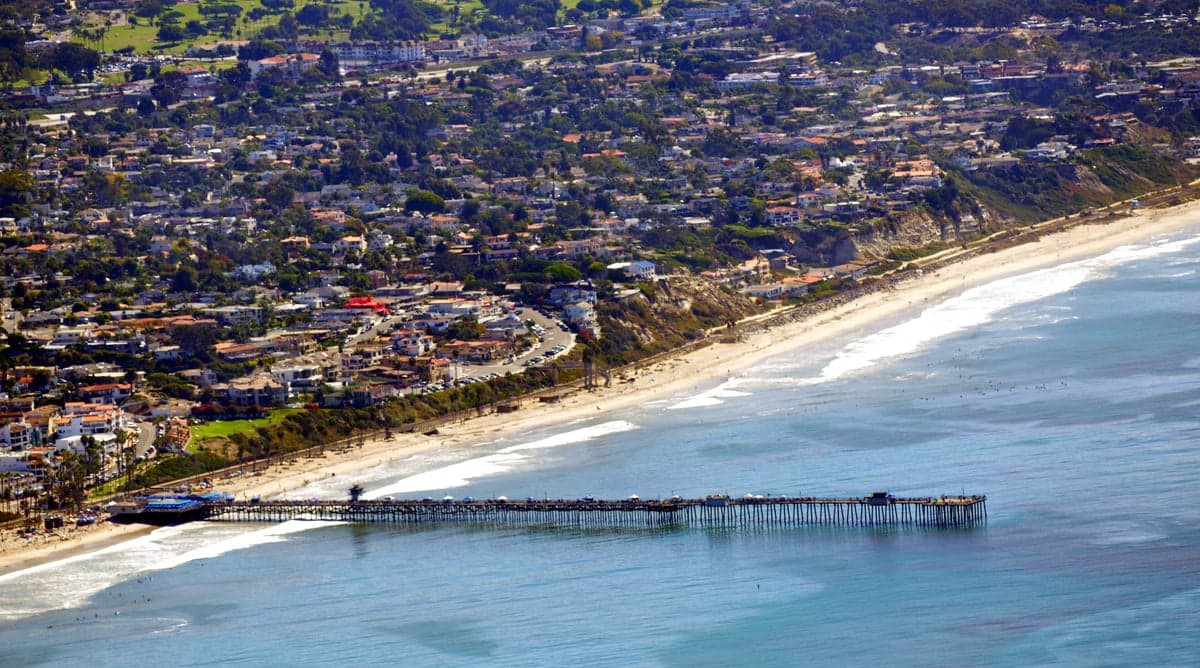
Photo: Wikipedia
Personal Sovereignty in San Clemente, CA
Moderate friction. Expect trade-offs in some aspect of personal liberty and independence.
What does Personal Sovereignty tell us?
Personal Sovereignty measures your capacity for self-reliance and independence with minimal government friction. Higher scores mean fewer barriers between you and the way you want to live... but it assumes you have the space you need and good neighbors.
What does this tell us?
Personal Sovereignty measures your capacity for self-reliance and independence with minimal government friction. Higher scores mean fewer barriers between you and the way you want to live... but it assumes you have the space you need and good neighbors.
State Policy
Energy independence: Importer (33% of energy produced in-state)
Personal Liberty
Homesteading

Personal Liberty Analysis
San Clemente offers a mixed personal sovereignty environment where California’s heavy state-level regulatory hand meets a distinctly more conservative local culture and geography that can support certain forms of autonomy. For a single individual or family prioritizing independence, the city provides meaningful opportunities in self-defense rights, property control, and lifestyle choice—but only within the firm boundaries set by Sacramento. Understanding where the friction points lie is essential before relocating here, as the tradeoffs between coastal quality of life and personal freedom are sharper than in most other parts of the country.
Tax burden and regulatory posture in San Clemente
California’s tax and regulatory framework is the single largest constraint on personal sovereignty in San Clemente. The state’s top marginal income tax rate of 13.3% applies to earnings over $1 million, but even middle-income households face a combined state and local tax burden that ranks among the highest nationally. Sales tax in San Clemente is 7.75%, and property taxes are capped at 1% of assessed value under Proposition 13, though annual reassessment upon sale can reset that base. For a family buying a median-priced home near $1.5 million, the annual property tax bill runs roughly $15,000—a significant fixed cost that reduces disposable income for self-directed spending or savings. The regulatory posture extends beyond taxes: California’s California Environmental Quality Act (CEQA) can delay or block home additions, ADU construction, and even minor landscaping changes if they trigger environmental review. San Clemente’s city government is generally more business-friendly than Los Angeles or San Francisco, but it still enforces strict coastal development rules through the California Coastal Commission, which has veto power over any project within the coastal zone—roughly the western half of the city. For someone seeking to build a workshop, install solar panels, or run a home-based business, expect permitting timelines of 6–12 months and fees that can run into the thousands. The net effect is that while San Clemente’s local politics lean center-right, the state apparatus imposes a heavy compliance burden that limits the speed and scope of personal projects.
Self-defense rights and gun law specifics in Orange County
California is a may-issue state for concealed carry, and Orange County—where San Clemente sits—has historically been one of the more permissive counties in the state. As of 2024, the Bruen decision has forced California to move toward shall-issue, meaning that if you meet objective criteria (background check, training course, good moral character), the sheriff should issue a CCW permit. Orange County Sheriff Don Barnes has been publicly supportive of Second Amendment rights, and processing times for CCW applications in the county have dropped to roughly 90–120 days. However, the state’s gun laws remain among the strictest in the nation: California bans assault weapons by feature (pistol grip, collapsible stock, flash suppressor), limits magazine capacity to 10 rounds, requires a 10-day waiting period for all firearm purchases, and mandates a Firearm Safety Certificate. Private party transfers must go through a licensed dealer. Open carry of handguns is prohibited, and open carry of long guns is effectively banned in incorporated areas. For self-defense at home, California law recognizes the Castle Doctrine but does not have a Stand Your Ground statute; a duty to retreat applies outside the home if safe retreat is possible. San Clemente’s low violent crime rate (roughly 1.5 incidents per 1,000 residents) means that defensive firearm use is rare, but for those who prioritize the right to carry, Orange County is one of the better jurisdictions in California to exercise it—though still far more restrictive than Texas, Florida, or Arizona.
Self-reliance and homesteading viability: lot sizes, zoning, and off-grid feasibility
San Clemente’s geography and zoning create a narrow window for self-reliance. The city is built on coastal hillsides with median lot sizes around 6,000–8,000 square feet in most residential neighborhoods, though some older areas near the pier have lots as small as 3,000 square feet. Larger parcels exist in the gated communities of Talega and the Forster Ranch area, where lots can reach 10,000–15,000 square feet, but these are rare and expensive. Zoning is predominantly single-family residential (R-1), which permits vegetable gardens, small livestock like chickens (hens only, no roosters), and beekeeping with a permit. However, goats, pigs, and other large livestock are prohibited on lots under one acre, and virtually no residential parcels in San Clemente meet that threshold. Off-grid living is effectively impossible within city limits: all homes must connect to municipal water and sewer, and the city enforces strict building codes that require grid-tied electrical systems. Solar panels are allowed and even incentivized through net metering, but battery storage for full independence is expensive and subject to permitting. Rainwater catchment is legal but limited to 5,000 gallons of storage without a permit, and greywater systems are allowed only for subsurface irrigation. For a family wanting to grow a significant portion of their own food, raise animals, or disconnect from utilities, San Clemente is not the right location. The nearby unincorporated areas of San Diego County (e.g., Fallbrook, Pauma Valley) offer larger lots and looser zoning, but come with longer commutes and fewer services.
Personal liberties: parental rights, medical autonomy, speech, and property
California law provides strong protections for certain personal liberties while restricting others. Parental rights in education are a flashpoint: the state mandates that schools cannot notify parents if a child changes their gender identity or pronouns without the child’s consent, a policy that has driven some conservative families to seek alternatives. San Clemente is served by the Capistrano Unified School District, which has a conservative-leaning board that has pushed back against state mandates, but state law still preempts local control on this issue. Private and religious schools are available, including St. Michael’s Abbey Preparatory School and several Christian academies, offering an opt-out for families who disagree with district policies. Medical autonomy is similarly mixed: California has broad vaccine mandates for school attendance (including COVID-19 for K-12, though enforcement has been uneven), and the state’s health department tightly regulates alternative medicine. However, the state also protects access to medical marijuana (with a doctor’s recommendation) and has strong patient privacy laws. Free speech is robustly protected under the California Constitution, which provides broader protections than the First Amendment in some areas (e.g., speech in shopping malls). Property rights are constrained by rent control (statewide caps on annual rent increases at 5% plus inflation for buildings over 15 years old) and by the Coastal Commission’s authority over development. For a homeowner, the biggest practical limitation is the inability to freely remodel or expand without extensive permitting—a direct constraint on the right to use one’s property as one sees fit.
Overall, San Clemente offers a moderate level of personal sovereignty relative to other coastal California cities, but it remains a high-regulation environment compared to most of the United States. The tradeoff is access to one of the most desirable climates and coastlines in the country, with a local government that is more aligned with conservative values than the state as a whole. For a family that values self-defense rights and can navigate California’s gun laws, and that is willing to accept high taxes and regulatory friction in exchange for quality of life, San Clemente can work. For those seeking true independence—off-grid living, minimal taxation, or broad parental control over education—the inland states or even the Central Valley will offer a far lighter touch.

* Values derived from national, state, county, city and local statistics and may differ in a specific area. Last updated: 2026-06-08T04:46:24.000Z
Narrative content on this page is AI-generated and may contain mistakes. Verify any details that matter before acting on them.
ReloMaps may earn a commission from affiliate links at no extra cost to you.

