Photo: Wikipedia
Demographics of Salem, OR
Affluence Level in Salem, OR
A middle-class area roughly in line with national averages across income, home values, education, and employment.
People of Salem, OR
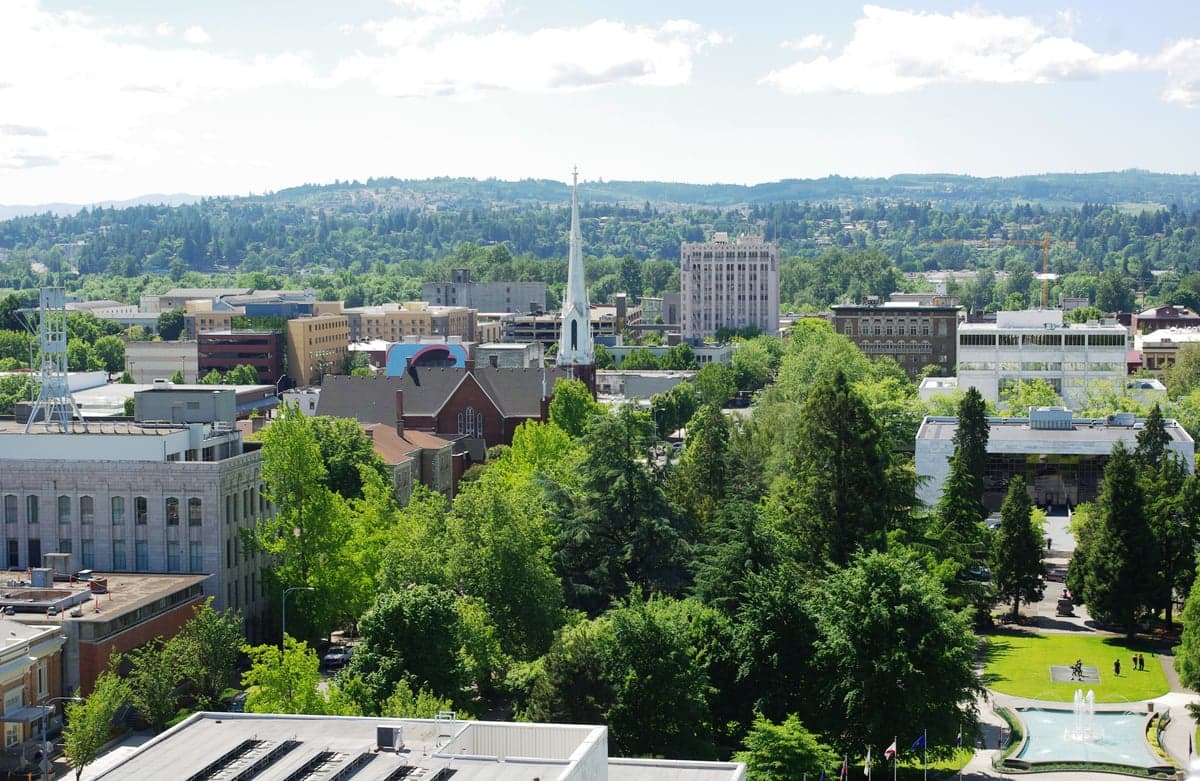
Salem, Oregon, is a city of roughly 177,000 residents that blends a historically white, agricultural-rooted population with a rapidly growing Hispanic community, now at 23.4% of the city. The foreign-born share sits at a modest 7.6%, and the city remains less diverse than the national average, with East/Southeast Asian residents at 2.9%, Black residents at 1.4%, and Indian-subcontinent residents at 0.6%. Salem’s identity is shaped by its role as the state capital, a regional healthcare and education hub, and a working-class city where government employment and food processing anchor the economy.
How the city was settled and grew
Salem was founded in the 1840s by Methodist missionaries who established the Oregon Institute (now Willamette University) on land ceded by the Kalapuya people. The Donation Land Claim Act of 1850 drew white American settlers from the Midwest and Upper South, who established farms in the fertile Willamette Valley. The city became the territorial capital in 1851 and was formally incorporated in 1857. The original white settlers built their homes and businesses in what is now the Historic District around the Capitol and Willamette University, with early commercial activity centered on Commercial Street. A second wave arrived with the railroad in the 1870s, bringing German and Irish immigrants who worked in the hop fields and lumber mills, settling in the Grant Neighborhood and Highland Neighborhood areas. By 1900, Salem was a majority-white city of about 4,000, with a small Chinese community that had built the rail lines and later concentrated near the Riverfront District. The mid-20th century saw growth from state government expansion and the establishment of the Oregon State Hospital, drawing white-collar workers from across the state who settled in the South Salem neighborhoods.
Modern era (post-1965)
The 1965 Hart-Cellar Act opened immigration from Latin America, and Salem’s Hispanic population began growing significantly in the 1980s and 1990s. Migrants from Mexico and Central America were drawn to agricultural work in the surrounding hop, berry, and nursery industries, as well as to food processing plants like the NORPAC (now Seneca Foods) cannery. These families initially settled in the Northeast Salem neighborhoods, particularly around Lancaster Drive and the Northgate area, where affordable housing and proximity to farm work made settlement practical. By 2020, the Hispanic share had risen to over 22%, and these neighborhoods now have a distinctly bicultural character, with Spanish-language signage, Mexican grocery stores, and Catholic parishes serving the community. Domestic in-migration from California and other Western states accelerated after 2000, driven by Oregon’s lower housing costs relative to the Bay Area and Portland. These newcomers, predominantly white and college-educated, have concentrated in West Salem (across the Willamette River) and newer subdivisions in South Salem, contributing to a growing economic and cultural divide between the older, more diverse northeast and the newer, whiter west and south. The East/Southeast Asian community (2.9%) is small but established, with a notable Vietnamese and Filipino presence in the Northeast Salem area, while the Indian-subcontinent population (0.6%) remains tiny and dispersed. The Black population (1.4%) has been historically small and is concentrated in the Highland Neighborhood and near the Salem-Keizer Transit Center.
The future
Salem’s population is projected to grow to roughly 200,000 by 2035, driven by continued domestic in-migration from California and the Portland metro area. The Hispanic share is expected to rise to 28-30% by 2040, as the existing community is relatively young (median age 27 for Hispanics vs. 42 for non-Hispanic whites) and continues to have higher birth rates. This growth will likely intensify the geographic sorting already underway: Northeast Salem and Northgate will become increasingly Hispanic-majority, while West Salem and South Salem will remain predominantly white and more affluent. The East/Southeast Asian and Indian-subcontinent populations are likely to grow slowly, as Salem lacks the tech-sector jobs that attract these groups to Portland or the Silicon Forest. The city is not homogenizing; rather, it is tribalizing into distinct enclaves by ethnicity and income. For a conservative-leaning newcomer, this means choosing a neighborhood that aligns with their preferences: West Salem offers newer homes, lower crime rates, and a more politically mixed environment, while Northeast Salem offers lower housing costs but higher diversity and a more urban feel.
Salem is becoming a city of two halves: a growing, younger, more Hispanic northeast and a whiter, older, more suburban west and south. For someone moving in now, the choice is less about the city as a whole and more about which of these two Salems they want to live in.

* Values derived from national, state, county, city and local statistics and may differ in a specific area. Last updated: 2026-05-02T22:11:54.000Z
Narrative content on this page is AI-generated and may contain mistakes. Verify any details that matter before acting on them.
ReloMaps may earn a commission from affiliate links at no extra cost to you.

