 Popular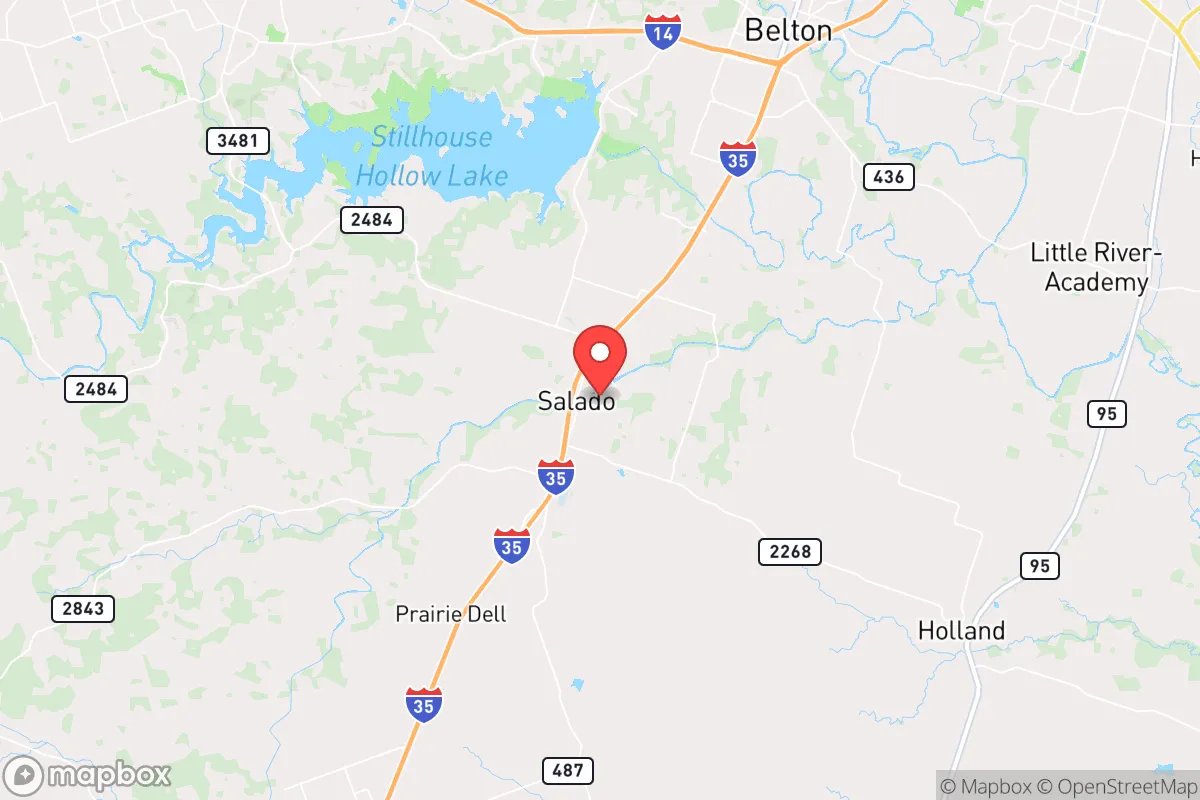
Political ClimatePolitical Climate in Salado, TX
District shown is the primary district for this city’s centroid. Cities may span multiple districts.
Local Political AnalysisPolitical Analysis of Salado, TX
Salado has long been a reliably conservative pocket in Central Texas, and that hasn't changed much over the years. The area sits in a Cook PVI of R+11, which is a solid seven points more Republican than the state of Texas as a whole, which clocks in at R+4. If you look at the voting patterns in Bell County, where most of Salado lies, you'll see a consistent 65-70% Republican vote share in presidential elections, and that trend has only hardened since 2020. The local vibe is deeply traditional, with a strong emphasis on property rights, low taxes, and a "live and let live" attitude that skews heavily toward conservative values.
How it compares
Compared to the rest of Texas, Salado is noticeably more conservative than the state average. The R+11 PVI means it's about as red as places like Midland or the Texas Panhandle, while the state's R+4 rating reflects the growing influence of blue-leaning metros like Houston, Dallas, and Austin. Nearby cities like Georgetown (R+9) and Temple (R+8) are also conservative, but Salado edges them out. The real contrast is with Austin, just 45 minutes south, which has a PVI of D+22. That's a 33-point gap in political lean between two towns that share a highway. In Salado, you'll see Trump signs and "Don't Tread on Me" flags year-round; in Austin, it's a different world entirely. The trajectory here is steady: Salado isn't flipping blue anytime soon, but as more people move from Austin for cheaper land, you do see a slow trickle of more moderate or libertarian-leaning folks who want the rural lifestyle without the hardline party politics.
What this means for residents
For conservative residents, Salado is a comfortable fit. Local government tends to be small and hands-off, zoning is minimal, and the school board and city council races are usually decided by a handful of votes among like-minded candidates. You won't find much pushback on Second Amendment issues or property tax protests. For liberal residents, life is more about finding your niche. There's a small but active group of progressive-leaning folks, often artists or retirees from Austin, who gather at the local coffee shop or the Salado Civic Center for events. They're not silenced, but they know they're in the minority. Politically, it means you can vote your conscience without much social friction, but you won't see many Democratic campaign signs in yards. The real-world impact is on policy: the county tends to fund law enforcement and roads over social programs, and development is kept low-density to preserve the historic village feel.
Culturally, Salado stands apart from much of Texas because of its strong historic preservation ethos. The village has a strict design review board for the historic district, which means no big-box stores or chain restaurants in the core—something you won't find in nearby Belton or Harker Heights. That's a policy distinction that crosses party lines: both conservatives who want to keep things "the way they were" and liberals who value walkable, unique downtowns support it. The local paper, the Salado Village Voice, covers council meetings and school board decisions with a neutral tone, and the annual Salado Christmas Stroll and Scottish Festival are community events where politics takes a back seat. Looking ahead, the biggest political tension will be growth management: as the Austin exurb creep continues, the debate between "keep it small" and "let the market decide" will define local elections for the next decade.

State Political ClimatePolitical Climate in Texas
State Political AnalysisPolitical Environment in the State
Texas has been a solidly Republican state for decades, with a Cook Partisan Voting Index of R+4, but that label masks a dramatic and ongoing shift. The dominant coalition is still conservative, anchored by the sprawling suburbs, rural counties, and the oil-and-gas economy, but the margin has been shrinking in every presidential election since 2012. In 2024, Donald Trump won the state by roughly 9 points, down from 15 points in 2016, driven by explosive growth in the blue-leaning metros of Dallas-Fort Worth, Houston, Austin, and San Antonio. The 10-20 year arc is clear: Texas is becoming more competitive, but it remains a state where Republicans control every statewide office and both legislative chambers, and where the policy agenda is firmly conservative.
Urban vs. rural divide
The political map of Texas is a study in extremes. The state’s five largest metros — Dallas-Fort Worth, Houston, San Antonio, Austin, and El Paso — are the engine of Democratic growth. Harris County (Houston) and Dallas County have flipped from purple to reliably blue over the past decade, while Travis County (Austin) and El Paso County are deep blue strongholds. Bexar County (San Antonio) is trending blue but still competitive. Meanwhile, the vast rural and exurban expanse — from the Panhandle down through West Texas and into the Hill Country — votes overwhelmingly Republican. The real battleground is the suburban ring: Collin County (north of Dallas) and Denton County voted for Trump in 2024 but by narrower margins than in 2020, while Fort Bend County (southwest of Houston) has become a swing county. The political future of Texas hinges on whether these suburbs continue to drift left or hold for the GOP.
Policy environment
Texas’s policy environment is defined by low taxes, light regulation, and a hands-off approach to social issues. There is no state income tax, and property taxes are high but capped by law. The regulatory posture is business-friendly, with no state-level minimum wage above the federal $7.25 and a right-to-work law that weakens unions. Education policy is a flashpoint: the state funds public schools through a complex formula that relies heavily on local property taxes, leading to wide disparities between wealthy and poor districts. School choice — including vouchers and education savings accounts — has been a top legislative priority but has stalled in the House due to rural Republican opposition. Healthcare is largely unregulated; Texas has the highest uninsured rate in the nation, and Medicaid expansion under the Affordable Care Act has been repeatedly rejected. Election laws have been tightened since 2021, with new voter ID requirements, restrictions on mail-in voting, and limits on drive-through and 24-hour voting. The state also has a near-total abortion ban, no exceptions for rape or incest, and a permitless carry law for handguns.
Recent policy direction
The last few legislative sessions have pushed Texas sharply to the right on several fronts. In 2023, the state passed SB 14, a near-total abortion ban, and SB 8, the “heartbeat bill” that allowed private citizens to sue anyone who aids an abortion. On guns, HB 1927 (2021) eliminated the requirement for a license to carry a handgun in public. On education, HB 3979 (2021) and SB 3 (2023) restricted how teachers can discuss race, gender, and current events, and required schools to post all instructional materials online. On parental rights, HB 900 (2023) required age verification for library materials and restricted “sexually explicit” content in schools. On property rights, the state passed SB 147 (2023) banning certain foreign nationals, including citizens of China, Iran, North Korea, and Russia, from buying land near military bases. On voting, SB 1 (2021) banned 24-hour and drive-through voting, added new ID requirements for mail ballots, and gave partisan poll watchers more access. On privacy and surveillance, the state passed HB 1399 (2023) restricting the use of facial recognition by law enforcement. On medical autonomy, the state banned gender-affirming care for minors (SB 14, 2023) and restricted access to puberty blockers and hormone therapy. On speech, the state passed HB 20 (2023) requiring social media platforms to host content they might otherwise remove, though parts of that law have been blocked in court.
Civil unrest & political movements
Texas has seen significant civil unrest and political organizing in recent years. The 2020 protests over George Floyd’s murder in Minneapolis sparked large demonstrations in Austin, Houston, and Dallas, with some turning violent. In response, the legislature passed a law (HB 9, 2021) increasing penalties for rioting and blocking highways during protests. Immigration politics are a constant flashpoint: Governor Greg Abbott’s Operation Lone Star has deployed state troopers and National Guard to the border, bused migrants to Democratic-led cities, and installed razor wire along the Rio Grande. The state has also passed laws (SB 4, 2023) making illegal entry a state crime, though that law is currently blocked by federal courts. Sanctuary city policies are banned statewide. Secession rhetoric has flared among some far-right activists, but it remains a fringe position with no serious political support. Election integrity controversies have been persistent: the 2020 and 2022 elections saw lawsuits over mail-in ballot procedures, and the state’s new voting laws have been challenged in court. A new resident would notice the heavy police presence in border towns like El Paso and the constant political advertising on TV and radio.
Projection
Over the next 5-10 years, Texas will continue to trend purple, but the pace of change depends on who moves in and where they settle. The state is adding roughly 1,000 new residents a day, many from California and the Northeast, and they tend to be younger, more diverse, and more Democratic-leaning. The suburbs of Dallas, Houston, and San Antonio are the key battlegrounds: if they continue to drift left, Texas could become a true swing state by the early 2030s. However, the rural and exurban vote is not shrinking, and the GOP is likely to maintain control of the legislature and statewide offices through redistricting and voter ID laws. The policy direction will remain conservative, but with more internal fights between the business-friendly wing and the social conservative wing. A new resident moving in now should expect a state that is politically competitive but still governed by a Republican majority, with low taxes, limited public services, and a culture of personal liberty that comes with minimal government intervention.
For a new resident, the bottom line is that Texas offers a low-tax, high-freedom environment that appeals to conservatives, but the political landscape is shifting. If you lean right, you’ll find a state that generally aligns with your values, especially on guns, taxes, and regulation. If you lean left, you’ll find a state where your vote matters more than it used to, but where policy will often frustrate you. Either way, the state’s rapid growth means the politics are in flux, and the Texas you move to today may not be the Texas you live in a decade from now.
* Values derived from national, state, county, city and local statistics and may differ in a specific area. Last updated: 2026-07-20T01:51:44.000Z
Narrative content on this page is AI-generated and may contain mistakes. Verify any details that matter before acting on them.
ReloMaps may earn a commission from affiliate links at no extra cost to you.

