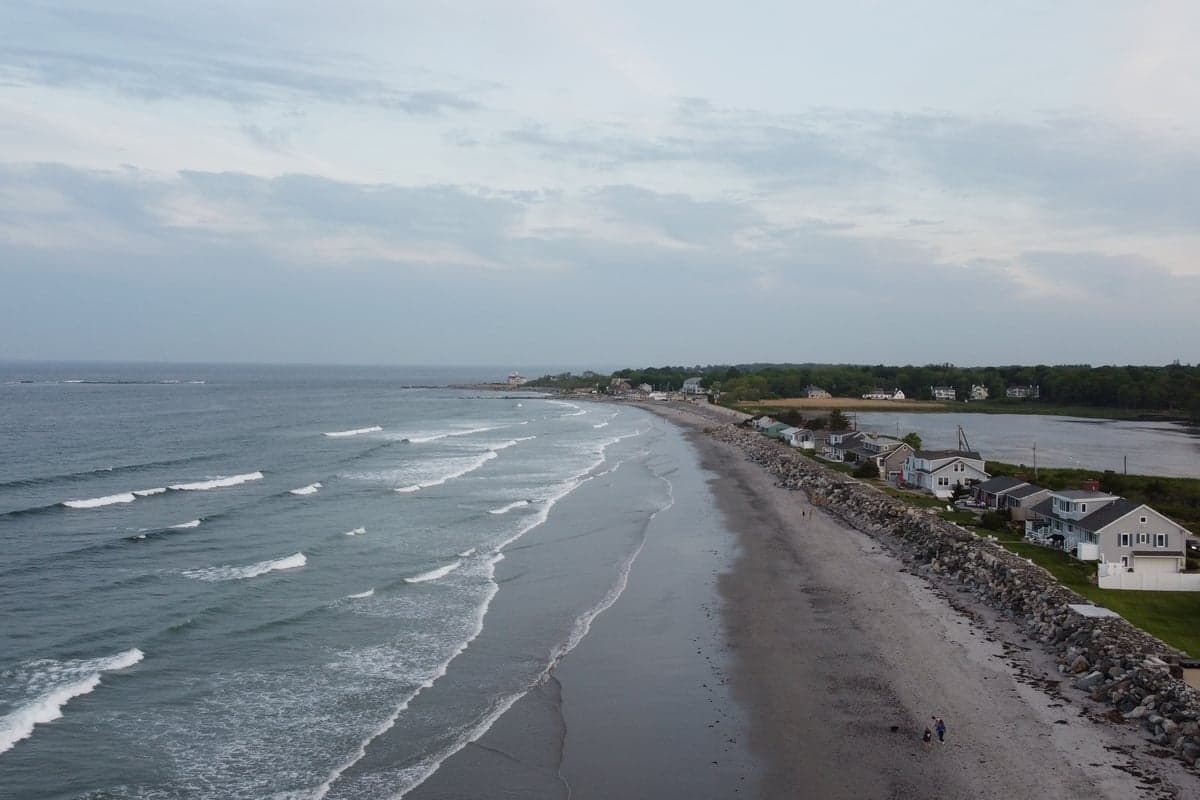
Photo: Wikipedia
Demographics of Rye, NH
Affluence Level in Rye, NH
An upper-middle-class area. Household wealth, education levels, and homeownership run ahead of national benchmarks.
People of Rye, NH
Rye, New Hampshire, is a coastal community of 22,332 residents whose character is defined by deep Yankee roots, a high concentration of college-educated professionals (63.4%), and a population that remains overwhelmingly white (86.7%). The town’s identity is a blend of historic fishing and farming heritage with modern affluence, shaped by its rocky Atlantic shoreline and proximity to Portsmouth. Despite its small size, Rye is not a monolithic suburb; distinct neighborhoods reflect different eras of settlement and the people who built them.
How the city was settled and grew
Rye’s earliest European settlers arrived in the 1620s and 1630s as part of the Great Migration from England, drawn by the promise of cod fishing, salt marsh haying, and land grants from the Masonian proprietors. The town was officially incorporated in 1726, carved out of what was then part of Newcastle and Greenland. These first families—the Randalls, the Philbricks, the Lockes—were subsistence farmers and fishermen who clustered along the protected harbor at Rye Harbor and the rocky coves of Odiorne Point, where the remains of their stone walls and cellar holes still dot the landscape. The interior of town, particularly around Central Road and Washington Road, was settled by second- and third-generation descendants who cleared upland farms for sheep and hay, creating a dispersed pattern of homesteads that persists today.
Through the 18th and 19th centuries, Rye remained a small, insular farming and maritime community. The population grew slowly, with many young men leaving for the sea or for the mills of nearby Dover and Manchester. A significant wave of Irish immigrants arrived in the 1840s and 1850s, fleeing the Potato Famine, and many settled in the modest homes and boarding houses near Rye Beach, where they worked as domestic servants for the wealthy summer families who were beginning to build grand hotels along the shore. By the early 20th century, the summer colony had transformed the beachfront, with wealthy Boston and New York families erecting shingle-style "cottages" along Ocean Boulevard, while the year-round population remained concentrated in the older inland neighborhoods.
Modern era (post-1965)
The post-1965 period brought the most significant demographic change in Rye’s history, driven not by immigration but by domestic in-migration from the Boston metropolitan area. The construction of Interstate 95 in the early 1960s made Rye a commutable suburb for professionals working in Portsmouth, Boston, and the growing high-tech corridor along Route 128. This wave of newcomers—largely white, college-educated managers, engineers, and academics—built new homes on former farmland in the Parsonage Road and Lang Road areas, creating the large-lot subdivisions that now characterize much of the town’s interior. The 1970s and 1980s saw the conversion of many summer cottages along Jenness Beach and Wallis Sands into year-round residences, as telecommuting and the region’s economic boom made coastal living feasible for a broader professional class.
Today, Rye’s foreign-born population is just 4.3%, a figure well below the national average. The largest non-white groups are Hispanic residents at 3.5% and East/Southeast Asian residents at 2.4%, with smaller communities of Indian-subcontinent residents (1.5%) and Black residents (0.7%). These populations are dispersed throughout the town rather than concentrated in any single neighborhood, reflecting the pattern of professional in-migration rather than chain migration. The Indian and East/Southeast Asian residents are predominantly employed in the technology, healthcare, and academic sectors in Portsmouth and the Seacoast region, while the Hispanic population includes both long-established families and newer arrivals working in hospitality, landscaping, and the fishing industry.
The future
Rye’s population is aging, with a median age in the mid-50s, and the town faces the dual pressures of rising property values and limited new housing stock. The demographic trajectory points toward a continued, gradual diversification, though from a very low base. The 2020s have seen modest growth in the Hispanic and Asian populations, driven by the expansion of the Portsmouth Naval Shipyard and the Seacoast’s growing biotech and healthcare sectors, which recruit skilled workers from outside New England. However, the high cost of housing—the median home price exceeds $1 million—means that Rye is unlikely to see significant influxes of working-class immigrants. The more likely scenario is that the town becomes slightly more diverse at the professional level, with Indian and East/Southeast Asian families moving into the newer subdivisions, while the historic Yankee character of the older neighborhoods remains largely intact.
New residential development is concentrated in the few remaining buildable parcels along the Parsonage Road corridor and near the Rye Junior High School area, where a handful of small subdivisions have been approved. The town’s cultural identity is evolving from a summer resort community into a year-round bedroom suburb, with the beachfront now dominated by permanent residents and short-term rentals rather than seasonal families.
For someone moving to Rye today, the town offers a stable, highly educated, and overwhelmingly white community with strong schools and a deep sense of place. The population is not changing rapidly, but it is slowly becoming more diverse at the professional level, and the historic neighborhoods—from the working-class roots of Rye Harbor to the affluent enclaves of Ocean Boulevard—continue to define the town’s character. Expect a community that values its past, manages growth cautiously, and offers a quiet, coastal lifestyle within easy reach of Portsmouth’s amenities.

* Values derived from national, state, county, city and local statistics and may differ in a specific area. Last updated: 2026-10-16T02:09:36.000Z
Narrative content on this page is AI-generated and may contain mistakes. Verify any details that matter before acting on them.
ReloMaps may earn a commission from affiliate links at no extra cost to you.

