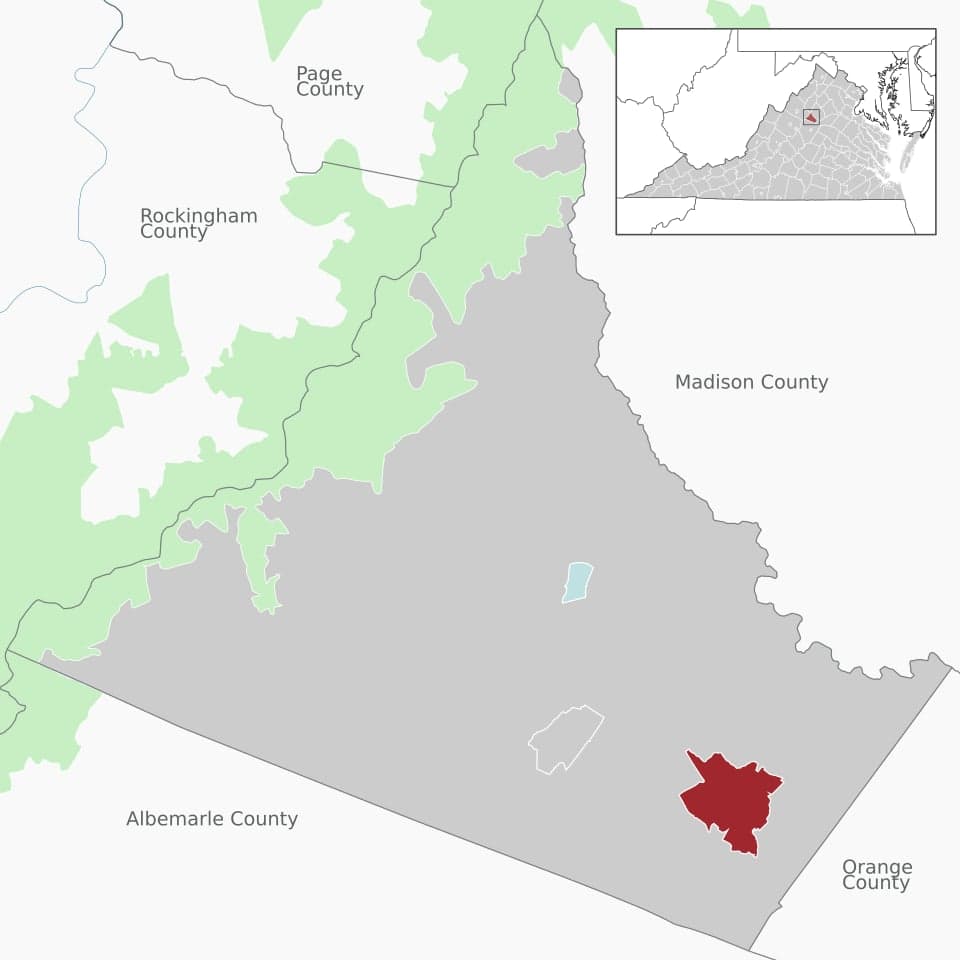
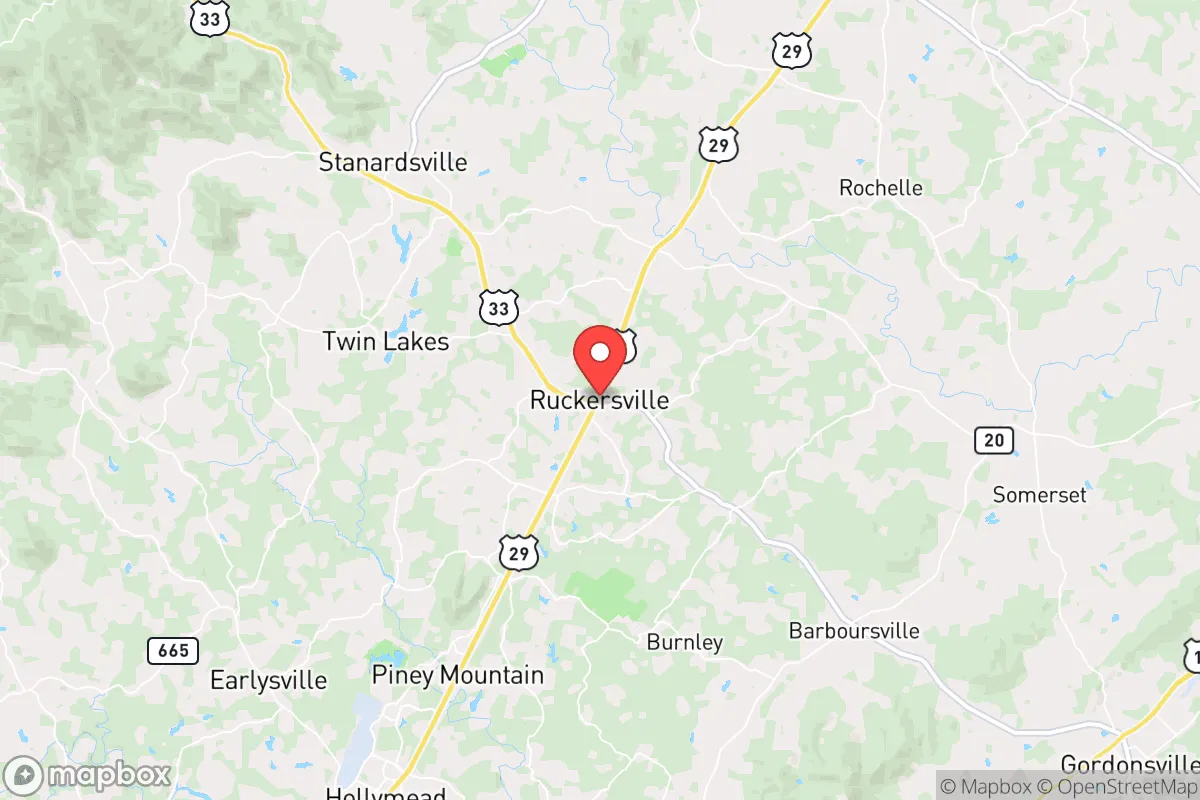
Photo: Wikipedia
Political ClimatePolitical Climate in Ruckersville, VA
District shown is the primary district for this city’s centroid. Cities may span multiple districts.
Inherited from parent state — no local data available.
Local Political AnalysisPolitical Analysis of Ruckersville, VA
Ruckersville sits in a bit of a political sweet spot, leaning slightly Democratic with a Cook PVI of D+2, but it’s noticeably more conservative than the rest of Virginia, which clocks in at D+4. That two-point gap might not sound like much, but it reflects a real tug-of-war here. Over the past decade, the area has shifted leftward as newcomers from Northern Virginia and the D.C. suburbs have moved in, drawn by lower housing costs and the scenic foothills of the Blue Ridge. Still, longtime residents—many of whom farmed or worked in local trades—keep a strong Republican undercurrent alive, especially in local races. If you drive ten minutes north to Madison, you’ll feel a redder vibe; head south toward Charlottesville, and the politics turn noticeably bluer.
How it compares
Compared to Virginia as a whole, Ruckersville is a microcosm of the state’s urban-rural divide. The state’s D+4 rating is pulled heavily by the deep-blue strongholds of Northern Virginia (think Arlington and Fairfax) and the Richmond metro area. Ruckersville, by contrast, is more of a purple patch—its D+2 lean comes from a mix of moderate Democrats and independents who often split tickets. In the 2024 presidential race, Greene County (where Ruckersville is the largest unincorporated community) voted about 52% for the Democratic candidate, while statewide Virginia went roughly 54% Democratic. That 2-point difference shows up in local elections too: county board seats often flip between parties, and school board races can get surprisingly heated over issues like curriculum and funding. Neighboring Albemarle County, home to Charlottesville, is a solid D+8, so Ruckersville feels like a moderate buffer zone.
What this means for residents
For conservative residents, the D+2 lean means you’re not in a deep-blue bubble—your vote still carries weight in local races, and you’ll find plenty of like-minded neighbors at the feed store or the Ruckersville Volunteer Fire Company’s annual barbecue. But you’ll also need to engage with a growing number of progressive voices, especially on issues like land use and school policies. For liberal residents, the D+2 rating means you’re part of a rising tide, but you can’t take victories for granted—turnout matters, and local elections are often decided by a few hundred votes. The practical upshot is that both sides have to show up and talk to each other, which keeps the political climate more civil than in hyper-partisan areas. You won’t see many yard signs for fringe candidates, and the local paper’s letters page tends to focus on potholes and zoning rather than national culture wars.
Culturally, Ruckersville’s political middle ground shows up in its policy choices. The county has resisted some of the more aggressive development pushes seen in Charlottesville, but it’s also approved new subdivisions and a solar farm that drew both support and opposition. There’s a live-and-let-live attitude here—you’ll see Trump flags on one pickup and a “Coexist” sticker on the next, and folks still wave to each other at the intersection of 29 and 33. Looking ahead, the trajectory is likely a slow drift leftward as more remote workers and retirees arrive, but the rural character and independent streak mean Ruckersville will probably stay a few points to the right of Virginia as a whole for the foreseeable future. It’s a place where your politics matter less than whether you show up to help a neighbor haul hay or fix a fence.

State Political ClimatePolitical Climate in Virginia
State Political AnalysisPolitical Environment in the State
Virginia has shifted from a reliably purple swing state to a solidly Democratic-leaning one over the past two decades, with a Cook PVI of D+4. The transformation is driven by explosive growth in the Washington, D.C. suburbs—particularly Fairfax County, Loudoun County, and Prince William County—which now supply enough Democratic votes to outweigh the rest of the state. Meanwhile, the rural south and west remain deeply Republican, creating one of the sharpest urban-rural divides in the country. For a conservative relocator, the practical reality is that state-level power has been in Democratic hands since 2020, but local control varies dramatically depending on which city or county you choose.
Urban vs. rural divide
The political map of Virginia is essentially a tale of two Virginias. The northern Virginia suburbs—Arlington, Alexandria, Fairfax, and Loudoun—are the engine of the state’s Democratic majority. These counties vote by margins of 60-70% Democratic, fueled by a highly educated, diverse, and government-oriented workforce. The Richmond metro area, including Henrico County and the city of Richmond itself, is another Democratic stronghold, while Virginia Beach and the Hampton Roads area are more competitive but trending left. In contrast, the rural Southside and Southwest Virginia—places like Danville, Martinsville, and the coal country around Wise County—vote 70-80% Republican. The I-95 corridor from D.C. to Richmond is the political spine; everything west of it is a different world. A notable flip: Loudoun County, once a Republican bastion, went from voting for George W. Bush by 20 points in 2004 to supporting Joe Biden by 25 points in 2020, making it the fastest-suburbanizing county in the nation politically.
Policy environment
Virginia’s tax structure is moderate compared to other states. The state income tax is a flat 5.75% (down from 5.75% in 2023, but still flat), and the sales tax is 5.3% (higher in some localities). Property taxes are set locally and vary widely—Loudoun County has rates around $1.20 per $100 of assessed value, while rural Halifax County is under $0.60. There is no state-level property tax. Education policy is a major battleground: Virginia has seen heated fights over school curriculum, transgender policies, and parental notification laws. The state’s regulatory posture is business-friendly in some areas (right-to-work state, no state-level minimum wage above federal) but increasingly progressive on environmental and labor issues. Election laws are relatively accessible: no-excuse absentee voting, same-day registration, and early voting are all in place. Virginia has no voter ID law requiring a photo ID; a utility bill or bank statement suffices.
Recent policy direction
Over the last five years, Virginia has moved decisively left on several fronts. In 2020, Democrats passed the Virginia Clean Economy Act, mandating 100% carbon-free electricity by 2050. In 2021, the state abolished the death penalty. On gun policy, Virginia enacted universal background checks, a "red flag" law (extreme risk protective orders), and a one-handgun-per-month limit in 2020—though a 2023 court ruling struck down the handgun limit. On education, Governor Glenn Youngkin (R) pushed through a Parental Bill of Rights in 2022, requiring schools to notify parents of sexually explicit content and allowing them to opt their children out. On abortion, Virginia remains a regional outlier: abortion is legal up to 26 weeks, with a 24-hour waiting period and parental consent for minors. No new restrictions have passed since the 2022 Dobbs decision, and Democrats have blocked Youngkin’s proposed 15-week ban. On voting, the state expanded no-excuse absentee voting and same-day registration in 2020. For a conservative relocator, the key takeaway is that state-level policy is a mixed bag: gun rights have been curtailed, but parental rights and school choice have gained ground under Youngkin.
Civil unrest & political movements
Virginia has been a flashpoint for political activism on both sides. The 2017 Unite the Right rally in Charlottesville remains a national symbol of far-right extremism and sparked a statewide debate over Confederate monuments. In 2020, Richmond saw massive Black Lives Matter protests, with the Robert E. Lee statue becoming a focal point until its removal in 2021. On the right, the Loudoun County parental rights movement erupted in 2021-2022 over school policies on transgender students and critical race theory, propelling Youngkin to the governorship. Immigration politics are less heated than in border states, but northern Virginia has several sanctuary jurisdictions—Fairfax County and Arlington limit cooperation with ICE. Election integrity remains a live issue: Youngkin’s 2021 win was narrow (2 points), and his administration purged 3,400 non-citizens from voter rolls in 2023, a move that drew both praise and lawsuits. A new resident in northern Virginia will see political yard signs and bumper stickers year-round; in rural areas, the culture is more quietly conservative.
Projection
Over the next 5-10 years, Virginia’s Democratic lean is likely to deepen. The D.C. suburbs continue to grow faster than the rest of the state, and in-migration from blue states (New York, California) reinforces the trend. The 2021 gubernatorial election was a Republican outlier, driven by parental backlash and a strong candidate; the 2023 legislative elections saw Democrats retake the House of Delegates and hold the Senate. The state’s electoral college votes are almost certainly staying Democratic for the foreseeable future. However, the rural-urban divide will widen, meaning that a conservative moving to Fredericksburg or Roanoke will find a very different political environment than one moving to Arlington. The key wildcard is whether the Democratic coalition fractures over economic or cultural issues—but for now, the trend is clear.
For a new resident, the bottom line is that Virginia offers a politically bifurcated experience. If you choose northern Virginia or Richmond, you’ll be in a blue bubble with progressive policies on taxes, education, and guns. If you choose a rural county like Augusta or Bedford, you’ll live under conservative local governance but still be subject to state-level laws you may disagree with. The state’s overall trajectory is leftward, but the pace is gradual, and local control remains strong. For a conservative family, the best bet is to target a red-leaning county within commuting distance of a job center—places like Spotsylvania County or Hanover County—where you can enjoy Virginia’s natural beauty and economic opportunity without feeling politically isolated.
* Values derived from national, state, county, city and local statistics and may differ in a specific area. Last updated: 2026-09-10T03:03:18.000Z
Narrative content on this page is AI-generated and may contain mistakes. Verify any details that matter before acting on them.
ReloMaps may earn a commission from affiliate links at no extra cost to you.

