Photo: Wikipedia
Demographics of Ruckersville, VA
Affluence Level in Ruckersville, VA
A middle-class area roughly in line with national averages across income, home values, education, and employment.
People of Ruckersville, VA
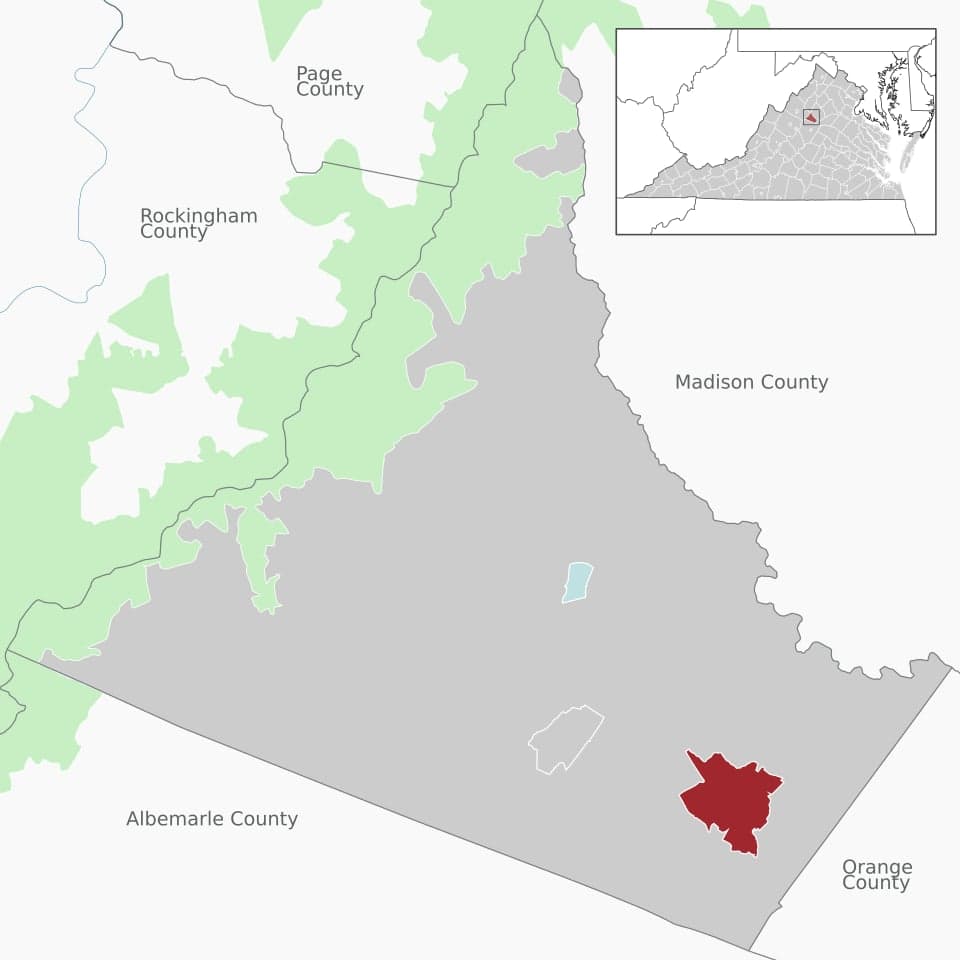
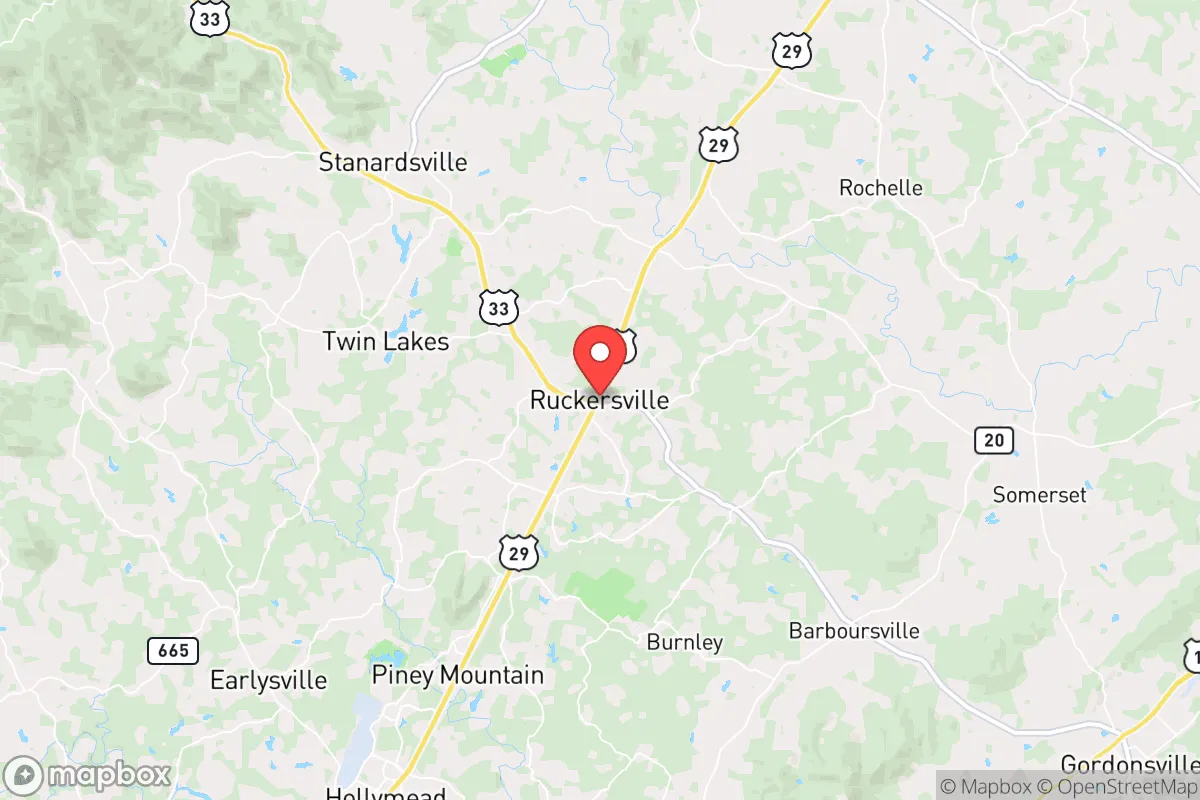
Today, Ruckersville, Virginia is a small, rapidly diversifying crossroads community of 1,314 residents, where a historically white rural population is being reshaped by significant Hispanic and Black growth. The town’s character is defined by its position along U.S. Route 29, blending agricultural roots with new suburban-style subdivisions and a growing service economy. With a 42.2% college-educated rate and a foreign-born population of 4.3%, Ruckersville attracts both families seeking affordable land and commuters working in Charlottesville and Culpeper. The population is notably younger and more ethnically mixed than Greene County’s historical average, giving the area a distinct, evolving identity.
How the city was settled and grew
Ruckersville’s population history begins with European settlers moving inland from the Tidewater region in the mid-1700s, drawn by land grants along the Rapidan River watershed. The community was named after the Rucker family, early landowners who established farms and a tavern at the intersection of what is now U.S. 29 and U.S. 33. For most of the 19th and early 20th centuries, the population was almost entirely white, Anglo-Saxon, and Protestant, living on dispersed family farms. The original settlement core, now referred to as Old Ruckersville around the Ruckersville General Store, was the commercial and social hub for these farming families. A small number of Black families, many descended from enslaved laborers on pre-Civil War plantations, established a separate community in the Simmons Gap area to the east, where a historic African American church and cemetery remain. The arrival of the railroad in the late 19th century bypassed Ruckersville proper, which slowed growth and kept the population small and homogeneous through the 1950s.
Modern era (post-1965)
The post-1965 period brought the first major demographic shifts. The 1965 Immigration and Nationality Act opened doors for new immigrant groups, but Ruckersville’s transformation was initially driven by domestic migration: white families from Northern Virginia seeking cheaper land and a slower pace, settling in new subdivisions like Lakeview Estates and Greene Acres along the Route 29 corridor. The most dramatic change began in the 1990s and accelerated after 2000, as Hispanic workers—primarily from Mexico and Central America—moved into the area for jobs in construction, landscaping, and poultry processing. Today, Hispanic residents make up 26.8% of the population, a share that has grown from near zero in 1990. They are concentrated in the Ruckersville Mobile Home Park and in rental duplexes along Seminole Trail, forming a tight-knit community with several Spanish-language churches and tiendas. The Black population, now 13.0%, has grown more slowly, driven by Black families moving from the Washington, D.C. metro area for lower housing costs; they are dispersed across newer subdivisions like Mountain View Estates rather than concentrated in a single neighborhood. East and Southeast Asian residents (1.4%) are a small but visible presence, primarily professionals working in healthcare and tech who commute to Charlottesville. The Indian subcontinent population is 0.0%, meaning no measurable community exists.
The future
Ruckersville’s population is becoming more diverse and more suburban, with the Hispanic share projected to continue rising as families grow and new arrivals are drawn by existing social networks and affordable housing. The white share, while still a majority at 58.8%, is declining as older residents age out and younger white families are priced out of the Charlottesville market but still find Ruckersville relatively affordable. New development is concentrated in the Ruckersville Crossing area, a mixed-use zone near the intersection of U.S. 29 and U.S. 33, where townhomes and apartment complexes are replacing older single-family homes. This area is likely to absorb most future growth, becoming more ethnically mixed and less rural in character. The foreign-born share (4.3%) is low compared to Northern Virginia but is expected to rise modestly as immigrant families already in the area sponsor relatives. The next 10-20 years will likely see Ruckersville become a denser, more diverse commuter suburb, with a cultural identity that blends its rural Southern past with a growing Latino influence.
For someone moving in now, Ruckersville offers a small-town setting with increasing diversity, a strong sense of local community, and proximity to Charlottesville’s jobs and amenities. The population is shifting from a historically white, agricultural base to a more multi-ethnic, suburban mix, with Hispanic and Black communities becoming permanent and visible parts of the town’s fabric. This is a place in transition, where newcomers will find both the stability of established neighborhoods and the dynamism of a community that is still defining its modern identity.

* Values derived from national, state, county, city and local statistics and may differ in a specific area. Last updated: 2026-09-10T03:03:18.000Z
Narrative content on this page is AI-generated and may contain mistakes. Verify any details that matter before acting on them.
ReloMaps may earn a commission from affiliate links at no extra cost to you.

