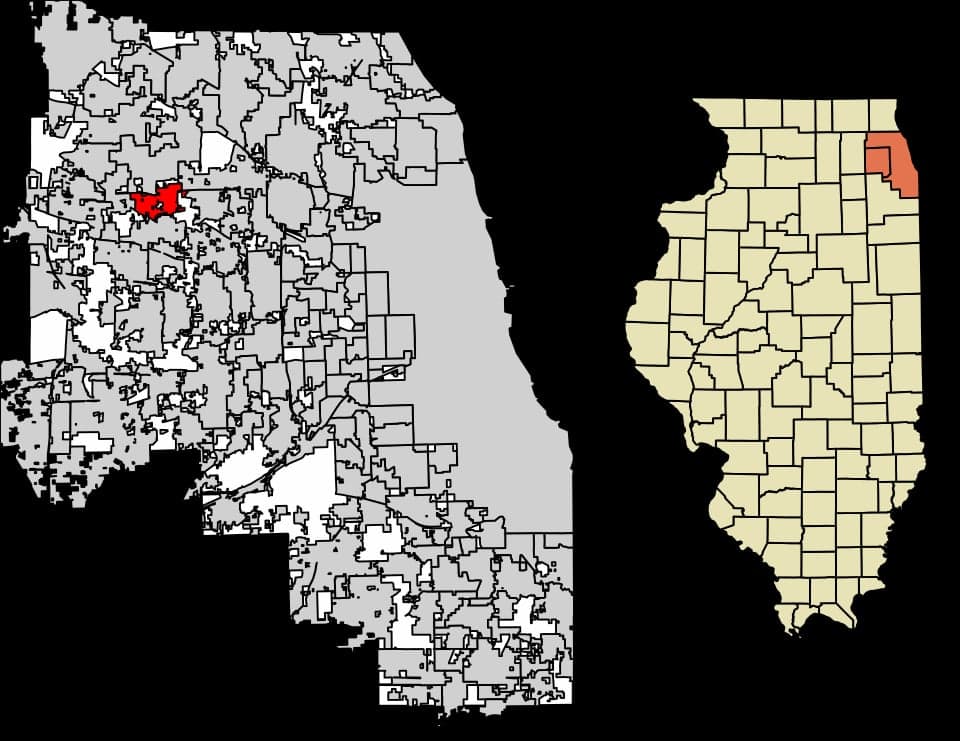
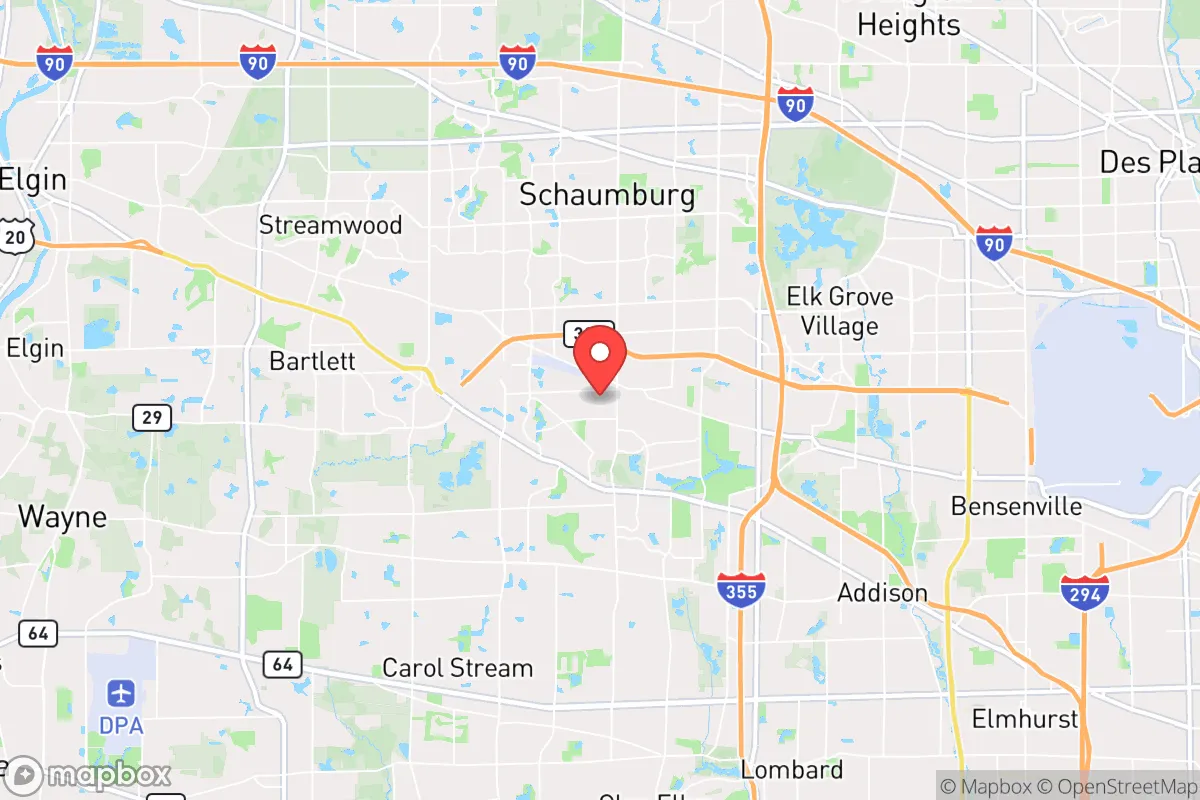
Photo: Wikipedia
Political ClimatePolitical Climate in Roselle, IL
District shown is the primary district for this city’s centroid. Cities may span multiple districts.
Political rankings in Illinois
- Most Conservative Cities in Illinois
- Most Liberal Cities in Illinois
- Best Liberal-Leaning Towns in the Midwest
- Safest Liberal-Leaning Towns in the Midwest
- Safest Conservative-Leaning Towns in the Midwest
- Affordable Small Towns for Conservatives
- Most Affordable Liberal-Leaning Small Towns in the U.S.
- Safest Conservative-Leaning Cities in the U.S.
- Most Conservative Counties in Illinois
- Most Liberal Counties in Illinois
Local Political AnalysisPolitical Analysis of Roselle, IL
Roselle leans reliably Democratic, but it’s not as deep blue as you might expect for a Chicago suburb. The area’s Cook PVI of D+5 puts it a couple notches to the right of Illinois as a whole (D+7), and that gap has been pretty stable over the last few cycles. In 2024, the village and its surrounding DuPage County precincts voted about 54-44 for the Democratic presidential candidate, which is a slightly tighter margin than the statewide 56-42 split. If you’ve lived here a while, you’ve probably noticed the shift: Roselle used to be a swing town in the 90s and early 2000s, often going for the winner, but over the last decade it’s settled into a comfortable but not overwhelming Democratic lean. The trend is toward the left, but it’s gradual—driven more by new families moving in from the city and changing demographics than by any dramatic local event.
How it compares
Compared to Illinois as a whole, Roselle is a slightly more moderate version of the state’s blue tilt. The D+5 PVI means it’s less Democratic than Cook County’s core (think Chicago proper or Evanston, which are D+20 or deeper) but also less Republican than the collar counties’ western fringe. Drive 15 minutes west to Bloomingdale or Hanover Park, and you’ll find similar D+4 to D+6 territory. But head 10 miles north to Lake Zurich or Barrington, and you’re in R+5 to R+8 country—a real contrast. Roselle’s political identity sits right at the border of DuPage and Cook counties, and that geography matters: the DuPage side tends to be more purple, while the Cook side pulls it left. In practice, this means local elections are often decided by a few hundred votes, and you’ll see a mix of yard signs for both parties during midterms.
What this means for residents
For liberal residents, Roselle is a comfortable place to live without feeling like an echo chamber. You’ll find plenty of neighbors who share your views, and the village government tends to lean progressive on issues like transit funding (the Metra station is a big deal) and environmental initiatives. But you won’t get the intense activism you’d see in Oak Park or Evanston. For conservative residents, the reality is that you’re in a blue-leaning area, but it’s not hostile. The local school board and village council have had Republican members in recent years, and issues like property taxes and development often get bipartisan attention. The key is that Roselle’s politics are pragmatic: people care more about the train schedule and the school ratings than national culture wars. You can be a vocal conservative here and still have good relationships with your neighbors—it’s not the kind of place where people put up political signs in their front yards and get into arguments.
One cultural distinction that sets Roselle apart from deeper-blue suburbs is its relationship with local government. The village has a strong tradition of fiscal conservatism, even from Democratic officials—the property tax rate is among the lowest in DuPage County, and there’s a real reluctance to raise fees or expand services without a clear vote. That’s a holdover from the town’s more moderate past, and it means both parties tend to campaign on efficiency rather than ideology. Looking ahead, the trajectory is likely to continue its slow drift left as the population gets younger and more diverse, but don’t expect a sudden flip. Roselle is the kind of place where the political climate changes at the pace of a Metra train—steady, predictable, and rarely surprising.

State Political ClimatePolitical Climate in Illinois
State Political AnalysisPolitical Environment in the State
Illinois is a reliably Democratic state at the statewide level, with a Cook PVI of D+7, but that number masks one of the most dramatic urban-rural political chasms in the country. The Democratic coalition is overwhelmingly powered by Chicago and its inner suburbs, while the rest of the state—from the Mississippi River towns to the southern tip—has shifted hard toward the GOP over the past two decades. The result is a state where statewide Democrats win by running up the score in Cook County, while Republicans hold near-total dominance in the 96 other counties, creating a political reality that feels like two different countries under one capitol dome.
Urban vs. rural divide
The political map of Illinois is essentially a story of Chicago versus everywhere else. Cook County alone casts about 40% of the state's votes, and it delivers margins of 60-70% for Democrats, effectively deciding every statewide election before the rest of the state is counted. The collar counties—DuPage, Lake, Kane, McHenry, and Will—were once Republican strongholds but have trended blue over the last decade, with DuPage County flipping to Biden in 2020 after voting for Trump in 2016. Meanwhile, downstate regions like the Metro East area around St. Louis, the Quad Cities, and the southern counties around Carbondale have moved sharply right. Counties that voted for Obama in 2008—like Madison, St. Clair, and Rock Island—now vote Republican by double digits. The rural western counties along the Mississippi, such as Hancock and Adams, are now reliably +30 to +40 Republican. The divide is so stark that a resident of Chicago's Lincoln Park neighborhood and a farmer near Effingham live under the same state government but experience entirely different political cultures.
Policy environment
Illinois has a progressive tax structure—a flat income tax rate of 4.95% after voters rejected a graduated income tax amendment in 2020—combined with the second-highest property tax burden in the nation, driven largely by school funding and pension obligations. The state's regulatory posture is generally business-friendly in name but heavy in practice, with a minimum wage of $14 per hour (rising to $15 in 2025) and strict environmental regulations. Education policy is dominated by the Chicago Teachers Union, which wields significant influence in Springfield; the state has a universal pre-K program and a school funding formula that directs more money to low-income districts. Healthcare is broadly accessible, with Illinois expanding Medicaid under the ACA and maintaining a state-based insurance exchange. Election laws are among the most liberal in the Midwest: no-excuse mail voting, automatic voter registration, and same-day registration are all in place. For a conservative relocator, the policy environment feels like a blue-state baseline with a few notable exceptions—the flat tax and relatively low sales tax (6.25% state rate) are less aggressive than in California or New York.
Recent policy direction
The last five years have seen Illinois move decisively in a progressive direction on several fronts. In 2021, the state eliminated cash bail entirely through the Pretrial Fairness Act, making it one of the first states to do so—a move that has sparked ongoing legal challenges and political backlash. On gun policy, Illinois passed a sweeping assault weapons ban in 2023 (HB 5471), prohibiting the sale of many semi-automatic rifles and high-capacity magazines, which is currently being litigated in federal court. Parental rights saw a shift with the 2023 expansion of the Keeping Youth Safe and Healthy Act, which allows minors to access reproductive health services without parental consent. On privacy and surveillance, Illinois has the Biometric Information Privacy Act (BIPA), one of the strictest biometric privacy laws in the country, which has generated a wave of class-action lawsuits against employers. Property rights are constrained by the state's strong eminent domain powers and a landlord-friendly eviction process that was temporarily tightened during COVID. Tax policy remains a flashpoint: the state's pension debt, now over $140 billion, continues to crowd out spending on other priorities and has led to repeated credit downgrades. Voting access has been expanded with the 2023 Elections Omnibus Bill, which mandates drop boxes in every county and allows 16- and 17-year-olds to pre-register. For a conservative weighing these policies, the direction is clearly toward a more regulated, higher-cost environment with less individual discretion on guns and parental consent.
Civil unrest & political movements
Illinois has a history of organized political activism on both sides. The 2020 George Floyd protests in Chicago were among the largest in the country, leading to significant property damage in the Loop and a subsequent debate over police funding that resulted in the city cutting the police budget by $80 million. On the right, the "Illinois Freedom Caucus" in the state legislature has grown more vocal, opposing vaccine mandates and gun restrictions, while grassroots groups like "Awake Illinois" have mobilized around parental rights in school curricula. Immigration politics are a major fault line: Chicago is a sanctuary city, and the state passed the Illinois Way Forward Act in 2021, which limits local law enforcement cooperation with ICE. This has created tension with downstate communities that have seen an influx of migrants bused from Texas, leading to local resolutions opposing sanctuary policies. Election integrity remains a live issue, with Republican activists challenging the state's mail-in voting system and the 2022 gubernatorial race seeing Darren Bailey, a downstate conservative, lose by 12 points while carrying 96 of 102 counties. The most visible flashpoint for a new resident is likely the ongoing debate over crime in Chicago, where the elimination of cash bail has become a central issue in local elections and media coverage.
Projection
Over the next 5-10 years, Illinois's political trajectory points toward continued Democratic dominance at the state level, driven by population growth in the Chicago suburbs and continued out-migration from rural areas. The 2020 census cost Illinois a congressional seat, and the state's population loss is concentrated in downstate counties, which will further dilute rural political power. However, the collar counties are not becoming uniformly blue—places like McHenry County remain competitive, and the GOP could make gains if they nominate more moderate candidates who can appeal to suburban swing voters. The pension crisis is the wild card: if the state's debt continues to grow, it could force either a tax increase or severe service cuts, which might trigger a political realignment. For a conservative moving in, the realistic expectation is that Illinois will remain a blue state with a strong progressive tilt on social issues, but with a robust and vocal conservative minority that holds significant power in local governments outside Cook County. The practical takeaway is that you can live a conservative life in Illinois—in places like Naperville, Peoria, or Quincy—but you will be voting in a state where your vote for president or governor is almost certainly going to the Democratic candidate.
For a new resident, the bottom line is that Illinois offers a high level of public services and infrastructure, but at a cost that is increasingly hard to ignore. If you value strong labor protections, expansive voting access, and a safety net, you'll find a state that delivers. If you prioritize low taxes, gun rights, and local control, you'll find yourself fighting an uphill battle in Springfield. The smart move is to choose your county carefully—your experience in Chicago's Lincoln Park will be radically different from life in a rural county like Effingham, and the state's political divide means your local government may reflect your values even if the state government does not.
* Values derived from national, state, county, city and local statistics and may differ in a specific area. Last updated: 2026-11-27T16:00:46.000Z
Narrative content on this page is AI-generated and may contain mistakes. Verify any details that matter before acting on them.
ReloMaps may earn a commission from affiliate links at no extra cost to you.

