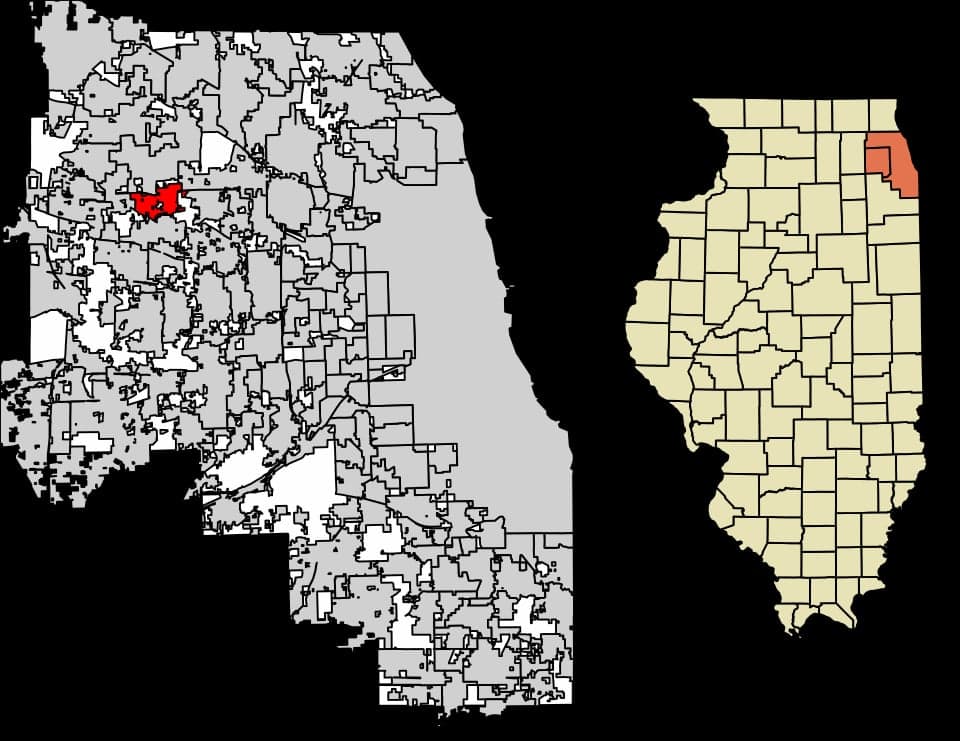
Photo: Wikipedia
Personal Sovereignty in Roselle, IL
Viable for self-reliance. Generally workable, though some barriers may limit total independence.
What does Personal Sovereignty tell us?
Personal Sovereignty measures your capacity for self-reliance and independence with minimal government friction. Higher scores mean fewer barriers between you and the way you want to live... but it assumes you have the space you need and good neighbors.
What does this tell us?
Personal Sovereignty measures your capacity for self-reliance and independence with minimal government friction. Higher scores mean fewer barriers between you and the way you want to live... but it assumes you have the space you need and good neighbors.
State Policy
Energy independence: Importer (63% of energy produced in-state)
Personal Liberty
Homesteading

Personal Liberty Analysis
Roselle, Illinois, offers a mixed personal sovereignty environment that balances the structural advantages of a well-run suburban municipality with the constraints of one of the nation's most heavily regulated states. For a resident prioritizing autonomy, the day-to-day experience is defined by moderate local flexibility within a firm state-level framework—property taxes are high, gun laws are restrictive, and homesteading is limited, but the village government maintains a light touch on routine property use and personal conduct. Understanding where Roselle sits on the spectrum between individual freedom and collective regulation is essential for anyone evaluating relocation here.
Tax burden and regulatory posture: what residents actually pay and face
Roselle's tax burden is the single most significant constraint on personal sovereignty for most residents. The combined property tax rate in DuPage County, where most of Roselle sits, typically falls between 2.0% and 2.5% of assessed value, among the highest in the nation. On a $350,000 home, that translates to roughly $7,000–$8,750 annually. This is not a low-tax jurisdiction by any measure, and the revenue funds a dense network of services—police, fire, schools, parks, and library—that many residents value but that also represent a substantial mandatory transfer of personal resources. The state income tax is a flat 4.95%, and sales tax in Roselle is 9.0% (state 6.25%, county 1.75%, village 1.0%), which is high relative to most of the country. There is no local municipal income tax, which is a modest plus.
On the regulatory side, Roselle's local code is pragmatic rather than intrusive. The village enforces standard suburban zoning and building permits, but does not impose rent control, business licensing hurdles beyond basic requirements, or unusual restrictions on home-based enterprises. The regulatory posture is best described as "moderate compliance"—you will need permits for structural changes and must follow the International Building Code, but the village staff is generally responsive and not adversarial. Illinois state-level regulations are heavier: environmental rules, labor laws, and vehicle emissions testing add layers of compliance that a resident in a state like Texas or Florida would not encounter. For a self-reliant individual, the cumulative effect is a noticeable drag on time and money, but not a barrier to daily autonomy.
Self-defense and gun law specifics: what is legally possible in Roselle
Illinois is a shall-issue state for concealed carry, and Roselle residents must navigate a state-level framework that is among the most restrictive in the Midwest. To carry a concealed firearm, you must obtain a Firearm Owner's Identification (FOID) card from the Illinois State Police, pass a background check, complete 16 hours of certified training (including range time), and then apply for a Concealed Carry License (CCL). The process typically takes 90–120 days. Open carry is illegal in Illinois, and concealed carry is prohibited in a long list of "sensitive places" defined by state law, including public parks, libraries, government buildings, and any establishment that derives more than 50% of its revenue from alcohol sales. Roselle itself does not add local restrictions beyond state law, so the village's posture is neutral—it simply enforces what Springfield mandates.
Magazine capacity is limited to 15 rounds for handguns and 10 for long guns under state law. The state also requires a 72-hour waiting period for long gun purchases and a 24-hour wait for handguns. Private firearm sales between individuals must go through a licensed dealer (FFL) for a background check. Stand-your-ground laws do not exist in Illinois; the state imposes a duty to retreat in public places before using deadly force, unless you are in your home (the Castle Doctrine applies). For a resident who values self-defense autonomy, these restrictions are significant. However, Roselle's crime rates are low—violent crime is roughly 1.5 per 1,000 residents, well below national averages—so the practical need for defensive firearm use is minimal. The trade-off is clear: you can own and carry a firearm, but the process is costly, time-consuming, and circumscribed by law.
Self-reliance and homesteading viability: lot sizes, zoning, and off-grid feasibility
Roselle is a fully built-out first-ring suburb, and the opportunities for serious homesteading or off-grid living are extremely limited. The typical residential lot size is 0.15 to 0.25 acres, with most homes on 50-foot-wide lots. There are no large agricultural parcels within village limits. Zoning is strictly residential (R-1 through R-4), and raising livestock—chickens, goats, or bees—is prohibited in most single-family districts. The village code allows vegetable gardens and small fruit trees without a permit, but any structure like a greenhouse or shed over 120 square feet requires a building permit. Rainwater collection is not regulated locally, but Illinois state law does not restrict it for non-potable uses. Solar panels are permitted by right, though homeowners' associations (HOAs) in some subdivisions may impose aesthetic restrictions.
Off-grid living is effectively impossible within Roselle because the village requires connection to municipal water and sewer for all habitable structures. There is no provision for private wells or septic systems on residential lots under one acre. Composting toilets are not recognized by the building code. For a resident seeking energy independence, grid-tied solar with net metering is the most viable option, and Illinois has a favorable net metering policy (1:1 credit for excess generation). However, the high property tax burden means that any investment in self-reliance infrastructure—solar panels, battery storage, a backup generator—adds to the assessed value of the home, increasing the tax bill. The overall assessment: Roselle is not a homesteading destination. If self-reliance means growing your own food, generating your own power, and managing your own waste, you will need to look at rural areas in McHenry or DeKalb counties, 30–45 minutes west.
Personal liberties: parental rights, medical autonomy, speech, and property
Illinois state law is generally protective of individual liberties in some areas and restrictive in others. On parental rights, Illinois law gives parents broad authority over their children's education, medical decisions, and upbringing, but the state also mandates school attendance until age 17 and requires homeschoolers to provide instruction in specified subjects (language arts, math, science, social studies, health, and physical education). There is no state-level "Parents' Bill of Rights" as seen in some conservative states, but local school boards in Roselle (Community Consolidated School District 54 and Lake Park High School District 108) have not been aggressive in overriding parental preferences. School choice is limited to the assigned public school; there are no charter schools in Roselle, and private school tuition is a significant expense.
Medical autonomy is a mixed picture. Illinois has no state-level restrictions on abortion access, and the state has codified reproductive rights into law. Vaccine mandates for school attendance exist, with medical and religious exemptions available. The state does not have a right-to-try law for experimental treatments, but it does allow medical aid-in-dying (physician-assisted suicide) for terminally ill adults. For a conservative-leaning reader, the medical autonomy environment may feel less aligned with personal choice than in states like Florida or Texas, particularly on vaccine and reproductive issues. Free speech and property rights are robust at the local level. Roselle has no local ordinances restricting political signage beyond standard time-and-size limits, and the village does not regulate peaceful assembly. Property rights are constrained primarily by zoning and the high tax burden, but there is no rent control, no inclusionary zoning mandates, and no local transfer taxes on real estate sales. The village's approach is to enforce clear, predictable rules rather than impose discretionary approvals.
Overall, personal sovereignty in Roselle is a study in trade-offs. The village itself is administratively light-handed, but the state-level tax and regulatory framework imposes significant costs on income, property, and self-defense choices. For a resident who values community services, low crime, and predictable governance, the constraints may feel like a fair price. For someone seeking maximum autonomy—low taxes, permissive gun laws, the ability to live off-grid, and minimal state intervention in medical and educational decisions—Roselle will feel constraining. Compared to a low-regulation state like New Hampshire or Idaho, the sovereignty gap is wide. Compared to other Illinois suburbs, Roselle is average: not the most restrictive, but certainly not a haven for the self-reliant individualist. The best fit is a resident who wants a stable, safe community with good schools and is willing to accept higher taxes and moderate state-level regulation in exchange for those benefits.

* Values derived from national, state, county, city and local statistics and may differ in a specific area. Last updated: 2026-11-27T16:00:46.000Z
Narrative content on this page is AI-generated and may contain mistakes. Verify any details that matter before acting on them.
ReloMaps may earn a commission from affiliate links at no extra cost to you.

