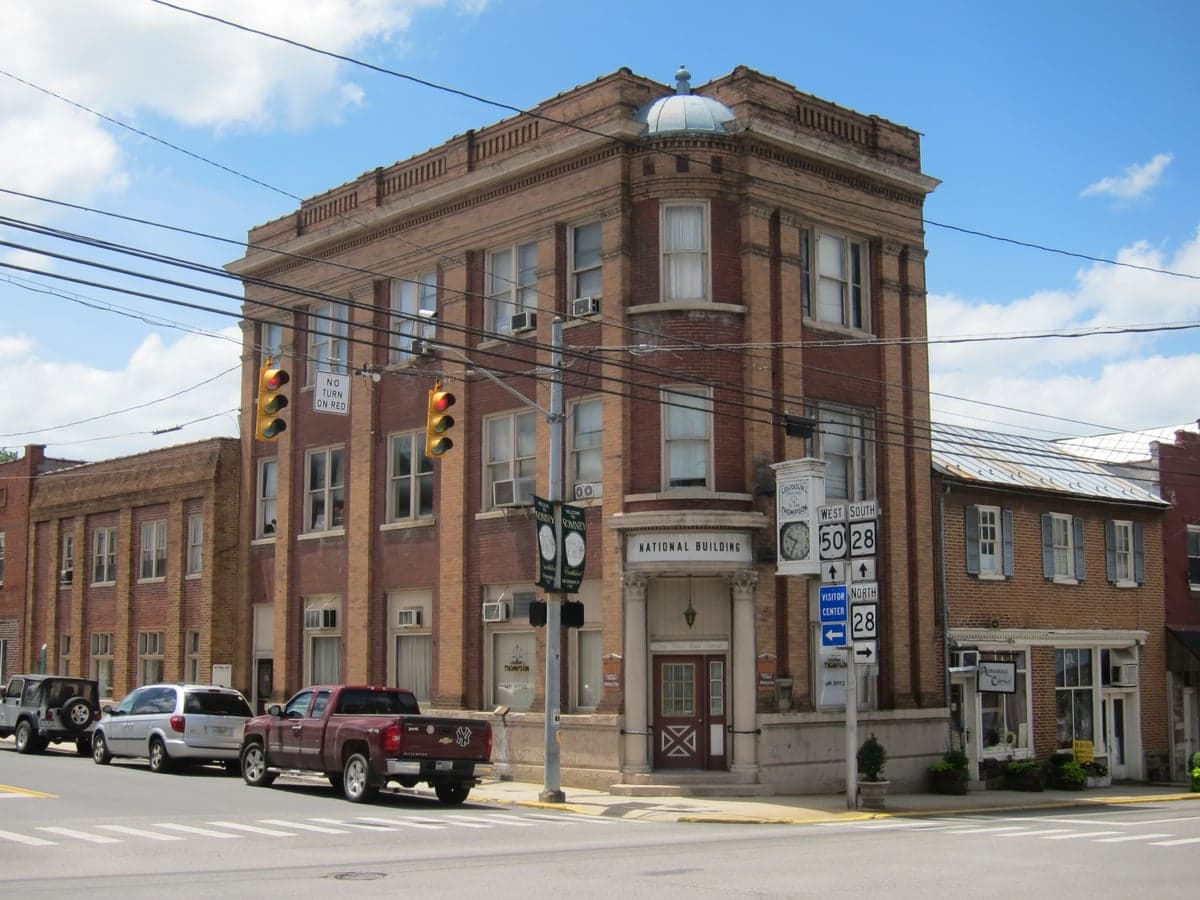
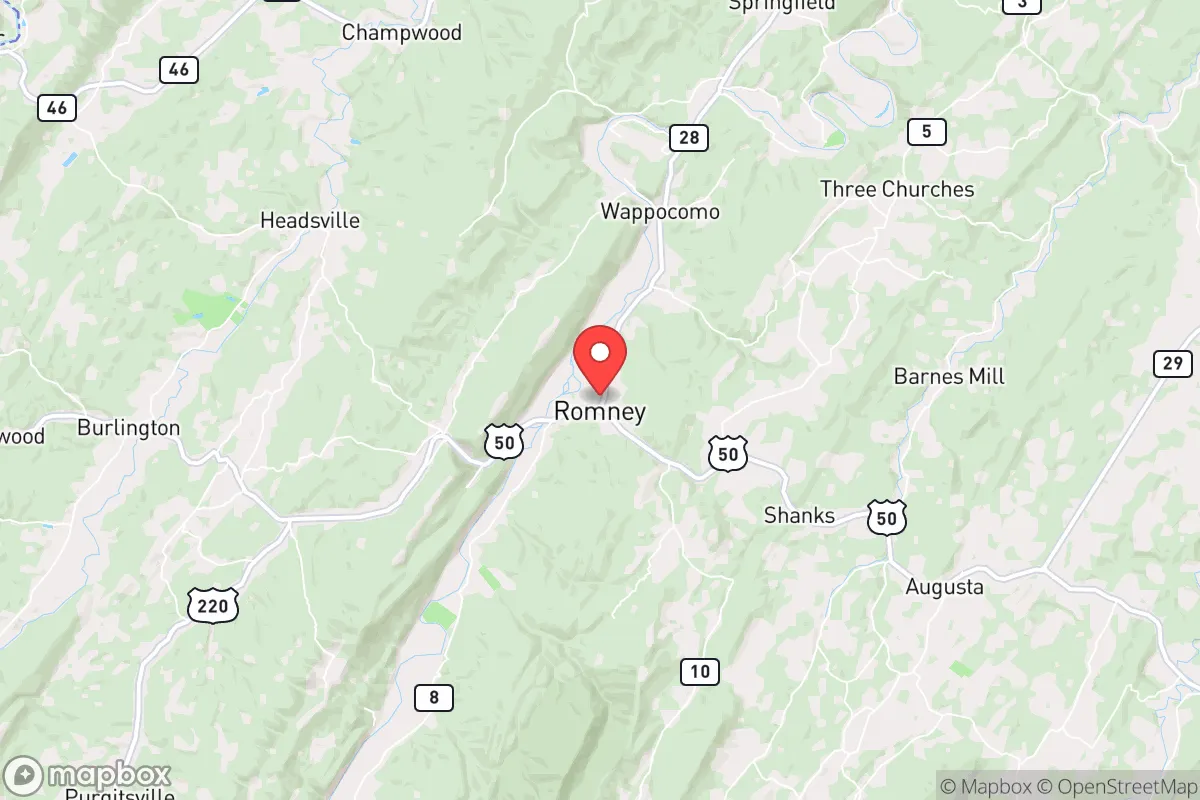
Photo: Wikipedia
Personal Sovereignty in Romney, WV
Strong independent fundamentals that actively favor personal liberty and low regulation.
What does Personal Sovereignty tell us?
Personal Sovereignty measures your capacity for self-reliance and independence with minimal government friction. Higher scores mean fewer barriers between you and the way you want to live... but it assumes you have the space you need and good neighbors.
What does this tell us?
Personal Sovereignty measures your capacity for self-reliance and independence with minimal government friction. Higher scores mean fewer barriers between you and the way you want to live... but it assumes you have the space you need and good neighbors.
State Policy
Energy independence: Net exporter (200% of energy produced in-state)
Personal Liberty
Homesteading

Personal Liberty Analysis
Romney, West Virginia, offers a personal sovereignty environment that is among the most permissive in the Mid-Atlantic region, driven by the state's consistently low tax burden, minimal regulatory footprint, and strong constitutional protections for individual rights. For a relocation audience prioritizing autonomy, the town functions as a practical base where state-level policies—such as no state income tax on Social Security benefits and a right-to-work law—directly reduce dependency on government systems. The surrounding Hampshire County, with its rural character and small-town governance, amplifies this independence by limiting local ordinances that might otherwise constrain property use or daily life. This analysis breaks down the specific factors that make Romney a high-sovereignty choice for single individuals and families seeking maximum personal control.
Tax burden and regulatory posture: How West Virginia's policies reduce government dependency
West Virginia's tax structure is among the most favorable in the nation for those seeking to minimize government extraction from personal income. The state imposes a flat personal income tax rate of 3.99% as of 2026, with no additional brackets for higher earners, and fully exempts Social Security benefits from taxation—a significant advantage for retirees or those planning for later-stage independence. Property taxes are exceptionally low, with effective rates averaging 0.55% of assessed value in Hampshire County, roughly half the national average. There is no state-level sales tax on groceries or prescription drugs, and the general sales tax is a flat 6%. The regulatory posture at the state level is deliberately light-touch: West Virginia is a right-to-work state, meaning no private-sector employee can be compelled to join a union or pay dues as a condition of employment. Occupational licensing requirements are less burdensome than in neighboring states like Maryland or Virginia, particularly for trades such as electrical, plumbing, and HVAC work, where the state offers reciprocity for licenses from many other jurisdictions. Local governance in Romney is minimal—the town has a small council and limited zoning, which translates to fewer permits, fees, and bureaucratic hurdles for home-based businesses, property improvements, or land use changes. For a family or individual, this means more of your earnings stay in your pocket, and fewer layers of government approval are needed to start a business, build a structure, or alter your property.
Self-defense and gun law specifics: Constitutional carry and castle doctrine in practice
West Virginia is one of the most firearm-friendly states in the country, and Romney residents benefit from the full suite of protections. The state has permitless constitutional carry for both open and concealed carry for any law-abiding adult 21 or older (18 for military members). No permit, training, or background check beyond the federal NICS check at purchase is required to carry a firearm in public. The state also has a strong castle doctrine with no duty to retreat in any place where a person is lawfully present, including one's home, vehicle, or place of business. This means that if you are in Romney and face a threat of serious bodily harm or death, you are legally justified in using deadly force without first attempting to flee. Stand-your-ground protections extend to public spaces as well. Magazine capacity is unrestricted, and there is no state-level assault weapons ban. The state preempts local firearm ordinances, so Romney's town council cannot enact its own gun restrictions—what applies in Charleston applies in Romney. For those who want to carry for self-defense while hiking, hunting, or simply going about daily life, the legal environment is unambiguous and supportive. The only notable restriction is that concealed carry is prohibited in certain sensitive locations like courthouses and schools, but signage is required, and penalties for violations are generally civil rather than criminal.
Self-reliance and homesteading viability: Lot sizes, zoning, and off-grid feasibility
Romney's rural character and Hampshire County's land-use policies make it a strong candidate for homesteading and off-grid living. The town itself has limited zoning—primarily focused on commercial districts and basic setback requirements—while unincorporated areas of the county have no county-wide zoning ordinance. This means that on most parcels outside town limits, you can build a home, raise livestock, install solar panels, drill a well, and set up a septic system without needing a special use permit or variance. Minimum lot sizes in the county are generally 1 acre for a single-family home with a septic system, though larger parcels are common and affordable. As of 2026, raw land in Hampshire County averages $3,000–$5,000 per acre, making it feasible to acquire 5–10 acres for a serious homesteading operation. Off-grid living is legally straightforward: the state has no law requiring connection to a municipal power grid, and rainwater collection is permitted without restriction. Solar panel installation is unregulated at the state level, though net metering is available if you choose to remain grid-tied. The county health department handles septic permits, which are generally routine for standard systems. For those raising animals, the county has no livestock density restrictions beyond basic nuisance ordinances, so chickens, goats, sheep, and even cattle are common on small acreages. The primary practical constraint is that the town of Romney does have municipal water and sewer in its core, so if you buy within town limits, you may be required to connect—but outside those boundaries, full self-sufficiency is the norm.
Personal liberties: Parental rights, medical autonomy, speech, and property protections
West Virginia law provides strong protections for parental rights, medical autonomy, and property ownership, which directly enhance personal sovereignty in Romney. The state has a parental bill of rights that affirms parents' authority to direct the upbringing, education, and health care of their children, including the right to opt out of any school curriculum or activity without penalty. Homeschooling is legal with minimal regulation—parents need only submit a simple notice of intent and provide an annual assessment, with no state-mandated curriculum or teacher certification requirements. Medical autonomy is supported by the state's broad health care freedom amendment (Article III, Section 22), which prohibits any law that compels an individual to participate in a health care system or purchase health insurance. This amendment has been interpreted to protect the right to refuse medical treatment and to use alternative therapies, though it does not override standard malpractice laws. Speech protections are robust: West Virginia is a right-to-work state and also has a strong anti-SLAPP statute that protects citizens from frivolous lawsuits intended to silence criticism of government or corporate actions. Property rights are reinforced by the state's eminent domain restrictions, which limit takings to public use projects like roads and schools, and prohibit the seizure of private property for economic development or tax revenue generation. For a family, this means you can raise your children according to your values, make medical decisions without state interference, speak freely about local government, and be confident that your land cannot be taken for a private developer's project.
Overall, Romney's personal sovereignty profile ranks among the highest in the eastern United States for those who prioritize minimal government intrusion. The combination of low taxes, constitutional carry, permissive land-use rules, and strong protections for parental and medical autonomy creates an environment where individual and family independence is the default rather than an exception. Compared to areas in neighboring Maryland, Virginia, or Pennsylvania, where state-level income taxes are higher, gun laws are more restrictive, and zoning is more prescriptive, Romney offers a significantly lighter regulatory touch. For a single individual or family seeking to maximize personal control over finances, self-defense, homesteading, and daily life, this area represents a practical and legally supported choice for a self-reliant lifestyle.

* Values derived from national, state, county, city and local statistics and may differ in a specific area. Last updated: 2026-10-05T19:37:22.000Z
Narrative content on this page is AI-generated and may contain mistakes. Verify any details that matter before acting on them.
ReloMaps may earn a commission from affiliate links at no extra cost to you.

