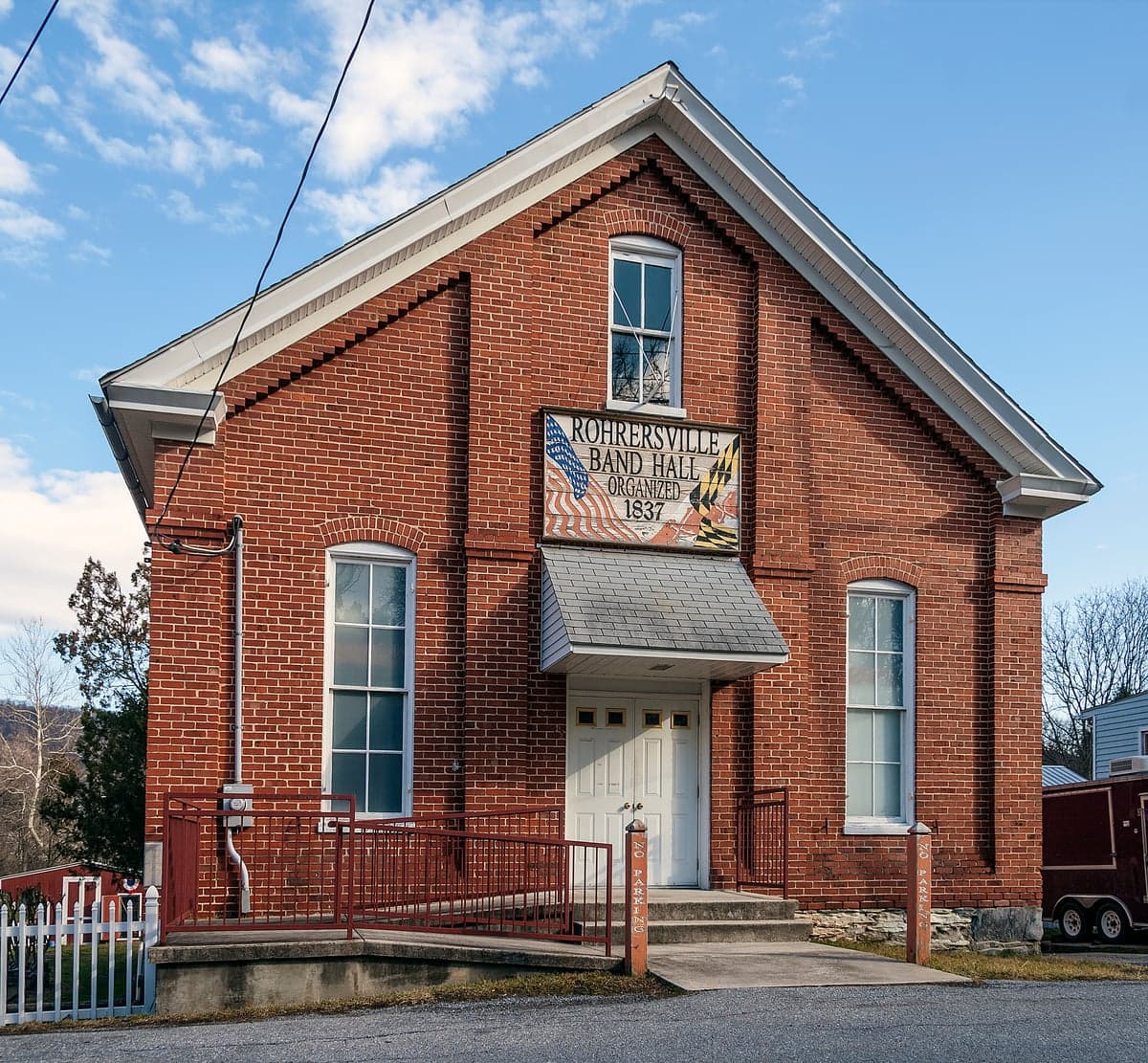
Photo: Wikipedia
Political ClimatePolitical Climate in Rohrersville, MD
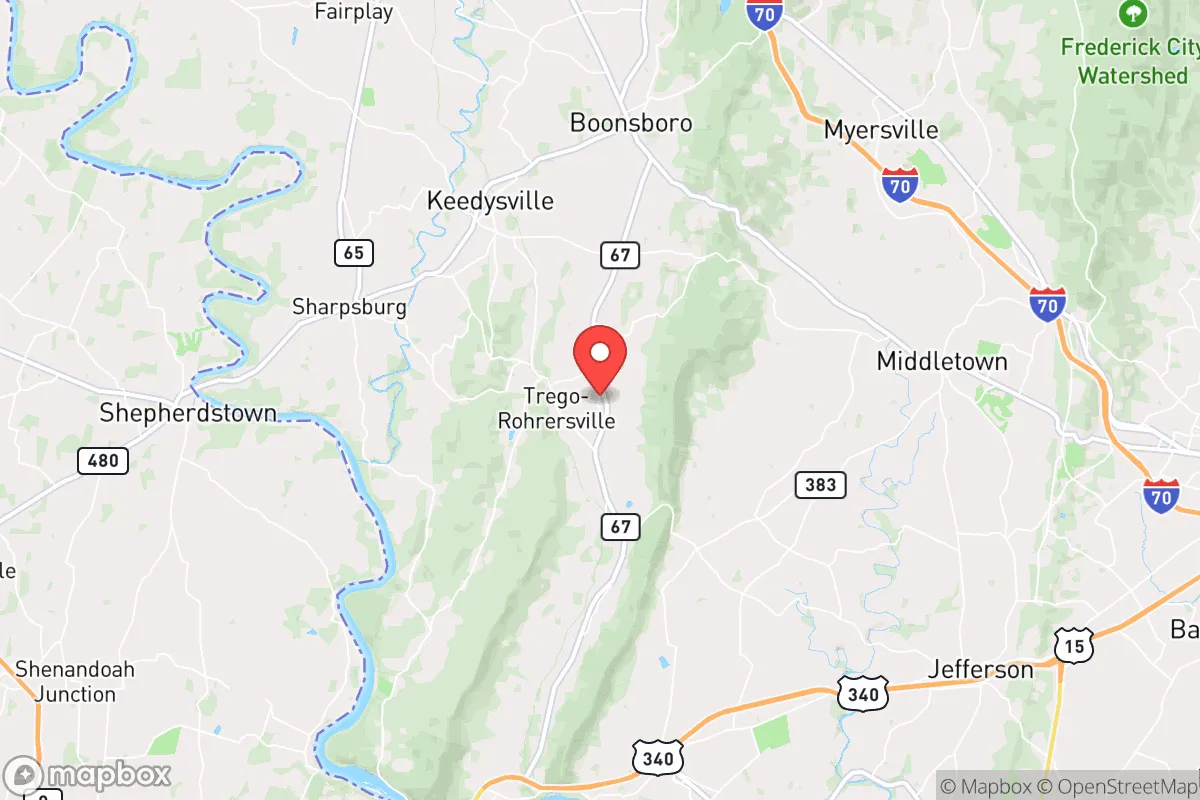
District shown is the primary district for this city’s centroid. Cities may span multiple districts.
Local Political AnalysisPolitical Analysis of Rohrersville, MD
Rohrersville sits in a bit of a political pocket that feels more like a rural crossroads than a typical Maryland suburb. The area leans Democratic, but with a Cook PVI of D+3, it’s a much softer blue than the state as a whole, which sits at D+17. That gap is the whole story: Rohrersville is a place where you’ll find Trump signs next to Harris signs on the same gravel road, and where the local volunteer fire department’s chicken BBQ draws everyone regardless of party. The trajectory here is slow but steady—newcomers from Frederick and Hagerstown are nudging the vote a little bluer each cycle, but the old farming families and second-home owners from Washington County keep it from swinging hard.
How it compares to Maryland’s statewide politics
Maryland as a whole is one of the most reliably Democratic states in the country, driven by the Baltimore-Washington corridor. Rohrersville, by contrast, is closer in spirit to the rural panhandle than to Bethesda or Columbia. Drive 15 minutes east to Boonsboro, and you’ll find a town that votes more Republican than Rohrersville—Boonsboro’s precincts often go +5 to +10 R. Head west to Sharpsburg, and it’s similar. The real contrast is with Frederick City, 20 minutes north, which is solidly D+15 or so, with a young, diverse population and a progressive city council. Rohrersville’s D+3 means it’s a swing precinct in a swing county (Washington County overall is about R+5), so local elections here are genuinely competitive. Statewide, Rohrersville’s vote gets swallowed by the Baltimore suburbs, but locally, it’s a place where a Republican can win a county commission seat and a Democrat can win the school board.
What this means for residents
For a conservative resident, Rohrersville is a comfortable place to live without feeling politically isolated. You’ll find plenty of neighbors who share your views on gun rights, taxes, and development. The local Republican club is active, and the county sheriff’s office is conservative-leaning. You won’t get side-eye for flying a Gadsden flag. For a liberal resident, you’re not in a bubble, but you’re also not in hostile territory. The local Democratic club is small but vocal, and the nearby college town of Frederick offers a progressive outlet. The practical reality is that most local issues—zoning, school funding, road maintenance—don’t break cleanly along party lines. The biggest political fights in recent years have been over a proposed data center campus near Rohrersville, which split both parties between pro-development and anti-sprawl factions.
Culturally, Rohrersville is distinct from the rest of Maryland in a few ways. The area has a strong Civil War history—Antietam Battlefield is five miles away—and that heritage is a point of pride across the political spectrum. You’ll see both “Black Lives Matter” and “Thin Blue Line” flags on the same road, and people mostly get along. The local school, Rohrersville Elementary, is small and community-focused. The biggest policy distinction is land use: Washington County is much more permissive with rural development than Montgomery or Howard counties, so you’ll see more new houses on acre lots and fewer restrictions on farming. That’s a feature for conservatives and a frustration for liberals who want more conservation. Looking ahead, if the area continues to attract remote workers from D.C., the PVI could drift toward D+5 or D+6 in a decade, but it’ll never be Bethesda. Rohrersville’s political identity is stubbornly moderate, and that’s exactly how most folks here like it.

State Political ClimatePolitical Climate in Maryland
State Political AnalysisPolitical Environment in the State
Maryland is a solidly blue state with a Cook PVI of D+17, meaning it votes about 17 points more Democratic than the national average in presidential elections. Over the past 20 years, the state has shifted leftward, driven primarily by the explosive growth of the Washington, D.C., suburbs and the consolidation of African American voters in Baltimore and Prince George’s County. While Republicans can win statewide in rare circumstances (Larry Hogan’s two terms as governor, 2015–2023), the state legislature has been under Democratic supermajority control for decades, and no Republican has carried Maryland in a presidential race since George H.W. Bush in 1988. For a conservative relocator, this means your vote in state and local elections will almost always be in the minority, but your voice can still matter in specific counties and municipal races.
Urban vs. rural divide
The political map of Maryland is a textbook case of the urban-rural split. The Democratic stronghold is the Washington, D.C., suburban crescent: Montgomery County (population ~1.1 million) and Prince George’s County (~960,000) together cast nearly a third of the state’s votes and reliably deliver 75–85% Democratic margins. Baltimore City (~570,000) is another deep-blue anchor, voting over 85% Democratic. The flip side is rural and exurban Maryland: Garrett County in the far west, Allegany County around Cumberland, and the Eastern Shore counties like Caroline and Worcester (home to Ocean City) routinely vote 65–75% Republican. The key swing areas are the outer suburbs and exurbs: Frederick County (northwest of D.C.) and Harford County (northeast of Baltimore) have trended blue in recent cycles but still host competitive races. Anne Arundel County (Annapolis) is a purple bellwether—it voted for Biden by 10 points in 2020 but elected a Republican county executive in 2022. For a conservative, the best bet for like-minded neighbors is the rural west, the Eastern Shore, or the more conservative pockets of Harford and Carroll counties.
Policy environment
Maryland’s policy environment is distinctly progressive, with high taxes and heavy regulation. The state has a progressive income tax with rates up to 5.75% (plus local add-ons that can push the top rate over 8%), a 6% sales tax, and some of the highest property taxes in the country—especially in the D.C. suburbs. Education policy is centralized: the state has a Blueprint for Maryland’s Future law that dramatically increases K-12 funding (an extra $3.8 billion annually by 2030) but also mandates union-friendly staffing ratios and curriculum standards. Healthcare is heavily regulated, with a state-run insurance exchange and strict certificate-of-need laws that limit new hospital construction. Election laws are among the most liberal: no-excuse mail-in voting, same-day voter registration, and automatic voter registration at the DMV. For a conservative, the tax burden is the biggest practical shock—Maryland ranks 46th in the Tax Foundation’s State Business Tax Climate Index. However, the state’s strong economy (median household income ~$98,000, highest in the nation) partially offsets the cost for high earners.
Recent policy direction
Maryland’s recent legislation has pushed the state further left on nearly every front. On gun and self-defense law, the General Assembly passed a sweeping gun safety act in 2023 that bans “ghost guns,” raises the purchasing age for rifles to 21, and requires a state police-issued handgun qualification license—effectively a de facto permit-to-purchase system. Parental and education rights saw a flashpoint in 2024 when the state board of education adopted a policy requiring all school districts to implement “culturally responsive” curriculum standards; conservative parents in counties like Carroll and Frederick have pushed back with local opt-out efforts. On medical and bodily autonomy, Maryland passed a 2023 law protecting abortion providers and patients from out-of-state lawsuits, and in 2024 expanded Medicaid coverage for gender-affirming care. Property rights are constrained by strict land-use planning—the state’s “Smart Growth” laws limit development in rural areas and funnel growth to existing towns. Taxation saw a modest 2024 income tax cut for middle earners (reducing the 4.75% bracket to 4.5%), but overall the trend is toward higher spending. Voting and ballot access expanded in 2024 with a law requiring all counties to offer ballot drop boxes and same-day registration. For a conservative, the net effect is a state that is increasingly restrictive on gun rights, assertive on social issues, and expensive to live in—but with robust public services and infrastructure.
Civil unrest & political movements
Maryland has a history of visible political activism, particularly in the D.C. suburbs and Baltimore. The 2020 George Floyd protests in Baltimore were large and occasionally violent, leading to property damage in the Inner Harbor area. Since then, the state has seen organized left-wing movements around police reform (the 2021 Maryland Police Accountability Act) and tenant rights (a 2024 law requiring “just cause” evictions). On the right, the most active groups are the Maryland State Rifle Association (a local NRA affiliate) and the Maryland Republican Party’s grassroots “constitutional conservative” wing, which has gained influence in county-level races in Carroll and Harford. Immigration politics are a flashpoint: Maryland is a “sanctuary state” under a 2019 executive order (codified in 2023) that limits local law enforcement cooperation with ICE. This has led to tensions in Frederick and Anne Arundel counties, where some sheriffs have publicly refused to comply. Election integrity controversies flared after 2020, with Republican activists in Garrett and Allegany counties pushing for hand-count audits; the state legislature responded in 2024 by requiring all counties to use paper ballots but rejecting a full audit mandate. A new resident would notice the stark contrast between the liberal D.C. suburbs (where “Defund the Police” signs were common in 2020) and the rural west (where “Trump 2024” flags still fly from pickup trucks).
Projection
Over the next 5–10 years, Maryland will likely become even more Democratic, driven by continued in-migration from the D.C. area and the aging-out of the state’s conservative rural population. The D.C. suburbs are growing fast—Frederick County added 30,000 residents between 2020 and 2025—and these new arrivals tend to be younger, more diverse, and more liberal. The Republican Party’s best hope is to hold the line in the rural west and Eastern Shore, but even there, second-home buyers from D.C. are slowly shifting places like Talbot County (Easton) toward purple. The state legislature will remain under Democratic supermajority control, meaning further leftward movement on gun control, environmental regulation (Maryland has a 2035 zero-emission vehicle mandate), and tax increases for high earners. For a conservative moving in now, expect to be in a permanent political minority at the state level, but with real influence in local races—especially in county commissions and school boards, where conservative candidates can still win in Carroll, Harford, and the Eastern Shore.
Bottom line: If you’re a conservative relocating to Maryland, you’re moving to a state where your vote for president or U.S. Senate will almost never count, but your vote for county commissioner or school board can still matter. The trade-off is access to one of the strongest economies in the country, excellent public schools in the suburbs, and world-class cultural amenities in D.C. and Baltimore. Just be prepared for high taxes, tight gun laws, and a political culture that will feel alien if you’re coming from a red state. If you can find your niche in a conservative-leaning county like Carroll or Garrett, you’ll have like-minded neighbors—but you’ll still be driving past “Hate Has No Home Here” yard signs on the way to the grocery store.
* Values derived from national, state, county, city and local statistics and may differ in a specific area. Last updated: 2026-08-11T03:15:10.000Z
Narrative content on this page is AI-generated and may contain mistakes. Verify any details that matter before acting on them.
ReloMaps may earn a commission from affiliate links at no extra cost to you.

