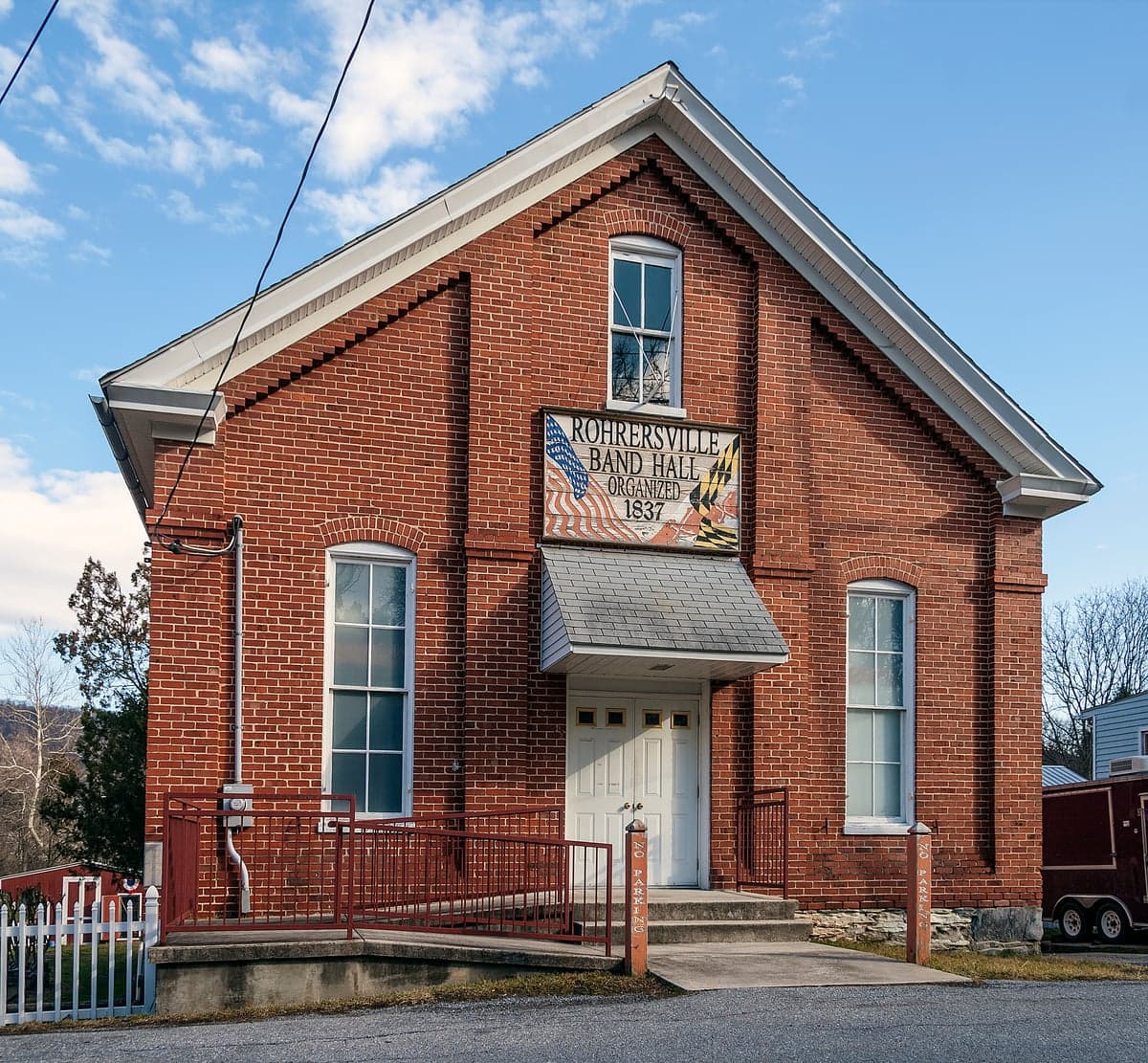
Photo: Wikipedia
Demographics of Rohrersville, MD
Affluence Level in Rohrersville, MD
A below-average socioeconomic profile. Incomes, home values, and educational attainment trail the U.S., with higher poverty and unemployment.
People of Rohrersville, MD
Rohrersville, Maryland, is a small, unincorporated community in Washington County with a population of 141 as of the most recent estimates, making it one of the state's most homogeneous and tight-knit hamlets. The population is 100% White and non-Hispanic, with zero foreign-born residents and no recorded college-educated adults, reflecting a deeply rooted, rural, and working-class character. Residents identify strongly with the area's agricultural and historical German heritage, and the community maintains a quiet, family-oriented atmosphere centered on local churches and volunteer fire services. For those seeking a low-density, culturally stable environment away from the sprawl of Hagerstown or Frederick, Rohrersville offers a distinct sense of place that has changed little in generations.
How the city was settled and grew
Rohrersville was founded in the mid-18th century by German-speaking immigrants, primarily from the Palatinate region, who were drawn to the fertile limestone valleys of western Maryland by land grants from the Calvert family. The community was named after the Rohrer family, early settlers who established a mill along the Little Antietam Creek, and the original wave of families—bearing surnames like Rohrer, Bowers, and Stottlemyer—built the first homesteads in what is now Old Town Rohrersville, the historic core clustered around Rohrersville Road and the old mill site. By the early 19th century, the population grew modestly as the National Pike (now Alternate U.S. 40) brought trade and small-scale industry, including a tannery and a distillery, which attracted additional German and Scots-Irish laborers to Mill District, a small neighborhood along the creek where several water-powered operations stood. The arrival of the Baltimore and Ohio Railroad in the 1830s bypassed Rohrersville proper, limiting growth and preserving its rural character; instead, the community remained a farming hub, with families working the limestone-rich soil for grain and livestock. The Civil War brought temporary disruption—skirmishes occurred nearby during the Antietam Campaign—but the population rebounded slowly, and by 1900, Rohrersville had stabilized at roughly 200 residents, nearly all of German descent, living in scattered farmsteads and the compact Church Hill neighborhood surrounding the Rohrersville United Methodist Church.
Modern era (post-1965)
After the 1965 Hart-Cellar Act, Rohrersville experienced no significant immigration wave; the foreign-born population remains zero, and the community's ethnic composition has remained entirely White. Domestic in-migration has been minimal, limited to a small number of families from the Washington, D.C., and Baltimore suburbs seeking affordable rural land and a slower pace of life. These newcomers have settled primarily in Fox Run Estates, a small subdivision of single-family homes built in the 1990s on the eastern edge of the community, and in scattered lots along Burkittsville Road, where newer modular and ranch-style homes sit on former farmland. The population peaked at around 200 in the 1970s and has since declined to 141, driven by out-migration of younger adults to larger towns for employment and education, as well as an aging demographic profile. The 0.0% college-educated rate reflects the area's reliance on blue-collar and agricultural work, with most employed residents commuting to Hagerstown, Frederick, or Martinsburg for jobs in manufacturing, construction, and logistics. The community's cultural identity remains firmly rooted in its German Protestant heritage, with the Rohrersville Volunteer Fire Company and the annual Rohrersville Ruritan Club events serving as the primary social anchors, and there is no visible presence of non-White or immigrant populations in any neighborhood.
The future
Rohrersville's population is projected to remain stable or decline slightly over the next 10–20 years, as the area lacks the job growth, housing development, or amenities to attract significant in-migration. The community is becoming slightly older, with a median age likely rising above the current county average of 42, as younger residents continue to leave for urban centers. No new subdivisions are planned, and the existing housing stock—mostly older single-family homes and mobile homes—is unlikely to draw diverse newcomers; the 0.0% foreign-born and 0.0% non-White figures are expected to persist. The cultural identity will likely remain homogeneous and traditional, with the Ruritan Club and church continuing as the main institutions, though the volunteer fire company may face recruitment challenges as the population ages. For someone moving in now, Rohrersville offers a stable, predictable, and insular community where neighbors know each other and change is slow—but it requires a willingness to embrace a rural lifestyle with limited services and a population that is not becoming more diverse.
Rohrersville is becoming a quieter, older version of itself—a place where the past is preserved not through museums but through daily life, and where the next decade will likely see more of the same. For a family or individual seeking a low-cost, low-crime, and deeply rooted rural setting with no demographic flux, it remains a viable choice, but those expecting growth, diversity, or urban amenities should look elsewhere.

* Values derived from national, state, county, city and local statistics and may differ in a specific area. Last updated: 2026-08-11T03:15:10.000Z
Narrative content on this page is AI-generated and may contain mistakes. Verify any details that matter before acting on them.
ReloMaps may earn a commission from affiliate links at no extra cost to you.

