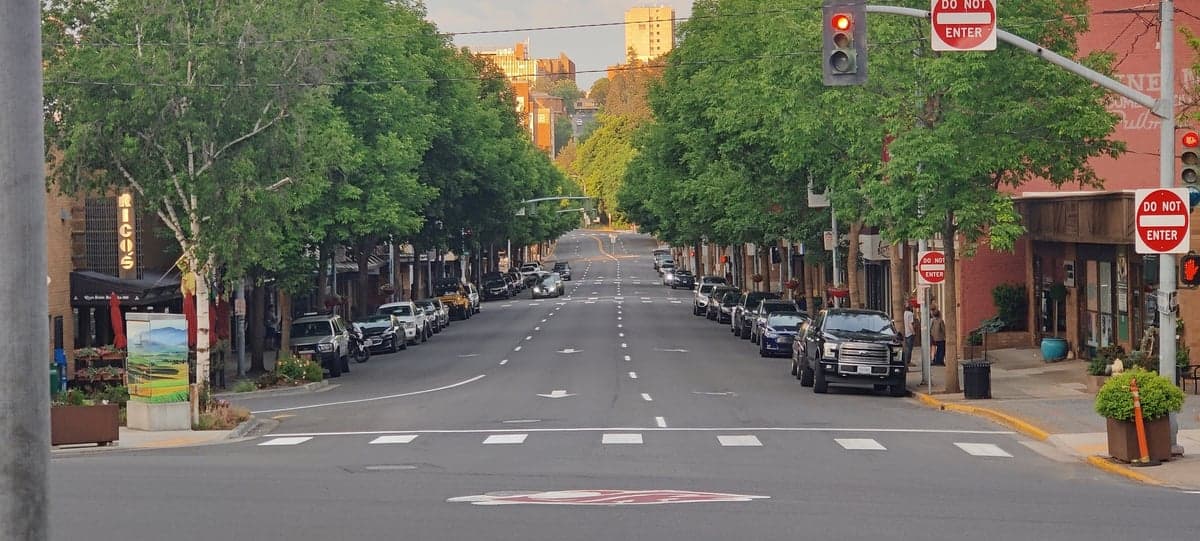

Photo: Wikipedia
Political ClimatePolitical Climate in Pullman, WA
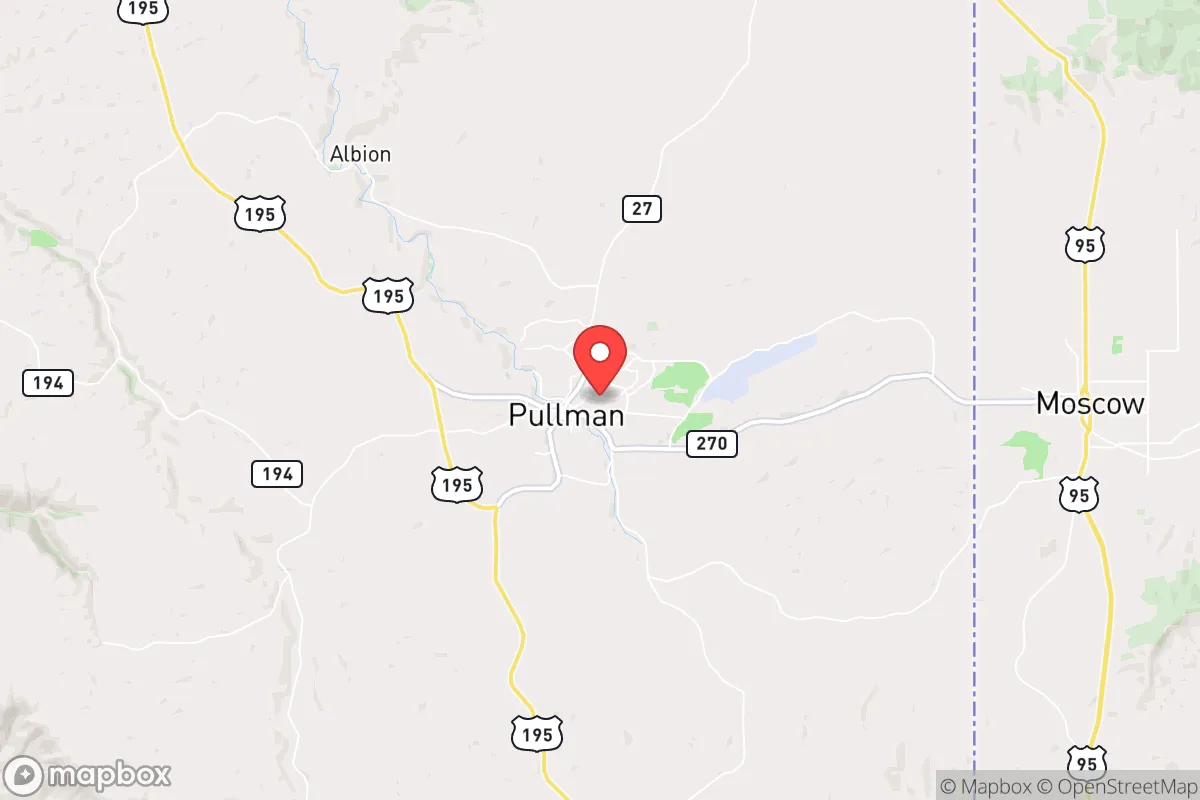
District shown is the primary district for this city’s centroid. Cities may span multiple districts.
Local Political AnalysisPolitical Analysis of Pullman, WA
Pullman, Washington, has historically been a bit of a blue dot in a red county, thanks mostly to Washington State University’s influence, but the surrounding area leans solidly conservative. The Cook PVI for the district is R+5, meaning the area is about five points more Republican than the national average, which tells you the real story is outside the city limits. Over the last decade, though, you’ve seen a slow creep of progressive policies in town—things like zoning changes and local ordinances that feel more like Seattle-lite than the Eastern Washington I grew up in. It’s not a full-on flip, but the trajectory is concerning if you value limited government and local control.
How it compares
Drive ten miles out of Pullman and you’re in places like Colfax or Uniontown, where the politics are as straightforward as the wheat fields—strong Republican, low taxes, and a general distrust of government overreach. Moscow, Idaho, just across the state line, is a similar college town but with a noticeably more libertarian streak; Idaho’s state preemption laws keep local governments from getting too creative with gun control or property restrictions. Meanwhile, Whitman County as a whole votes reliably red, but Pullman’s city council has been flirting with progressive pet projects—like symbolic resolutions on state-level issues that have no business in a town of 30,000. The contrast is stark: you can be in a county that values personal freedom, but inside Pullman’s city limits, you’ll find folks pushing for more regulations on everything from rental properties to short-term rentals.
What this means for residents
For a long-time resident, the biggest red flag is how local government has started to nibble at personal freedoms under the guise of “community standards.” There’s been chatter about stricter rental inspection programs and noise ordinances that give the city more power over what you do on your own property. Property taxes have crept up faster than inflation, and while the county commissioners are generally fiscally conservative, the city council has shown a willingness to fund pet projects that feel like overreach. If you’re a gun owner, Washington’s state-level restrictions are already a headache, but Pullman hasn’t added its own layer—yet. The real concern is the long-term trend: as WSU grows and attracts more out-of-state faculty and students, the political center of gravity shifts left, and with it comes more appetite for government solutions to problems that don’t exist in a town this size.
Culturally, Pullman still has a strong sense of community and neighborliness, but you can feel the tension between the old guard and the newcomers. The university’s administration has pushed diversity, equity, and inclusion initiatives that sometimes feel more like political statements than practical help, and that trickles down into local discourse. On the bright side, the county’s Republican lean keeps a lid on the worst impulses—you won’t see a city income tax or radical zoning changes anytime soon. But if you’re looking for a place where government stays out of your business and your wallet, you’re better off in the surrounding towns. Pullman is still a good place to raise a family, but keep an eye on the ballot box; the direction it’s heading isn’t the one most of us who’ve been here a while would choose.

State Political ClimatePolitical Climate in Washington
State Political AnalysisPolitical Environment in the State
Washington State has shifted from a purple swing state to a solidly Democratic stronghold over the past two decades, with Democrats now holding every statewide office and commanding supermajorities in the legislature. The state hasn’t voted for a Republican presidential candidate since 1984, and the 2024 election saw Kamala Harris carry it by roughly 19 points. The dominant coalition is a fusion of Seattle-area tech wealth, union labor, and suburban progressive activists, while the eastern half of the state and many rural counties feel increasingly disenfranchised. For a conservative considering relocation, the key takeaway is that Washington’s political center of gravity has moved sharply left, and that trend shows no sign of reversing.
Urban vs. rural divide
The political map of Washington is a tale of two states. The Puget Sound region—King County (Seattle), Snohomish County (Everett), and Pierce County (Tacoma)—generates roughly 60% of the state’s vote and is overwhelmingly Democratic. King County alone delivered 73% of its vote to Biden in 2020 and Harris in 2024. The tech corridor stretching from Redmond (Microsoft) to Bellevue and Kirkland has become a Democratic stronghold, even as these suburbs were once reliably Republican. Meanwhile, the rest of the state votes red. Eastern Washington counties like Spokane, Yakima, and Grant reliably go Republican, with Spokane County flipping back to the GOP in 2020 after a brief Democratic flirtation. The rural Olympic Peninsula and southwestern counties like Lewis and Cowlitz are deeply conservative, but their populations are too small to offset the Seattle metro. The only notable exception is Clark County (Vancouver), which has trended purple-to-blue as Portland exurbs spill across the Columbia River.
Policy environment
Washington’s policy environment is aggressively progressive, with a tax structure that is both unusual and burdensome. The state has no personal income tax, but it levies the highest state sales tax in the nation (averaging 9-10% in most cities) and a gross receipts business tax (B&O) that hits small businesses hard. Property taxes are moderate but rising. The state has a strict capital gains tax (7% on gains over $250,000) that was upheld by the state Supreme Court in 2023, effectively creating a wealth tax. Education policy is dominated by teachers’ unions, with mandatory sex education (SB 5395) and a “Healthy Youth Act” that many conservatives view as age-inappropriate. Healthcare is heavily regulated, with a state-run insurance exchange and some of the nation’s strictest abortion laws (codified in 2018). Election laws are among the most liberal: universal mail-in voting (since 2011), same-day voter registration, and no voter ID requirement at the polls. The state also has a “sanctuary” law (Keep Washington Working Act) that limits local law enforcement cooperation with federal immigration authorities.
Trajectory & freedom
Over the past five years, Washington has become less free by nearly any measure of personal liberty. On gun rights, the state passed a ban on “assault weapons” (HB 1240) in 2023, a 10-day waiting period for all firearm purchases, and a requirement for a permit to purchase a handgun (HB 1143). Magazine capacity is capped at 10 rounds. These laws were passed without a voter referendum and are being challenged in court, but the state Supreme Court is hostile to Second Amendment claims. On parental rights, the state passed a “shield law” (SB 5599) in 2023 that allows minors to receive gender-affirming care without parental consent, and a law (HB 1469) that prohibits schools from notifying parents if a child changes their gender identity or pronouns. On medical autonomy, the state mandated COVID-19 vaccines for healthcare workers and state employees, with no religious exemption. Property rights have been eroded by the state’s Growth Management Act, which restricts development in rural areas and drives up housing costs. The state also passed a long-term care payroll tax (WA Cares Fund) in 2019, which took effect in 2023, forcing workers to pay 0.58% of their wages into a state-run benefit program with no opt-out.
Civil unrest & political movements
Washington has a long history of visible political activism, from the 1999 WTO protests in Seattle to the 2020 CHOP/CHAZ occupation in Capitol Hill, which lasted three weeks and saw multiple shootings before police cleared the area. The state’s sanctuary policies have made it a destination for illegal border crossings, with the Washington State Patrol reporting a 400% increase in fentanyl seizures since 2020. There is an active secession movement in eastern Washington—the “51st state” proposal called Liberty, which has gained traction in rural counties like Lincoln and Whitman. Election integrity remains a flashpoint: the 2020 and 2022 elections saw widespread use of ballot drop boxes, and the state’s lack of voter ID has led to ongoing lawsuits from conservative groups. The state also saw a wave of school board activism in 2021-2022, with parents protesting critical race theory and mask mandates, but those efforts have largely been neutralized by Democratic supermajorities in Olympia.
Projection
Over the next 5-10 years, Washington will likely become more progressive, not less. Demographic trends favor the left: the Seattle metro is growing faster than the rest of the state, and in-migration from California and Oregon brings voters who are already comfortable with high taxes and government regulation. The state’s Republican Party is in disarray, with no viable statewide candidate since Dino Rossi in 2008. The legislature is likely to pass a state income tax (currently blocked by a 1930s-era law, but a constitutional amendment could change that), further gun restrictions, and a single-payer healthcare system. The only countervailing trend is the growth of conservative enclaves in places like Spokane Valley, Wenatchee, and the Tri-Cities (Kennewick, Pasco, Richland), but these areas lack the population to flip the state. A conservative moving to Washington now should expect to live under a one-party government that is increasingly hostile to traditional values, with no realistic prospect of political change at the state level.
Bottom line for a new resident: If you’re a conservative considering Washington, you need to be honest about what you’re signing up for. The state’s natural beauty and outdoor lifestyle are world-class, but the political climate is aggressively progressive and getting more so. You’ll pay high sales taxes, deal with strict gun laws, and live under a government that prioritizes LGBTQ+ and immigrant rights over parental authority and religious liberty. If you can afford to live in a red pocket like Spokane County or the Tri-Cities, you’ll find like-minded neighbors, but you’ll still be subject to state laws you didn’t vote for. For many conservatives, the trade-off isn’t worth it—and the data suggests they’re leaving faster than they’re arriving.
* Values derived from national, state, county, city and local statistics and may differ in a specific area. Last updated: 2026-09-21T19:02:15.000Z
Narrative content on this page is AI-generated and may contain mistakes. Verify any details that matter before acting on them.
ReloMaps may earn a commission from affiliate links at no extra cost to you.

