Photo: Wikipedia
Demographics of Pullman, WA
Affluence Level in Pullman, WA
A middle-class area roughly in line with national averages across income, home values, education, and employment.
People of Pullman, WA
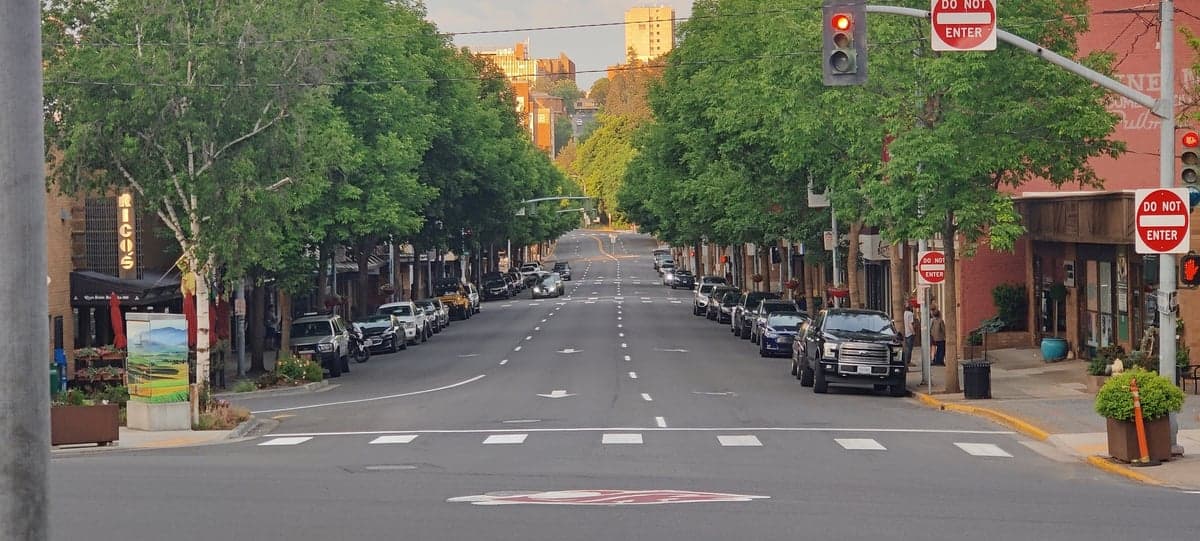
The people of Pullman, Washington, today form a dense, transient, and highly educated community of 31,939, anchored by Washington State University. The city’s identity is defined by a stark contrast: a majority-white, college-town core of students and faculty alongside a growing, professionally oriented Asian and Indian population drawn to the university and regional tech employers. With 62.5% of adults holding a bachelor’s degree or higher, Pullman is one of the most educated small cities in the state, yet its population is notably younger and more mobile than the surrounding Palouse region.
How the city was settled and grew
Pullman was founded in the 1880s as a railroad and agricultural service center on the Palouse prairie, named after industrialist George Pullman. The original white settlers were predominantly Northern European farmers—German, Scandinavian, and English—who established wheat and lentil operations that still define the rural landscape. The arrival of the Washington State Agricultural College (now WSU) in 1892 shifted the town’s trajectory from farm hub to college town. Early faculty and administrators built homes in the College Hill neighborhood, which remains the historic core of university life, with many late-19th-century houses now serving as student rentals. The working-class families who serviced the college and railroad settled in Downtown Pullman and the Milan area, a modest grid of bungalows east of the tracks. Through the mid-20th century, Pullman remained overwhelmingly white and native-born, with little immigration beyond the occasional European-born professor.
Modern era (post-1965)
The 1965 Immigration and Nationality Act opened the door to Pullman’s first significant non-white populations, almost entirely tied to WSU’s graduate programs and research labs. The most visible change has been the growth of East and Southeast Asian communities—Chinese, Korean, and Vietnamese—who now make up 8.4% of the population. These families and graduate students concentrated in the Sunshine Terrace and Pioneer Hill neighborhoods, which offer newer, affordable housing near campus. A separate, smaller wave of Indian-subcontinent immigrants (2.2% of the population) arrived later, primarily in the 2000s and 2010s, drawn to WSU’s engineering and computer science programs; they tend to settle in the Bishop Boulevard apartment corridor and newer subdivisions like Kamiak Butte. The Hispanic population, at 9.6%, is the oldest non-white group, rooted in agricultural labor and service industries, with families concentrated in the Milan and South Pullman areas. The Black population remains small at 1.8%, mostly graduate students and faculty living near campus. Domestic in-migration since 1990 has been dominated by white retirees from the West Coast and young families employed by Schweitzer Engineering Laboratories (SEL), a major tech employer that has drawn engineers from across the U.S. to neighborhoods like Pioneer Hill and Kamiak Butte.
The future
Pullman’s population is heading toward greater ethnic diversity, but in a segmented, not integrated, pattern. The East/Southeast Asian and Indian communities are growing steadily, driven by WSU’s international recruitment and SEL’s hiring of skilled foreign-born engineers. These groups are likely to plateau as a share of the population (around 10-12% combined) because many graduates leave after earning degrees. The Hispanic population is growing more slowly, primarily through natural increase, and remains concentrated in lower-cost neighborhoods. The white majority is aging and slowly declining in share, though it will remain dominant for the foreseeable future. The city is not tribalizing into hostile enclaves, but distinct residential patterns are clear: students and internationals cluster near campus, while white families and professionals dominate the newer subdivisions. The transient nature of the student population—about half the city turns over every four years—means Pullman will never develop the deep ethnic enclaves seen in larger cities.
For someone moving in now, Pullman is a highly educated, majority-white college town with a growing but contained Asian and Indian professional class, a stable Hispanic service workforce, and very little Black or Arab presence. The population is young, transient, and politically moderate to liberal, shaped overwhelmingly by the university. New residents should expect a community where social circles are defined by WSU affiliation or employer (SEL), and where ethnic diversity is visible but largely confined to specific neighborhoods and apartment complexes near campus.

* Values derived from national, state, county, city and local statistics and may differ in a specific area. Last updated: 2026-09-21T19:02:15.000Z
Narrative content on this page is AI-generated and may contain mistakes. Verify any details that matter before acting on them.
ReloMaps may earn a commission from affiliate links at no extra cost to you.

