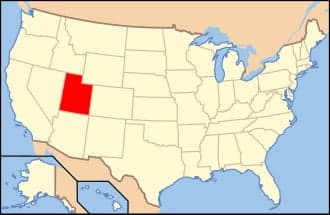
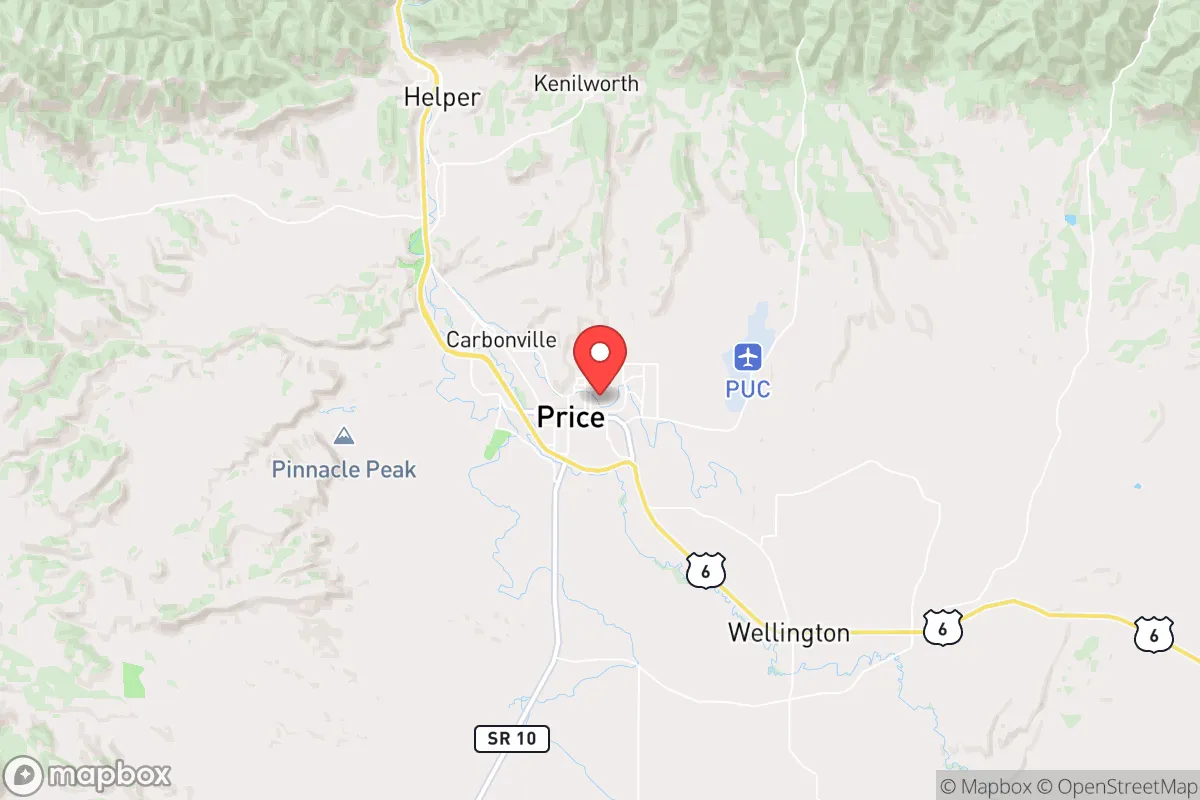
Photo: Wikipedia
Demographics of Price, UT
Affluence Level in Price, UT
A low-income area with significant economic hardship. Household wealth and educational attainment are well below national averages.
People of Price, UT
The people of Price, Utah, today form a tight-knit, predominantly white and Hispanic community of 8,216 residents, shaped by a century of coal mining, railroad work, and family-rooted stability. With a population that is 76.8% white and 17.6% Hispanic, the city retains a distinctly working-class, conservative character, where a relatively low 19.1% of adults hold a college degree and the foreign-born share sits at just 2.0%. This is a place where multi-generational families, many of whom trace their roots to the early 1900s mining boom, live alongside a growing Hispanic population that has become an integral part of the local economy and culture.
How the city was settled and grew
Price was founded in the late 1870s as an agricultural outpost along the Price River, but its population exploded after the arrival of the Denver and Rio Grande Western Railroad in 1883. The railroad opened the region's vast coal reserves, and by the early 1900s, Price was a booming coal town drawing immigrants from Southern and Eastern Europe, including Italians, Greeks, and Slavs, who settled in the Lower Price neighborhood near the rail yards and mine entrances. These groups built the city's early Catholic and Orthodox churches, and their descendants still form a notable part of the white population today. A second major wave came during the 1910s and 1920s, when Mormon settlers from other parts of Utah moved in to establish businesses and civic institutions, concentrating in the Central Price district around Main Street and the Carbon County Courthouse. By mid-century, the population had stabilized around 6,000, with the coal industry and the nearby College of Eastern Utah (now Utah State University Eastern) anchoring the local workforce.
Modern era (post-1965)
After the 1965 Hart-Cellar Act, Price did not experience the large-scale immigration seen in coastal cities. Instead, the most significant demographic shift has been the steady growth of the Hispanic population, which rose from a small minority in the 1970s to 17.6% today. This growth has been driven by domestic migration from the Southwestern U.S. and Mexico, with families drawn to work in coal mining, energy, and service industries. The Hispanic community is most concentrated in the East Price neighborhood, east of Carbon Avenue, and in the Fairgrounds area near the Carbon County Fairgrounds, where newer housing developments and mobile home parks have absorbed much of the growth. The white population, while still the majority, has aged slightly and seen some out-migration of younger adults to larger Utah cities like Salt Lake City and Provo. The Asian and Black populations remain very small, at 0.5% and 1.0% respectively, and are dispersed across the city without forming distinct ethnic enclaves. The Indian subcontinent population is effectively zero, reflecting the area's limited draw for tech or professional migrants.
The future
Price's population is projected to remain stable or grow slowly, with the Hispanic share likely continuing to rise gradually as younger families move in and the white population ages. The city is not becoming dramatically more diverse in the broad sense, but the Hispanic community is becoming more established, with second- and third-generation families moving into neighborhoods like West Price and North Price, areas that were historically almost entirely white. The overall foreign-born share (2.0%) is unlikely to increase significantly, as the local economy—centered on coal, healthcare, and education—does not attract large numbers of international immigrants. The college-educated share (19.1%) may rise modestly as Utah State University Eastern expands, but Price will likely remain a blue-collar, family-oriented community. The cultural identity is evolving from a purely white, Mormon-rooted town to a more bicultural one, with Spanish-language services and Hispanic-owned businesses becoming more visible along Main Street.
For someone moving in now, Price offers a stable, affordable, and safe community where the population is slowly becoming more Hispanic and slightly more educated, but remains overwhelmingly working-class and conservative. The city's human history is one of successive waves—railroad workers, miners, and now Hispanic families—each adding a layer to a place that values continuity, family, and hard work over rapid change.

* Values derived from national, state, county, city and local statistics and may differ in a specific area. Last updated: 2026-10-17T03:53:25.000Z
Narrative content on this page is AI-generated and may contain mistakes. Verify any details that matter before acting on them.
ReloMaps may earn a commission from affiliate links at no extra cost to you.

