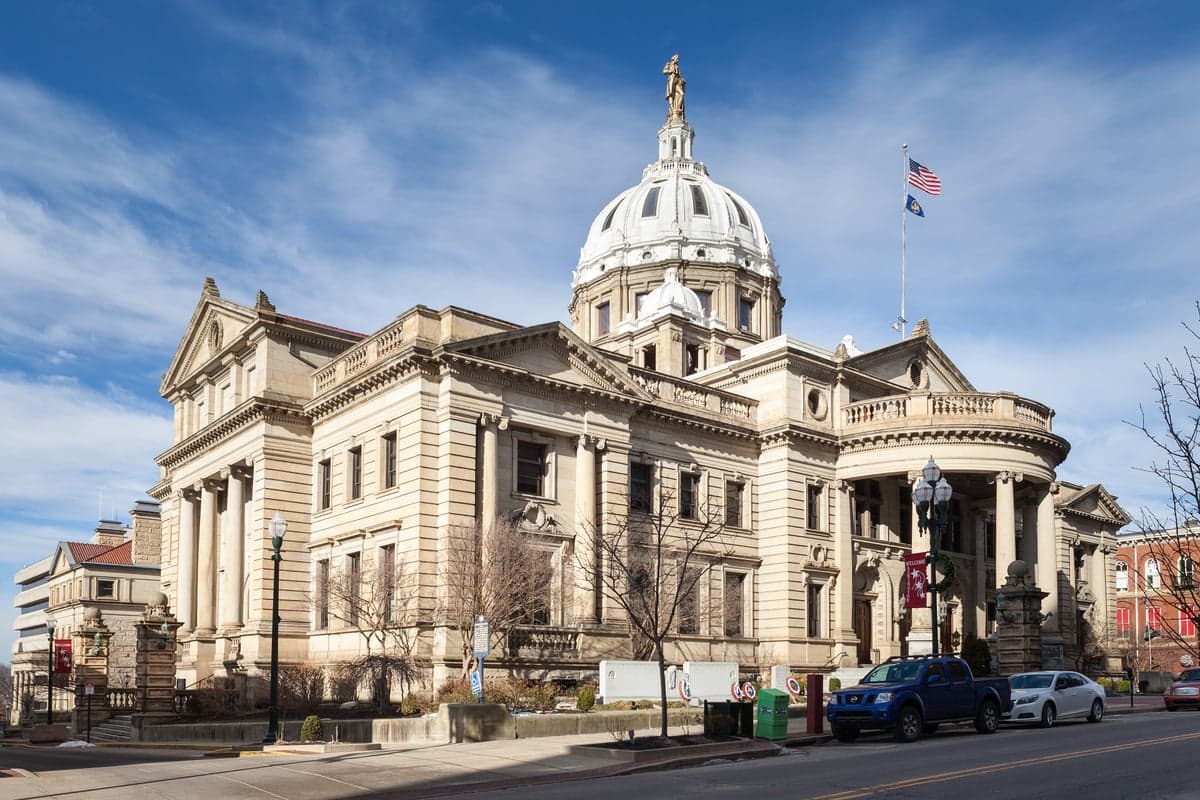
Photo: Wikipedia
Political ClimatePolitical Climate in Washington County
Showing county-level results — no local-only data available.
Lean and PVI are calculated from this county’s 2020 and 2024 presidential results, Cook-style.
Political rankings in Pennsylvania
- Most Conservative Cities in Pennsylvania
- Most Liberal Cities in Pennsylvania
- Best Conservative-Leaning Towns in the Northeast
- Best Conservative-Leaning Towns in the Mid-Atlantic
- Most Affordable Liberal-Leaning Small Towns in the U.S.
- Safest Liberal-Leaning Cities in the U.S.
- Most Conservative Counties in Pennsylvania
- Most Liberal Counties in Pennsylvania
Local Political AnalysisPolitical Analysis of Washington County
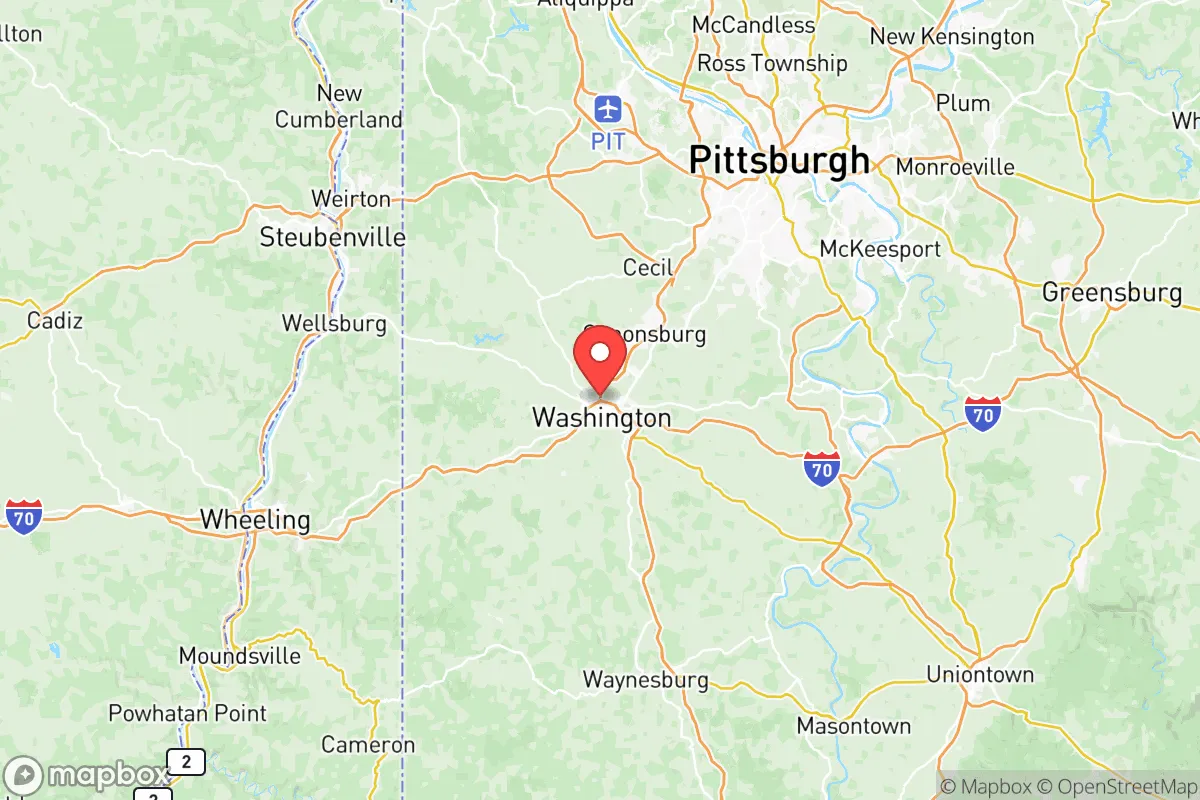
Washington County, Pennsylvania, is one of the most reliably Republican corners of the state, carrying a Cook Political Report Partisan Voting Index (PVI) of R+17. That means the county votes roughly 17 points more Republican than the national average, a stark contrast to the state of Pennsylvania as a whole, which sits at a dead-even EVEN PVI. While the county has drifted rightward in recent cycles, the story isn't uniform across its borders—pockets of blue in the old mill towns and college-adjacent precincts keep things from being a total landslide.
How it compares
The gap between Washington County and the rest of Pennsylvania is the defining feature of its politics. Statewide, Pennsylvania is a perennial battleground, decided by razor-thin margins in Philadelphia’s suburbs and the collar counties around Pittsburgh. Washington County, sitting just 30 minutes south of the Steel City, is the opposite: a place where Republican candidates routinely clear 60% of the vote. In 2024, Donald Trump carried the county by a margin that mirrored the R+17 PVI, while the state as a whole flipped back to the Democratic column. The county’s trajectory has been a slow but steady march rightward since the 2008 Obama years, when it was still a swing county that Democrats could win with strong union turnout. That era is gone; the working-class, union-heavy electorate that once anchored the county’s Democratic machine has largely realigned with the GOP on cultural and economic issues.
But the county is not a monolith. The city of Washington, the county seat, is the clearest blue dot—its precincts around Washington & Jefferson College and the downtown core lean Democratic, often by 10-15 points. Canonsburg, the birthplace of Perry Como, is a genuine swing area, with precincts that flip between parties depending on the cycle and the candidate. The eastern townships—like Peters Township and Cecil Township—are the red engine of the county, filled with commuters and professionals who vote reliably Republican. The rural western and southern reaches, including towns like Burgettstown and Claysville, are deep red, often voting 70-80% Republican. The swing precincts that decide local races are typically in the middle-class bedroom communities like Houston and McMurray, where ticket-splitting is still a habit.
What this means for residents
For conservative residents, living in Washington County means their votes carry real weight in local races—county commissioner seats, row offices, and the judiciary are all reliably Republican, so the primary is often the real election. They also enjoy a political environment where their views are the default, not the exception. For liberal residents, the reality is more isolating. They are a clear minority, and their votes rarely change county-level outcomes, though they can tip the occasional school board race in the more moderate eastern townships. The practical effect is that Democrats here tend to focus their energy on statewide races, where their votes matter more, and on local issues like zoning and school funding, where party labels matter less than personality.
Cultural and policy distinctions
The county’s politics are deeply shaped by its history as a coal and steel hub. The decline of those industries in the 1980s and 90s created a lingering economic anxiety that fuels the current populist conservative bent. Policy-wise, this means strong support for fossil fuel development—the Marcellus Shale natural gas boom has been a lifeline, and fracking is broadly popular across party lines. The county is also culturally distinct from the more liberal Philadelphia suburbs: gun ownership is common, church attendance is high, and the social fabric is more traditional. That said, the county is not culturally isolated—Pittsburgh’s influence is everywhere, from sports fandom to the steady flow of commuters, which keeps Washington County connected to a more diverse, urban political world just up the road. Looking ahead, the R+17 lean is likely to hold, but the margins in the swing precincts around Canonsburg and the eastern townships will determine whether it becomes a R+20 county or starts to moderate back toward the state average.

State Political ClimatePolitical Climate in Pennsylvania
State Political AnalysisPolitical Environment in the State
Pennsylvania is the ultimate swing state, with a Cook PVI of EVEN, meaning it votes almost exactly like the nation as a whole. The state’s politics are a knife’s-edge battle between the heavily Democratic, urbanized southeast (Philadelphia and its collar counties) and the vast, Republican-leaning expanse of the "T" — the rural north and west. Over the last 20 years, the state has oscillated wildly: it went for Obama twice, flipped to Trump in 2016, flipped back to Biden in 2020, and saw Trump reclaim it in 2024, a cycle that perfectly mirrors the national mood.
Urban vs. rural divide
If you want to understand Pennsylvania politics, forget the middle of the state — the action is at the edges. The political map is a tale of two metros. Philadelphia and its four suburban collar counties (Bucks, Montgomery, Chester, Delaware) are the engine of the Democratic Party, delivering margins of 300,000+ votes that Democrats need to offset losses everywhere else. Pittsburgh and its immediate Allegheny County base are also reliably blue, though the surrounding counties in Western PA — Washington, Westmoreland, Butler — have become deeply red, a shift that accelerated dramatically after 2016.
The rural "T" — stretching from the northern tier (Bradford, Tioga, Potter counties) down through the center (Centre, Mifflin, Huntingdon) and into the southwest — is as Republican as any place in the country. These are ancestrally Democratic, union-heavy areas that have swung hard to the GOP on cultural and gun issues. The key battlegrounds are the "collar counties" of the northeast (Luzerne, Lackawanna, Monroe) and the Lehigh Valley (Northampton, Lehigh). Luzerne County, anchored by Wilkes-Barre, is the single most-watched bellwether in the state — it went for Obama by 20 points in 2012, flipped to Trump by 19 in 2016, and has stayed red since. Meanwhile, the suburbs of Harrisburg (Cumberland County) and the growing exurbs around Allentown are the fastest-growing conservative areas, drawing in migrants from the expensive Philly suburbs.
Policy environment
Pennsylvania’s policy environment is a study in split government. The state has a flat income tax rate of 3.07%, which is low by national standards, but the sales tax is also a flat 6% (higher in Philadelphia and Allegheny County). Property taxes are the real burden — among the highest in the nation, with effective rates often exceeding 2% of home value, which is a major consideration for relocators. The state has no inheritance tax on spouses, but does have one on other heirs, and it taxes retirement income, which makes it less attractive for retirees than Florida or Texas.
Regulation is a mixed bag. Pennsylvania is a "home rule" state, meaning cities like Philadelphia and Pittsburgh can impose their own mandates, including paid sick leave and minimum wage hikes above the state’s $7.25 floor. The state preempts local gun laws, which is a win for Second Amendment advocates, but it also has one of the most restrictive liquor distribution systems in the country, with state-run wine and spirits stores. Education is locally funded, which means wealthy suburbs have excellent schools while rural districts struggle with consolidation and declining enrollment.
Recent policy direction
The last few years have seen Pennsylvania lurch in both directions, depending on which party holds the Governor’s mansion. Under Democratic Governor Josh Shapiro, the state has moved left on some fronts while holding the line on others. Act 18 of 2024 expanded background checks for long guns and created a "red flag" law, a significant shift in a state with strong gun culture. However, Pennsylvania remains a "shall-issue" state for concealed carry permits, and permitless carry (constitutional carry) is a live legislative proposal that has passed the Republican-controlled House but stalled in the Senate.
On education, Shapiro signed a historic school funding reform in 2023, directing billions to underfunded districts, but the state still has no school choice voucher program — a major disappointment for conservatives. On energy, Pennsylvania is the second-largest natural gas producer in the nation, and Shapiro has walked a tightrope, supporting fracking while pushing for carbon capture subsidies. The state has no income tax on Social Security benefits, but it does tax 401(k) and pension withdrawals, which is a sticking point for retirees. Election law is a flashpoint: the state has no voter ID requirement (a photo ID is requested but not required for first-time voters), and the 2020 and 2024 cycles saw intense litigation over mail-in ballot deadlines and drop boxes.
Civil unrest & political movements
Pennsylvania has been a hotbed of political activism on both sides. The 2020 election integrity controversy centered on Philadelphia and Allegheny County, where Republican poll watchers claimed they were denied access to ballot counting — a dispute that went to the state Supreme Court. The "Stop the Steal" movement had a strong presence in rural counties, while the January 6th investigation ensnared several Pennsylvania residents, including a state representative. On the left, the Black Lives Matter protests in Philadelphia in 2020 were among the largest in the nation, and the city has a strong progressive activist core that has pushed for defunding the police, though the city council has largely resisted.
Immigration politics are less visible than in border states, but the issue flared in 2023 when New York City bused migrants to Philadelphia and Pittsburgh, prompting a backlash from both parties. Philadelphia is a self-declared "sanctuary city," and the state’s attorney general has sued the federal government over ICE enforcement policies. The most visible flashpoint for a new resident is the sheer number of political yard signs and the intensity of local elections — Pennsylvania has over 2,500 municipalities, each with its own school board, township supervisors, and zoning boards, making local politics unusually contentious and personal.
Projection
Over the next 5-10 years, Pennsylvania is likely to remain a toss-up, but the demographics are shifting subtly. The Philly suburbs are getting bluer as educated professionals move in from New York and New Jersey, while the rural north is getting redder and older. The wildcard is the Lehigh Valley and the northeast — areas like Scranton and Allentown are seeing an influx of Hispanic and Asian immigrants, which could tip them back toward the Democrats, but those same voters are often socially conservative and could be persuaded by the GOP. The state is losing population overall, but the growth areas are the exurbs of Harrisburg and the Poconos, which are reliably red.
The biggest political shift will likely come from the state’s aging population. Pennsylvania has the fourth-oldest median age in the nation, and the under-30 cohort is shrinking. That favors Republicans in the long run, but the countervailing trend is the urbanization of the Philly metro, which is growing and diversifying. Expect the state to remain a battleground for at least another decade, with the outcome of every statewide race determined by a few thousand votes in Luzerne and Northampton counties.
For a new resident, the bottom line is that Pennsylvania offers a genuine mix of both worlds. If you’re conservative, you’ll find a strong Second Amendment culture, low income taxes, and a rural landscape where your values are the majority — but you’ll also pay high property taxes and deal with a Democratic governor who has veto power over most legislation. If you’re liberal, you’ll find vibrant cities, strong unions, and a social safety net, but you’ll also live in a state where your vote is constantly contested and where rural areas feel like a different country. The practical takeaway: Pennsylvania rewards those who engage locally. School boards, county commissioners, and township supervisors have more real power here than in most states, and the outcome of your daily life depends less on Washington and more on the meetings in your local municipal building. Come prepared to participate, because in Pennsylvania, every vote — and every meeting — genuinely counts.
* Values derived from national, state, county, city and local statistics and may differ in a specific area. Last updated: 2026-11-01T08:21:32.000Z
Narrative content on this page is AI-generated and may contain mistakes. Verify any details that matter before acting on them.
ReloMaps may earn a commission from affiliate links at no extra cost to you.

