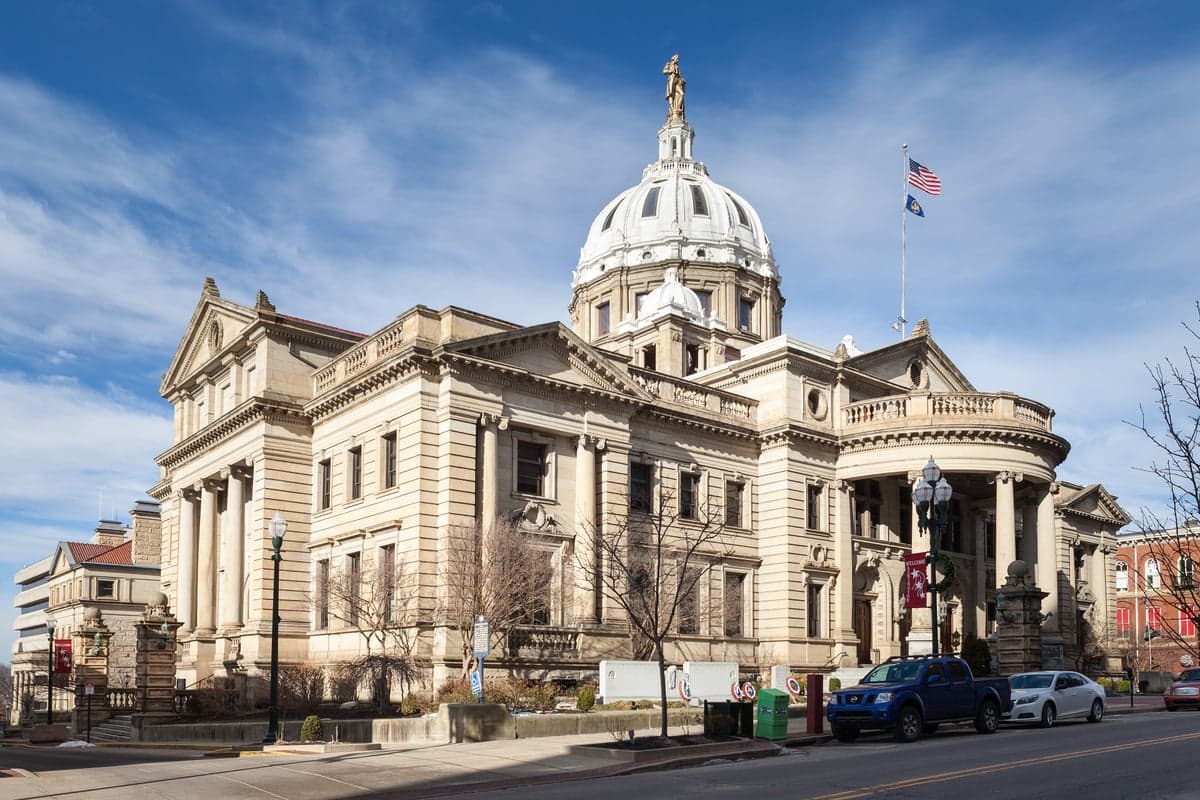
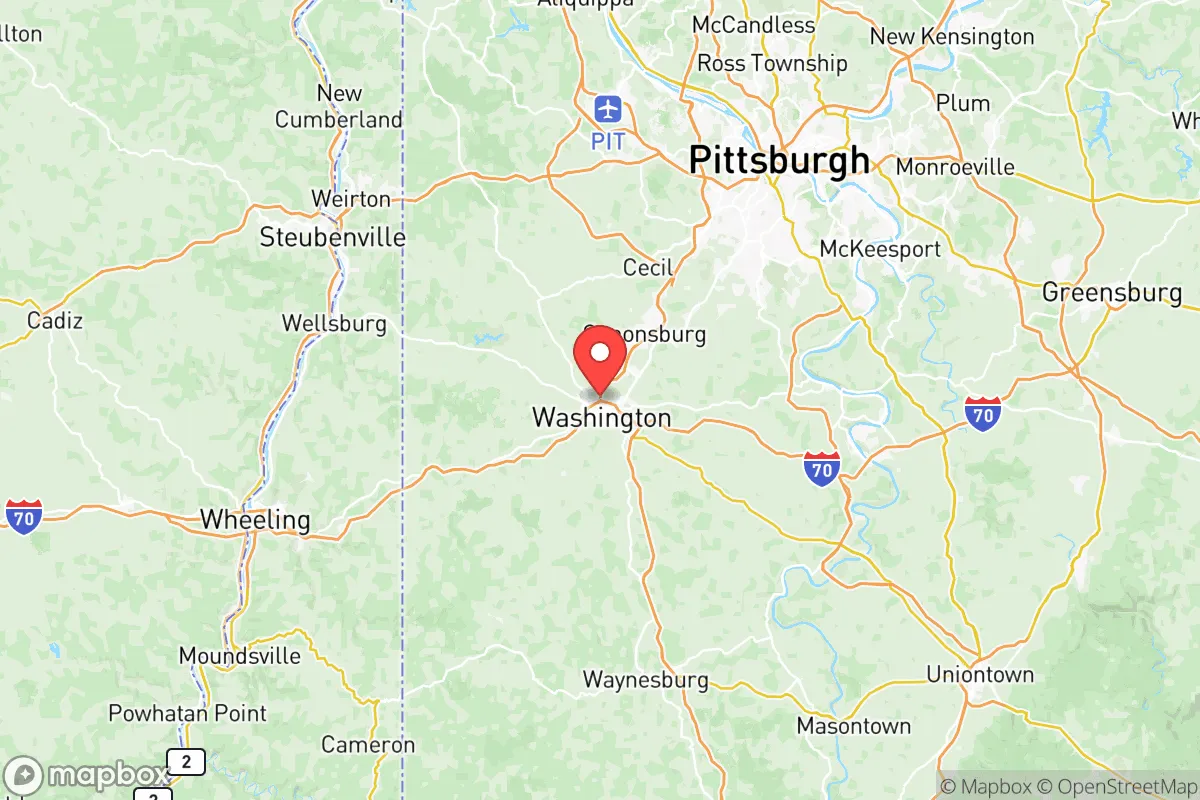
Photo: Wikipedia
Demographics of Washington County
Affluence Level in Washington County
A middle-class area roughly in line with national averages across income, home values, education, and employment.
People of Washington County
Washington County, Pennsylvania, is home to roughly 209,778 residents, a population that is 90.1% White and overwhelmingly native-born, with a foreign-born share of just 1.0%. This is a region where the cultural imprint of early American settlers remains unusually strong, and where the demographic story is less about new arrivals and more about the persistence and slow evolution of long-established communities. The county’s identity is rooted in its Appalachian foothills, its historic role as a gateway to the American frontier, and a modern economy that has transitioned from coal and steel to natural gas and healthcare.
Settlement & growth (pre-1960)
Long before European settlers arrived, the area that is now Washington County was the domain of the Lenape (Delaware) and Shawnee peoples, who used the region’s river valleys for hunting and trade routes. The area was a contested borderland between French and British colonial claims, but it was the British victory in the French and Indian War that opened the region to Anglo-American settlement. The first permanent European settlers were largely Scots-Irish Presbyterians, who began arriving in the 1760s and 1770s, pushing south and west from the older settlements of Chester and Lancaster counties.
These Scots-Irish pioneers were the dominant cultural force in the county’s formative years. They were drawn by the promise of cheap, fertile land in the hills and valleys west of the Alleghenies, and they established the county’s earliest towns, including Washington (founded 1781), Canonsburg, and Charleroi. Washington, the county seat, was named in honor of George Washington, who had surveyed the region as a young man. The county was officially formed in 1781, and its early economy was agrarian, centered on wheat, corn, and livestock, with the Monongahela River serving as a vital commercial artery for shipping goods to Pittsburgh and beyond.
The 19th century brought a second major wave of settlement, driven by the region’s vast mineral wealth. The discovery of high-quality bituminous coal seams, followed by the rise of the steel industry in nearby Pittsburgh, transformed Washington County from a rural farming district into an industrial powerhouse. This industrial boom attracted a wave of European immigrants, primarily from Germany, Ireland, and later Italy and Eastern Europe. These new arrivals settled in the county’s emerging mill towns, such as Monongahela, Donora, and California, where they found work in the coal mines, coke ovens, and steel mills that lined the Monongahela River. The town of Charleroi, named after a Belgian steel town, became a particular hub for Italian and Belgian glassworkers, while Canonsburg developed a strong Italian-American community that remains visible today.
This industrial era also saw a smaller but significant influx of African Americans, who migrated from the rural South in the early 20th century as part of the Great Migration, seeking work in the mills and mines. Their numbers were never large compared to the industrial cities of the Northeast, but they established a distinct community in Washington, the county seat, which became the social and cultural center of Black life in the county. By 1960, the county’s population had peaked at over 217,000, a figure it has never since regained, as the post-war era brought the first signs of deindustrialization and suburban flight.
Modern era (post-1965)
The passage of the 1965 Hart-Cellar Act, which abolished national-origin quotas, had a minimal direct impact on Washington County. Unlike the booming Sun Belt or the major coastal metropolises, this region did not attract large numbers of new immigrants. The county’s foreign-born population today stands at just 1.0%, a figure that is roughly one-tenth of the national average. The small immigrant communities that do exist are scattered, with no single ethnic enclave dominating any particular town. The most notable recent arrivals have been a modest number of Indian subcontinent professionals, who make up about 0.7% of the population, many of whom work in the region’s healthcare and engineering sectors, particularly in and around Washington and Canonsburg. East and Southeast Asian residents, including those of Chinese, Vietnamese, and Filipino descent, account for a further 0.6%, a population largely connected to the academic and medical institutions in the broader Pittsburgh metropolitan area.
The far more significant demographic shift of the modern era has been domestic out-migration. As the steel and coal industries collapsed in the 1970s and 1980s, the county lost tens of thousands of residents to the Sun Belt and other regions. The population fell from its 1960 peak of over 217,000 to a low of around 202,000 in 1990. This decline has since stabilized, thanks in part to the Marcellus Shale natural gas boom, which began in the late 2000s and brought a wave of transient workers and some permanent residents to the county’s rural eastern and southern townships. The Hispanic population, while still small at 2.0%, has grown noticeably since 2000, driven largely by workers attracted to the natural gas industry and ancillary construction and service jobs. These families have concentrated in the more affordable, rural townships and small boroughs like Burgettstown and McDonald, rather than in the older industrial river towns.
Suburbanization has also reshaped the county’s internal geography. The post-war era saw a steady movement of population out of the dense river towns like Monongahela and Donora and into newer, auto-dependent suburbs and exurbs. The northern tier of the county, particularly the townships bordering Allegheny County, has seen the most growth, as commuters have been drawn to the lower taxes and larger lots available in places like Peters Township and Upper St. Clair. This northern corridor is now the most affluent and fastest-growing part of the county, with a college-educated population that significantly exceeds the countywide average of 32.8%.
The future
Washington County is likely to remain a predominantly White, native-born community for the foreseeable future. The county’s Black population (3.1%) and Hispanic population (2.0%) are both expected to grow slowly, but from a very low base. The most dynamic demographic trend is the continued concentration of younger, college-educated residents in the northern suburbs, while the older, industrial river towns in the south and east continue to age and slowly depopulate. The natural gas industry, while volatile, will likely continue to attract a modest influx of out-of-state workers, many of whom will settle permanently if energy prices remain stable.
Culturally, the county is becoming less insular. The growth of the Pittsburgh metropolitan area’s southern exurbs has brought a more diverse, professional class into the county, while the decline of the old industrial towns has weakened the traditional ethnic enclaves that once defined the region. The county’s political character, which has leaned increasingly Republican in recent decades, reflects this shift, as the new suburban voters in the north have joined with the socially conservative rural population in the south and east to form a solid electoral majority.
For someone moving to Washington County today, the bottom line is that this is a stable, affordable, and historically rooted community that is slowly diversifying at the edges. The economic anchors have shifted from coal and steel to natural gas, healthcare, and education, and the population centers have shifted from the river towns to the northern suburbs. The county offers a low cost of living, a strong sense of local identity, and proximity to Pittsburgh’s amenities, but it is not a place of rapid demographic change. New residents will find a community that is welcoming to newcomers but deeply proud of its Scots-Irish and industrial heritage, and one where the pace of life and the character of the towns remain distinctly grounded in the past.

* Values derived from national, state, county, city and local statistics and may differ in a specific area. Last updated: 2026-11-01T08:21:32.000Z
Narrative content on this page is AI-generated and may contain mistakes. Verify any details that matter before acting on them.
ReloMaps may earn a commission from affiliate links at no extra cost to you.

