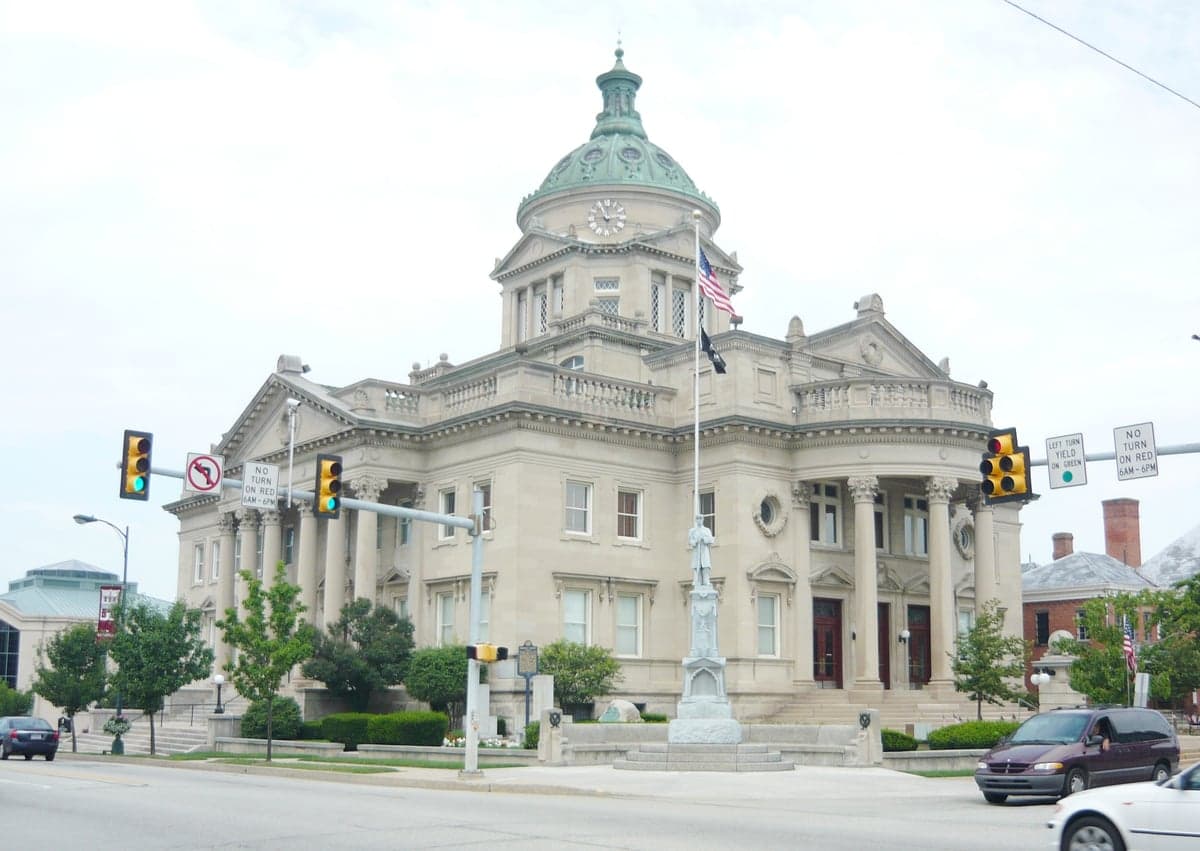
Photo: Wikipedia
Political ClimatePolitical Climate in Somerset County
Showing county-level results — no local-only data available.
Lean and PVI are calculated from this county’s 2020 and 2024 presidential results, Cook-style.
Political rankings in Pennsylvania
- Most Conservative Cities in Pennsylvania
- Most Liberal Cities in Pennsylvania
- Best Conservative-Leaning Towns in the Northeast
- Best Conservative-Leaning Towns in the Mid-Atlantic
- Most Affordable Liberal-Leaning Small Towns in the U.S.
- Safest Liberal-Leaning Cities in the U.S.
- Most Conservative Counties in Pennsylvania
- Most Liberal Counties in Pennsylvania
Local Political AnalysisPolitical Analysis of Somerset County
Somerset County is one of the most reliably Republican counties in Pennsylvania, carrying a Cook Partisan Voting Index of R+29. That means the county votes about 29 points more Republican than the national average, a stark contrast to the state of Pennsylvania as a whole, which sits at EVEN. In practice, this has been a deep-red stronghold for decades, and while the national GOP has shifted, Somerset’s conservatism has remained remarkably stable. The county hasn’t voted for a Democratic presidential candidate since Lyndon B. Johnson in 1964, and in 2024, Donald Trump carried it by a margin of roughly 40 points.
How it compares
Pennsylvania’s EVEN rating reflects its status as a true swing state, where Philadelphia and Pittsburgh pull the needle left and the rural center pulls it right. Somerset County sits squarely in that rural right-leaning bloc. The difference isn’t subtle: while the state overall is competitive, Somerset is a Republican lock. The county’s political geography does have some nuance, though. The borough of Somerset itself, the county seat, is slightly more moderate, occasionally electing Democrats to local offices like the school board or township supervisor. The town of Berlin leans heavily red, while Confluence and Meyersdale show a bit more Democratic support, largely tied to unionized manufacturing and older New Deal loyalties. The swing precincts tend to be in the central part of the county around the Somerset Borough area, where a mix of state employees, healthcare workers, and small business owners create a more balanced electorate. But even there, Republicans hold a comfortable edge. The real red strongholds are the rural townships like Brothersvalley and Stonycreek, where GOP candidates routinely win by 70% or more.
What this means for residents
For conservative residents, the political climate is comfortable. Local government, from the county commissioners to the district attorney, is almost entirely Republican. Policy debates tend to center on property taxes, school funding, and Second Amendment rights, with little pushback. For liberal residents, it can feel isolating. There is no organized Democratic Party infrastructure to speak of, and progressive candidates rarely make it past the primary. That said, the county’s small size means politics is less polarized on a day-to-day level. Neighbors help neighbors regardless of party, and the local paper, the Daily American, covers issues without the national partisan edge. The biggest practical impact is on state-level representation: Somerset County is part of the 35th Senatorial District, held by Republican Pat Stefano, and the 69th and 72nd House Districts, both held by Republicans. This means the county’s voice in Harrisburg is reliably conservative, but it also means that state funding for rural roads, broadband, and healthcare often requires bipartisan deal-making that Somerset’s representatives have to navigate carefully.
Culturally, Somerset County is distinct from the rest of Pennsylvania in its strong Appalachian identity. The county is part of the Laurel Highlands, and its politics are shaped by a mix of coal mining history, family farms, and a growing tourism economy around the Flight 93 National Memorial and the Great Allegheny Passage. There’s a deep skepticism of government overreach, but also a pragmatic streak—residents support local fire departments, libraries, and the county fair with equal enthusiasm. The biggest policy distinction from the rest of the state is on energy: Somerset County is home to the Quecreek Mine rescue site and has a long history of coal extraction, so debates about environmental regulations and renewable energy hit differently here than in Philadelphia or Pittsburgh. The county’s future political trajectory likely remains red, but as younger residents move to urban areas and retirees from elsewhere trickle in, the margins may narrow slightly—though not enough to flip the county anytime soon.

State Political ClimatePolitical Climate in Pennsylvania
State Political AnalysisPolitical Environment in the State
Pennsylvania is the ultimate swing state, with a Cook PVI of EVEN that perfectly captures its razor-thin margins in every recent presidential election. Over the past 20 years, the state has shifted from a reliably blue-leaning battleground (voting for Gore, Kerry, and Obama) to a true toss-up, with Trump winning it in 2016 by 44,000 votes and Biden flipping it back in 2020 by just 80,000. The long-term trajectory is one of slow, steady polarization: the Philadelphia and Pittsburgh metros have become deeper blue, while the vast rural and exurban middle has swung hard red, leaving the state’s outcome determined by a shrinking pool of suburban swing voters in places like Bucks, Chester, and Northampton counties.
Urban vs. rural divide
The political map of Pennsylvania is a tale of two cities and a whole lot of country. Philadelphia and its collar counties (Montgomery, Delaware, Chester) are the engine of the Democratic vote, delivering margins of 80-85% in the city proper and 55-65% in the inner suburbs. Pittsburgh and Allegheny County are similarly blue, though less extreme, with the city itself voting around 70% Democratic. The rest of the state is a sea of red: the northern tier (Tioga, Bradford, Potter counties) and the central spine (Huntingdon, Juniata, Perry) routinely vote 70-75% Republican. The real battlegrounds are the southeastern suburbs—Bucks County, which flipped from blue to red in 2024, and Northampton County in the Lehigh Valley, which went for Biden in 2020 but is now a toss-up. Lancaster County, once a Republican stronghold, has become a fascinating microcosm: the city of Lancaster votes blue, the Amish country votes red, and the growing suburbs are trending purple. Erie County in the northwest is another bellwether, having voted for Obama, Trump, and Biden in successive cycles.
Policy environment
Pennsylvania’s policy landscape is a mixed bag that reflects its divided government. The state has a flat income tax of 3.07%, one of the lowest in the nation, and a sales tax of 6% (higher in Philadelphia and Allegheny County). Property taxes are high, averaging around 1.5% of home value, which is a major pain point for homeowners. The regulatory posture is moderate: Pennsylvania is not a right-to-work state, and unions remain strong in the public sector and construction trades. Education policy is a flashpoint: the state has a massive funding disparity between wealthy suburban districts (like Lower Merion) and poor rural ones (like those in the northern tier), and a 2023 court ruling declared the system unconstitutional, but the legislature has yet to act. Healthcare is dominated by large systems like UPMC and Jefferson Health, and the state expanded Medicaid under the ACA. Election laws are relatively straightforward: no-excuse mail-in voting was enacted in 2019 (Act 77), but it remains controversial, with Republicans pushing for voter ID requirements and Democrats defending mail-in access. The state does not have a state-level gun preemption law, meaning Philadelphia and Pittsburgh can enact their own restrictions, which they have—Philadelphia requires a license to carry and bans assault weapons, while most of the state is more permissive.
Recent policy direction
Over the past five years, Pennsylvania has moved in a moderately conservative direction on some fronts and a liberal one on others, creating a patchwork that relocators need to understand. On gun rights, the state passed a "stand your ground" law in 2021 (Act 79), eliminating the duty to retreat in self-defense situations, and permitless carry is being debated but hasn’t passed. On education and parental rights, the 2022 election saw a Republican legislature pass a bill banning transgender athletes from girls’ sports (vetoed by Governor Shapiro), and a "parents’ bill of rights" is pending. On abortion and bodily autonomy, Pennsylvania remains a relative island of access in the Northeast: abortion is legal up to 24 weeks, and the 2022 Dobbs decision did not change state law, though the legislature has passed a 24-hour waiting period and ultrasound requirement. On taxation, the flat income tax was cut from 3.07% to 3.07% (it hasn’t changed), but the corporate net income tax is being phased down from 9.99% to 4.99% by 2031. On voting and ballot access, Act 77’s mail-in voting remains in place, but a 2024 court ruling (Mazurek v. Pennsylvania) upheld the requirement that mail-in ballots be dated by hand, a provision that disenfranchises some voters. On property rights, the state has no statewide zoning or rent control, but Philadelphia and Pittsburgh have their own landlord-tenant laws. On privacy and surveillance, Pennsylvania has a weak wiretap law (two-party consent), and there’s no state-level data privacy law akin to California’s.
Civil unrest & political movements
Pennsylvania has seen its share of political flashpoints. The 2020 election aftermath was intense: Trump’s campaign filed numerous lawsuits in the state, and the "Stop the Steal" movement held rallies at the state capitol in Harrisburg. In 2021, a group of Republican state senators launched a "forensic investigation" of the 2020 election, hiring a firm that had no election experience, which ultimately found no evidence of widespread fraud. On the left, the 2020 George Floyd protests in Philadelphia led to looting and property damage, and the city has since seen ongoing debates over police reform and defunding. Immigration politics are less heated than in border states, but Philadelphia is a sanctuary city, and the state has seen a surge in migrant arrivals from the southern border, with buses from Texas arriving in 2023-2024. The Amish and Mennonite communities in Lancaster and Lebanon counties are politically active on issues like religious freedom and school choice, and they tend to vote Republican. There’s no serious secession movement, but there is a growing "statehood for the northern tier" sentiment among some rural conservatives who feel ignored by Harrisburg and Philadelphia.
Projection
Over the next 5-10 years, Pennsylvania is likely to remain a toss-up, but the demographic trends favor a slow shift to the right. The Philadelphia suburbs are diversifying and growing, but they’re also aging, and younger voters are less reliable. The rural areas are depopulating, but those who remain are becoming more conservative. The wild card is the growing Hispanic population in the Lehigh Valley (Allentown, Bethlehem, Easton), which leans Democratic but is not as reliably blue as the Black vote in Philadelphia. In-migration is modest—Pennsylvania is not a boom state like Texas or Florida—but the people moving in tend to be retirees from New York and New Jersey, who bring their blue-state voting habits to the Poconos and the Delaware River valley. The state’s electoral map will likely hinge on a few thousand votes in Bucks, Northampton, and Erie counties for the foreseeable future. A relocator moving in now should expect a state that is perpetually contested, with divided government likely to continue, meaning that major policy shifts (on abortion, guns, or taxes) will be rare and incremental.
For a new resident, the bottom line is that Pennsylvania offers a genuine swing-state experience: your vote matters, but you’ll also live in a state where policy is constantly negotiated between a Democratic governor and a Republican legislature. If you’re conservative, you’ll find a welcoming environment in most of the state outside the two big cities, with low taxes and strong gun rights, but you’ll have to accept that your state government won’t always reflect your values. If you’re liberal, you’ll find safe havens in Philadelphia and Pittsburgh, with strong labor protections and abortion access, but you’ll pay higher city taxes and deal with a state legislature that blocks most of your priorities. Either way, you’ll be living in a place where politics is a contact sport, and the outcome of every election feels like it matters.
* Values derived from national, state, county, city and local statistics and may differ in a specific area. Last updated: 2026-11-21T22:40:05.000Z
Narrative content on this page is AI-generated and may contain mistakes. Verify any details that matter before acting on them.
ReloMaps may earn a commission from affiliate links at no extra cost to you.

