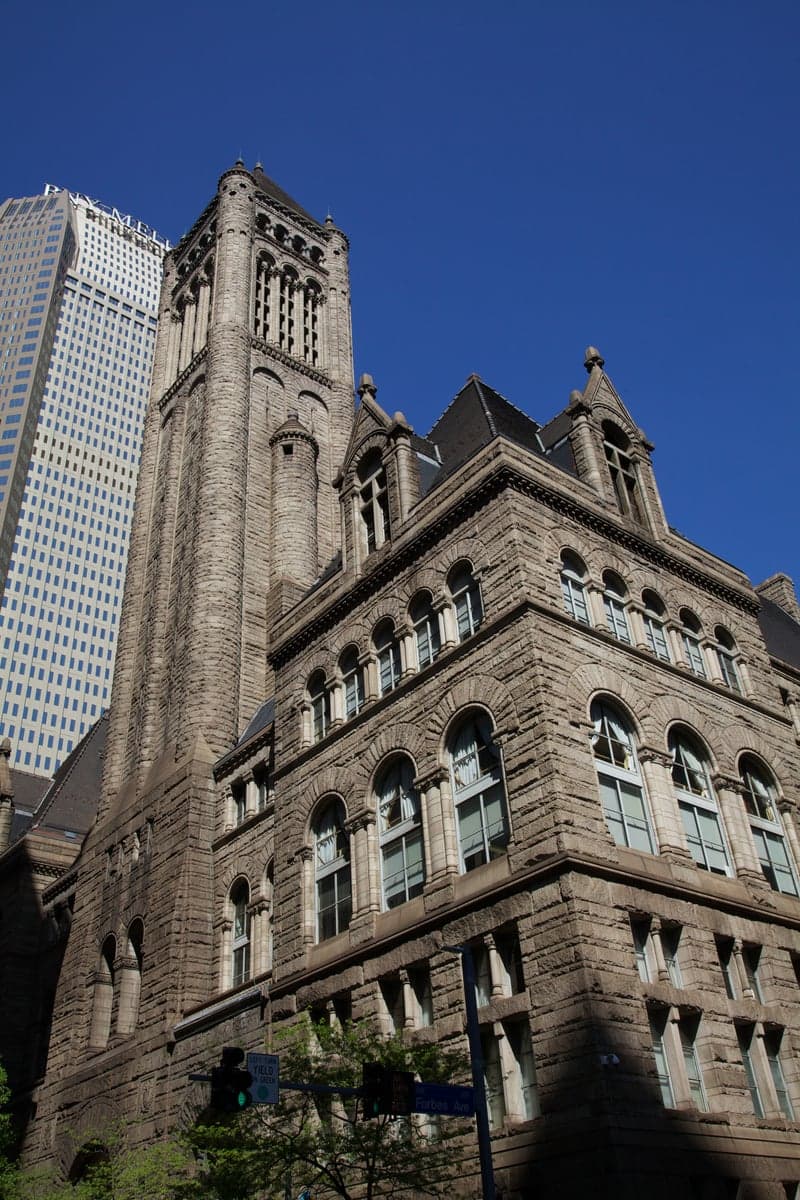
Photo: Wikipedia
Political ClimatePolitical Climate in Allegheny County
Showing district-level results — no local-only data available.
Local Political AnalysisPolitical Analysis of Allegheny County
Allegheny County is a solidly Democratic stronghold, carrying a Cook Partisan Voting Index of D+10, which means it votes about 10 points more Democratic than the national average. This stands in stark contrast to the rest of Pennsylvania, which as a whole is a pure toss-up with a Cook PVI of EVEN. The county has been trending bluer for decades, driven by the collapse of organized labor's old Republican ties and the rapid growth of the city of Pittsburgh's professional and academic sectors, but the story is more nuanced once you get outside the city limits.
How it compares
Pennsylvania is the ultimate swing state, flipping from Obama to Trump to Biden by razor-thin margins. Allegheny County is the engine of that Democratic performance. In 2020, Joe Biden won the county by roughly 200,000 votes, which was more than his entire statewide margin of victory. Without Allegheny's massive blue vote, Pennsylvania would be reliably red. But the county itself is far from monolithic. The city of Pittsburgh and inner-ring suburbs like Mount Lebanon, Wilkinsburg, and Swissvale are deep blue, often voting 70-80% Democratic. Meanwhile, the outer suburbs and exurbs—places like Pine-Richland, Franklin Park, and the South Hills villages of Upper St. Clair and Peters Township—are reliably red, often voting 60-65% Republican. The true swing precincts are in the middle-ring suburbs like Penn Hills, Plum, and parts of Ross Township, where working-class voters who once backed Reagan now split tickets or lean Democratic by single digits. This internal divide means that while the county's overall vote is safely Democratic, the lived political experience varies dramatically depending on whether you're in Shadyside or Cranberry.
What this means for residents
For liberal residents, especially in Pittsburgh and the close-in suburbs, the political climate is comfortable. You'll find Democratic candidates on every ballot, progressive policies on local issues like affordable housing and transit, and a city government that actively pushes green initiatives and social programs. For conservative residents in the outer suburbs, the experience is different. They are a clear minority in countywide elections, but they dominate their local school boards, township commissions, and state legislative seats. Conservative voters in places like Bethel Park or Hampton Township can feel politically isolated at the county level, but they have strong representation in Harrisburg and Washington, D.C., thanks to gerrymandered state House and Senate districts and a competitive congressional seat (PA-17) that often flips. The practical effect is that county-level policy—like the controversial 2023 soda tax or the county executive's push for renewable energy—tends to lean left, but local zoning, policing, and school funding remain deeply conservative in the red towns.
Culturally, this split creates a "two-counties" feel. Pittsburgh proper is a liberal, walkable, post-industrial city with a thriving arts scene and a heavy emphasis on universities and healthcare. The outer suburbs are more traditional, with larger homes, bigger yards, and a culture centered on churches, youth sports, and small business. One notable policy distinction is that Allegheny County has a countywide property reassessment system that is more progressive than many rural Pennsylvania counties, which can be a shock for newcomers from areas with frozen assessments. Also, the county's strong Democratic lean means that state-level Republican policies—like voter ID laws or restrictions on abortion access—are often met with vocal opposition from the county executive and Pittsburgh City Council, creating a constant tension between local and state government. For anyone moving here, the key takeaway is that your political experience will be shaped almost entirely by which side of the county line you choose to live on, not by the county's overall D+10 label.

State Political ClimatePolitical Climate in Pennsylvania
State Political AnalysisPolitical Environment in the State
Pennsylvania is the ultimate swing state, with a Cook PVI of EVEN that perfectly captures its 50/50 split. Over the last 10-20 years, the state has shifted from a reliably blue-leaning battleground to a true toss-up, driven by the collapse of union-heavy Democratic strongholds in the west and the explosive growth of conservative exurbs in the southeast. The dominant coalitions are a shrinking, aging Democratic base in Philadelphia and Pittsburgh versus a growing, energized Republican coalition in the rural center and fast-growing suburbs like those around Harrisburg and Scranton. The result is a state that feels like two different countries sharing a border, and every election is a knife fight.
Urban vs. rural divide
The political map of Pennsylvania is brutally simple: Philadelphia and Pittsburgh are deep blue islands surrounded by a red sea. Philadelphia County delivered 81% of its vote to Biden in 2020, while Allegheny County (Pittsburgh) gave him 60%. But drive 30 minutes outside either city, and you hit brick-red territory. The real story is the suburban and exurban shift. Places like Bucks County (north of Philly) and Chester County have trended Democratic as college-educated professionals move in, while Lancaster County and York County have become rock-ribbed Republican strongholds. The Scranton/Wilkes-Barre area (Lackawanna and Luzerne counties) is the classic bellwether — it went for Obama twice, then flipped hard for Trump in 2016 and 2020. The Erie and Allentown metros are similar: working-class, union-heavy towns that are now swing counties. The rural center — from State College out to the Poconos — is overwhelmingly Republican, with many counties giving Trump 70%+ of the vote.
Policy environment
Pennsylvania’s policy landscape is a mixed bag that reflects its split personality. The state has a flat income tax of 3.07%, one of the lowest in the nation, and no tax on retirement income — a huge draw for conservatives. But property taxes are high, averaging about 1.5% of home value, and the state sales tax is 6% (no tax on clothing or groceries). The regulatory posture is moderate: Pennsylvania is not Texas, but it’s not California either. Education policy is a flashpoint: the state has a patchwork of 500 school districts, with wealthy suburbs funding excellent schools while rural and urban districts struggle. Governor Josh Shapiro (D) has pushed for more state funding, but the Republican legislature blocks tax hikes. Election laws are relatively open: no-excuse mail-in voting was passed in 2019 (Act 77), but it remains controversial, with Republicans pushing for voter ID requirements. The state has no right-to-work law, and union membership remains above the national average, especially in construction and public sector jobs.
Recent policy direction
The last five years have seen Pennsylvania lurch back and forth. On gun rights, the state is a preemption state — cities like Philadelphia cannot pass their own gun laws, though they try. In 2022, the legislature passed a constitutional carry bill (permitting concealed carry without a license), but Governor Tom Wolf vetoed it. Shapiro has signaled he would also veto it, so expect this to remain a live issue. On parental rights and education, the state has seen fierce battles over school library books and curriculum transparency, with conservative counties passing resolutions to limit LGBTQ+ content. On abortion, Pennsylvania is a relative island of access in the Midwest: abortion is legal up to 24 weeks, and the 2022 election saw Shapiro win partly on a promise to protect those rights. On election integrity, the 2020 election was heavily litigated, and the state supreme court (5-2 Democratic) has generally upheld mail-in voting. Property rights are generally strong, though the state’s Act 13 (2012) on fracking preempts local bans — a win for energy but a loss for local control. Privacy and surveillance: the state has no comprehensive data privacy law, and police use of license plate readers and drones is largely unregulated.
Civil unrest & political movements
Pennsylvania has been a hotspot for political activism on both sides. The 2020 election aftermath saw massive protests in Philadelphia and Harrisburg, with Trump supporters busing in for "Stop the Steal" rallies. The Lancaster County area has a strong constitutional sheriff movement, with sheriffs refusing to enforce certain state gun laws. On the left, Philadelphia saw major BLM protests in 2020, and the city remains a hub for progressive activism, including defund-the-police rhetoric (though actual funding has increased). Immigration politics are less intense than in border states, but Philadelphia is a sanctuary city, and the state has seen fights over ICE detainers. Election integrity remains a raw nerve: the 2022 gubernatorial race saw Republican Doug Mastriano, a leading election denier, lose by 15 points — suggesting most voters are tired of the controversy. Still, you’ll see "Fight the Fraud" signs in rural areas and "Defend Democracy" signs in the suburbs.
Projection
Over the next 5-10 years, Pennsylvania will likely remain a toss-up, but the demographic trends favor Democrats slightly. The Philadelphia suburbs are getting more diverse and educated, while the rural west and north are aging and shrinking. The Pittsburgh region is a wild card: it’s losing population but gaining tech and medical jobs, which could bring in younger, more liberal voters. The I-81 corridor (Harrisburg to Scranton) is growing fast with warehouse and logistics jobs, attracting a mix of conservative locals and more moderate transplants. The big unknown is in-migration from other states: Pennsylvania is not a top destination like Texas or Florida, but it does attract retirees from New York and New Jersey, who tend to be moderate-to-liberal. Expect the state to stay purple, with the legislature remaining Republican (due to gerrymandering) and the governorship flipping between parties. A new resident moving in now should expect a state that is politically exhausting but also genuinely competitive — your vote actually matters here.
For a new resident, the bottom line is this: Pennsylvania offers a low-tax environment on income and retirement, but high property taxes and a patchwork of local services. Your political experience will depend entirely on where you live. If you’re conservative, you’ll feel at home in Lancaster, York, or the Poconos, with like-minded neighbors and a state legislature that reflects your values. If you’re liberal, you’ll thrive in Philadelphia, Pittsburgh, or the close-in suburbs, with progressive policies on abortion, voting, and education. The state is not for anyone who wants political uniformity — but if you enjoy a real fight and want your vote to count, there’s no better place in America.
* Values derived from national, state, county, city and local statistics and may differ in a specific area. Last updated: 2026-06-12T09:29:08.000Z
Narrative content on this page is AI-generated and may contain mistakes. Verify any details that matter before acting on them.
ReloMaps may earn a commission from affiliate links at no extra cost to you.

