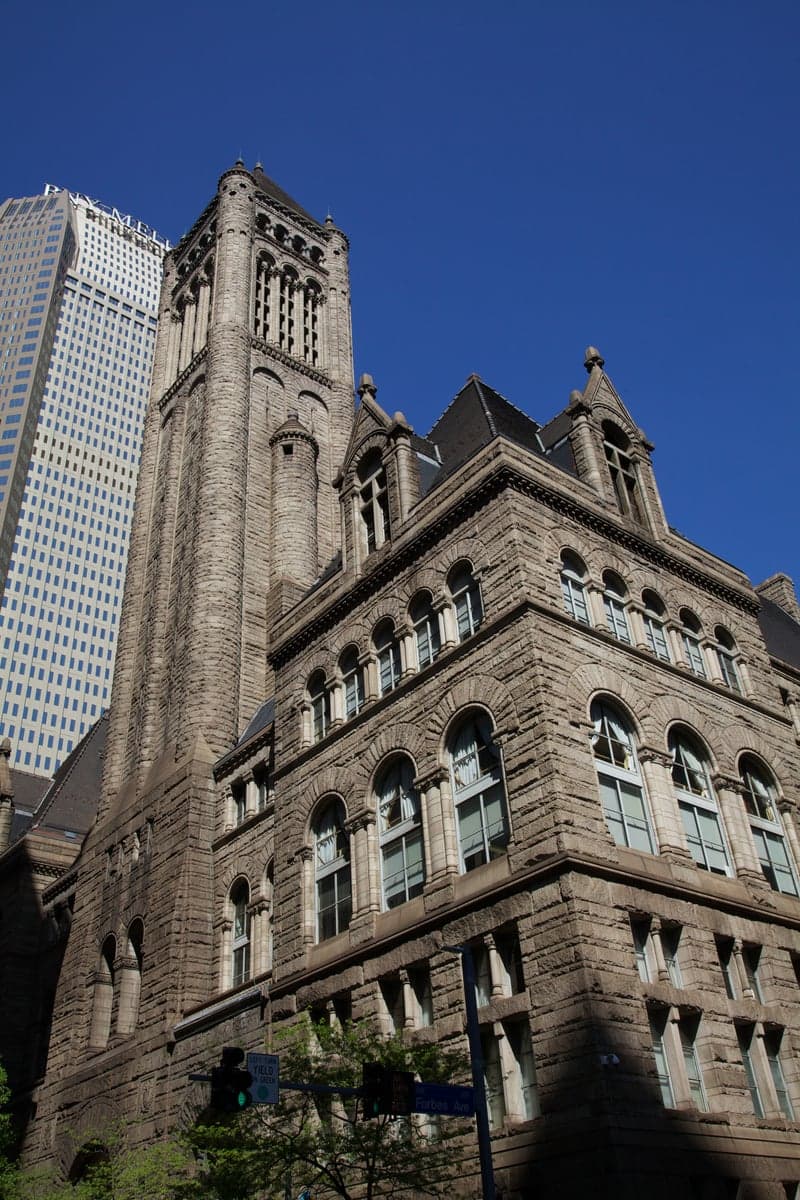
Photo: Wikipedia
Personal Sovereignty in Allegheny County
Strong independent fundamentals that actively favor personal liberty and low regulation.
What does Personal Sovereignty tell us?
Personal Sovereignty measures your capacity for self-reliance and independence with minimal government friction. Higher scores mean fewer barriers between you and the way you want to live... but it assumes you have the space you need and good neighbors.
What does this tell us?
Personal Sovereignty measures your capacity for self-reliance and independence with minimal government friction. Higher scores mean fewer barriers between you and the way you want to live... but it assumes you have the space you need and good neighbors.
State Policy
Energy independence: Net exporter (150% of energy produced in-state)
Personal Liberty
Homesteading

Personal Liberty Analysis
Allegheny County presents a complex personal sovereignty landscape where state-level preemptions provide a baseline of individual rights, but local municipal fragmentation creates a patchwork of regulatory intensity that varies dramatically from one neighborhood to the next. For the autonomy-minded individual or family, the key strategic question is not whether Allegheny County is "free" or "restrictive" as a monolith, but rather which specific municipality within the county aligns with your priorities—because the difference between, say, Fox Chapel and Pittsburgh's city limits can be as stark as the difference between two different states.
Tax burden and regulatory posture across Allegheny County municipalities
Pennsylvania's state-level framework is moderately friendly to personal sovereignty. There is no state personal property tax, no inheritance tax on transfers to a surviving spouse, and the flat 3.07% state income tax is among the lowest in the Northeast. However, Allegheny County itself layers on a county-wide 7% sales tax (the state maximum allowed for local add-ons) and a county realty transfer tax of 1% on top of the state's 1%, making property transactions notably expensive. The real variable is at the municipal and school district level. Property tax millage rates swing wildly: Pittsburgh Public Schools levy roughly 10.5 mills, while Mt. Lebanon's combined municipal and school millage can exceed 25 mills, making it one of the highest-taxed suburbs in the state. Conversely, West Deer Township and Pine-Richland School District areas offer comparatively lower combined rates, often in the 18-20 mill range. Regulatory posture follows a similar pattern. Pittsburgh city government enforces a robust rental registration and inspection regime, a plastic bag ban, and strict stormwater management ordinances. Move ten miles north to Hampton Township, and you'll find a lighter touch: no bag ban, fewer zoning overlays, and a generally more permissive attitude toward home-based businesses and property modifications. For the sovereignty-minded, the suburbs and townships outside Pittsburgh's core are where the regulatory burden lightens considerably.
Self-defense and gun law specifics in Allegheny County
Pennsylvania is a "shall-issue" state for concealed carry permits, meaning the Allegheny County Sheriff's Office must issue a License to Carry Firearms (LTCF) to any qualified applicant—no discretion, no "good cause" requirement. The process is straightforward: a $20 fee, a background check, and a photo, with permits typically issued within 45 days. Open carry is legal without a permit for anyone 18 or older who can legally possess a firearm, but open carry is prohibited in Philadelphia (a city-specific restriction that does not apply in Allegheny County). However, there is a critical local nuance: Pittsburgh city parks have been the subject of legal battles over firearm restrictions. While state preemption law generally bars municipalities from regulating firearms, Pittsburgh has attempted to ban guns in city-owned parks and recreation centers. As of 2026, the legal status remains contested, but the practical reality is that carrying in a Pittsburgh park carries a risk of citation. Outside the city, in municipalities like Bethel Park or Plum Borough, local police are generally aligned with state preemption and do not enforce additional restrictions. Stand-your-ground law applies statewide, with no duty to retreat in any place where the individual is lawfully present. Castle doctrine is also codified, providing a presumption of reasonable fear of death or great bodily harm if an intruder has unlawfully entered a residence. For the self-defense-focused individual, Allegheny County is functionally a free state for concealed carry, with the only meaningful friction point being the unresolved Pittsburgh park situation.
Self-reliance and homesteading viability: lot sizes, zoning, and off-grid feasibility
Homesteading and self-reliance potential in Allegheny County is almost entirely a function of which municipality you choose. Within Pittsburgh's dense urban core, lot sizes average 3,000-5,000 square feet, and zoning codes heavily restrict accessory structures, livestock, and rainwater collection. But drive 20 minutes to the county's rural fringe, and the picture flips. Elizabeth Township and South Park Township still have substantial parcels zoned for agricultural use, where keeping chickens, goats, or even a small horse is permitted by right. Forward Township in the county's southeastern corner offers true rural zoning with minimum lot sizes of one to two acres, and many properties sit on five or more acres with existing wells and septic systems. Off-grid feasibility is limited by Pennsylvania's Uniform Construction Code (UCC), which applies statewide and mandates certain building standards even for owner-built structures. However, the county does not have a blanket ban on composting toilets or solar panels. The key hurdle is that most municipalities require connection to public sewer if available within 150 feet of the property line. In truly rural townships like Fawn Township or Frazer Township, where public sewer is absent, septic systems are the norm and off-grid water (wells) is standard. Rainwater collection for non-potable use is generally unregulated, but potable rainwater systems must meet DEP standards. For the serious homesteader, the county's eastern and northern rural townships offer viable land at $8,000-$15,000 per acre—far cheaper than the $50,000+/acre in the suburban ring—but you must accept a 30-45 minute commute to Pittsburgh for employment or services.
Personal liberties: parental rights, medical autonomy, speech, and property
Pennsylvania law provides a strong baseline for parental rights. The state's compulsory attendance law allows for homeschooling with a straightforward affidavit process, and there is no requirement for standardized testing or portfolio review by the school district (though parents must submit a log of courses and materials). Allegheny County's school districts vary in their cooperativeness: North Allegheny School District has a reputation for being accommodating to homeschool families, while some smaller districts have been known to request additional documentation beyond what state law requires. Medical autonomy is a mixed bag. Pennsylvania has no state-level vaccine mandate for adults, and religious exemptions for school-required vaccines are recognized. However, the state's medical marijuana program is operational but does not allow home cultivation, and recreational cannabis remains illegal as of 2026. This limits medical autonomy for those who prefer plant-based treatments. Free speech protections are robust, with no county-level restrictions beyond standard nuisance ordinances. Property rights are generally strong, but the county's Clean and Green program offers preferential tax assessment for agricultural land in exchange for a ten-year commitment not to develop—a trade-off that sovereignty-minded landowners should evaluate carefully. Allegheny County also has a homestead exemption that excludes the first $18,000 of assessed value from county property taxes, a modest but real benefit for owner-occupants.
Overall, Allegheny County's personal sovereignty environment is best described as "choose your own adventure." The state provides a solid floor of rights—shall-issue carry, homeschooling freedom, low flat income tax—but the county's 130 municipalities each add their own ceiling. For the individual or family willing to locate in a rural township like Elizabeth or Forward, the sovereignty profile is genuinely strong: low taxes relative to the region, permissive zoning, and minimal local regulation. For those tied to Pittsburgh's urban core, the trade-offs are significant: higher taxes, more regulation, and contested gun rights. Compared to neighboring counties like Washington or Westmoreland, Allegheny is undeniably more regulated and taxed. But compared to the urban counties of the Northeast Corridor—Montgomery County, MD, or Fairfax County, VA—it offers a noticeably lighter touch on personal autonomy, particularly in the areas of self-defense and homeschooling. The strategic choice is clear: pick your municipality carefully, and the county can work for you.

* Values derived from national, state, county, city and local statistics and may differ in a specific area. Last updated: 2026-06-12T09:29:08.000Z
Narrative content on this page is AI-generated and may contain mistakes. Verify any details that matter before acting on them.
ReloMaps may earn a commission from affiliate links at no extra cost to you.

