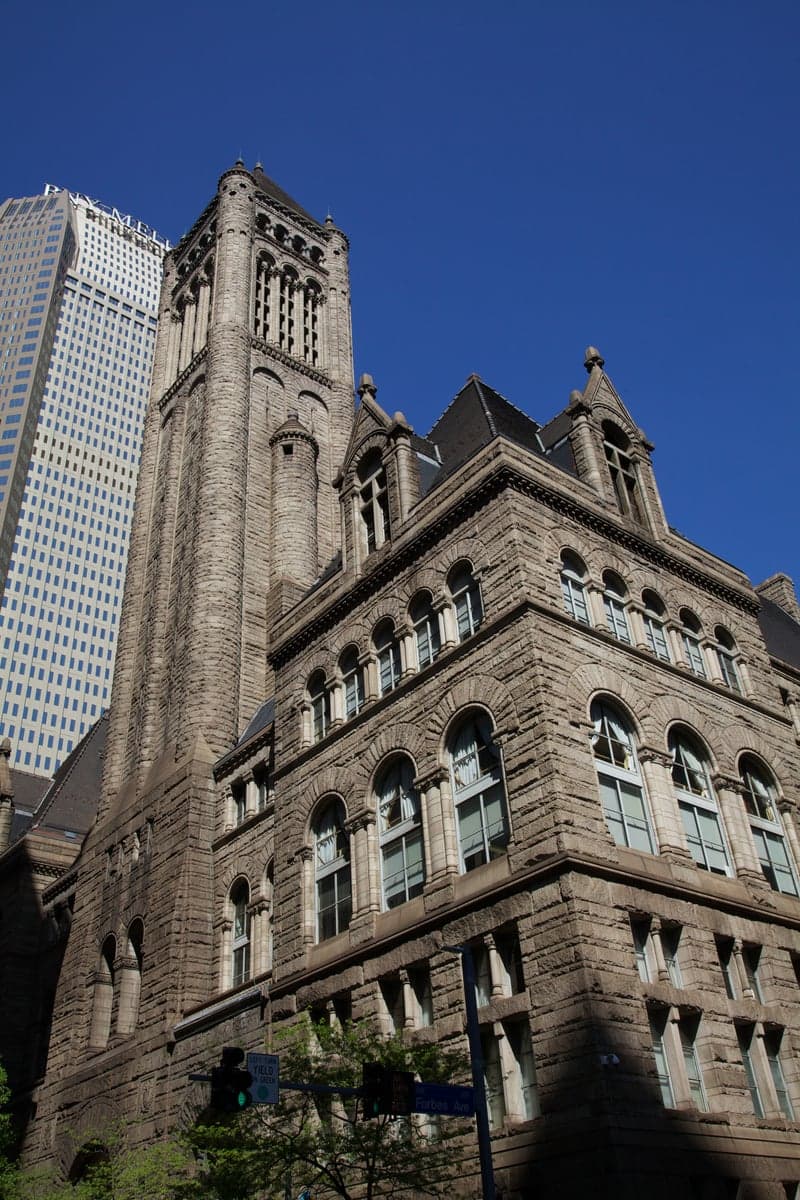
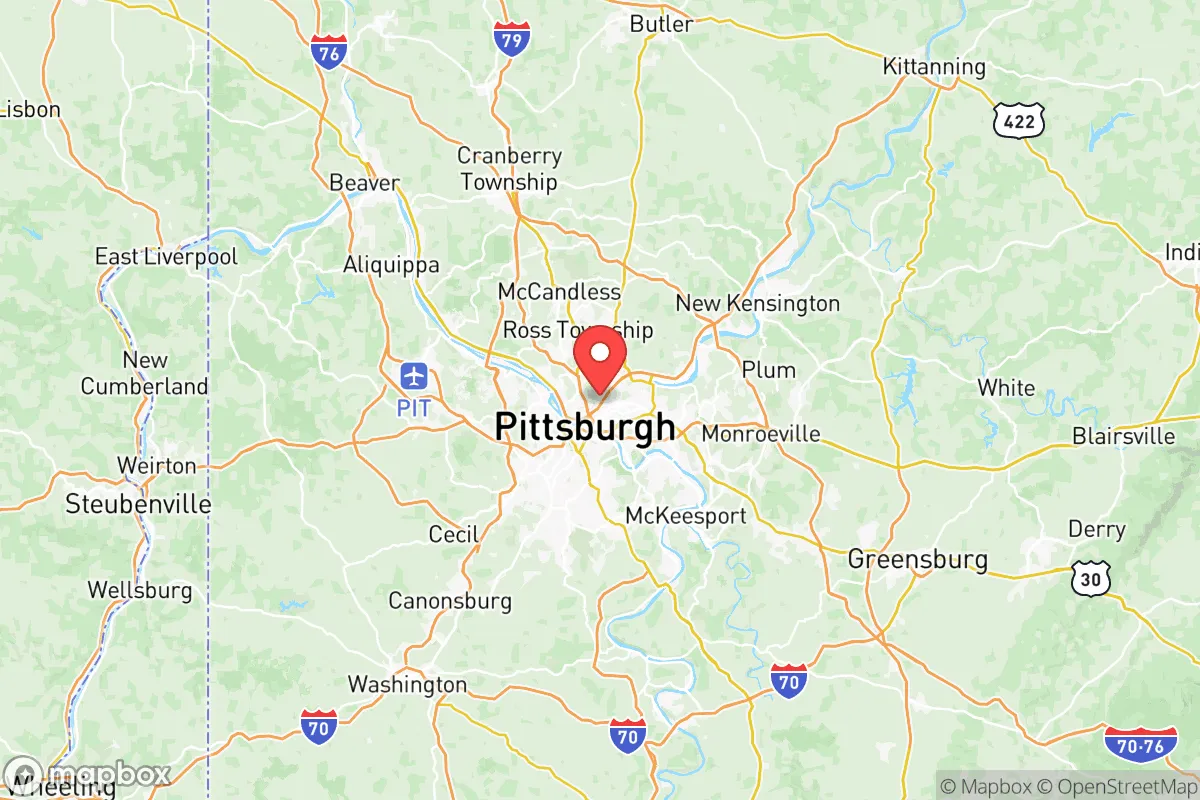
Photo: Wikipedia
Demographics of Allegheny County
Affluence Level in Allegheny County
A middle-class area roughly in line with national averages across income, home values, education, and employment.
People of Allegheny County
Allegheny County is home to just over 1.24 million residents, a population that has stabilized after decades of decline, creating a region defined by its deep-rooted ethnic enclaves, a strong sense of place, and a population that is older and more settled than the national average. The county’s character is shaped by the legacy of 19th- and early 20th-century European immigration, with a white population of 76.1% that is heavily concentrated in the eastern and southern suburbs, while a significant Black population (12.4%) is centered in the city of Pittsburgh and its immediate eastern neighborhoods. The foreign-born share is a low 3.2%, reflecting a region that has not been a primary destination for recent international migration, though small but growing East/Southeast Asian (2.1%) and Indian-subcontinent (2.1%) communities are establishing footholds in suburban tech corridors. For a conservative-leaning audience, the county offers a mix of stable, family-oriented suburbs with strong Catholic and Protestant institutional roots, alongside a city that has become increasingly liberal, creating a distinct cultural and political divide between urban and suburban life.
Settlement & growth (pre-1960)
Long before European arrival, the area now known as Allegheny County was a contested borderland among the Iroquois Confederacy, the Lenape, and the Shawnee, who used the confluence of the Allegheny, Monongahela, and Ohio Rivers as a hunting and trading hub. The French established Fort Duquesne at the Point in 1754, but after the British victory in the French and Indian War, they built Fort Pitt in 1758, laying the foundation for the city of Pittsburgh. The first permanent American settlers were largely Scots-Irish and German farmers who pushed westward from Pennsylvania’s eastern counties in the 1770s and 1780s, settling along the river valleys in what are now the boroughs of Bridgeville and Canonsburg, where their Presbyterian and Lutheran congregations still anchor the community.
The industrial revolution transformed the county’s population. By the 1830s, the region’s vast coal and iron deposits drew waves of Irish immigrants fleeing the Great Famine, who dug the canals and laid the railroad tracks, settling in working-class neighborhoods like Lawrenceville and the Strip District. The steel boom after the Civil War, led by Andrew Carnegie and others, pulled in massive numbers of Eastern and Southern Europeans. Between 1880 and 1920, hundreds of thousands of Poles, Slovaks, Italians, Croats, and Hungarians arrived, taking jobs in the mills and mines. They formed dense, self-sufficient ethnic enclaves: Polish Hill and the South Side became centers of Polish and Slavic life, while Bloomfield emerged as Pittsburgh’s “Little Italy,” a neighborhood that retains its Italian-American character to this day. German Jews also arrived in significant numbers, establishing a strong community in Squirrel Hill, which remains the historic heart of Pittsburgh’s Jewish population.
The Great Migration brought a major demographic shift. Between 1910 and 1960, tens of thousands of Black Americans from the rural South—primarily from Virginia, the Carolinas, and Alabama—moved to Allegheny County for steel and manufacturing jobs. They settled overwhelmingly in Pittsburgh’s Hill District and Homewood, creating a vibrant cultural and commercial hub that was home to jazz clubs, Black-owned businesses, and a strong middle class. By 1960, the county’s population peaked at over 1.6 million, with the steel industry employing one in three workers and the ethnic neighborhoods of the city and industrial river towns like McKeesport and Clairton at their most dense and insular.
Modern era (post-1965)
The collapse of the steel industry in the 1970s and 1980s triggered a profound demographic upheaval. Between 1970 and 2000, the county lost over 300,000 residents, as manufacturing jobs vanished and families left for the Sun Belt. The white ethnic neighborhoods of the city hollowed out, with many families moving to the outer suburbs of the North Hills (like Wexford and Cranberry Township) and the South Hills (like Upper St. Clair and Bethel Park), where they found newer housing, better schools, and lower taxes. This suburbanization was heavily white and accelerated the racial segregation of the county: by 2020, Pittsburgh’s Black population was largely concentrated in a few eastern neighborhoods, while the suburbs remained overwhelmingly white.
The 1965 Hart-Cellar Act had a modest impact on Allegheny County compared to coastal cities. The foreign-born share remains low at 3.2%, but the composition has shifted. The most notable new group is East/Southeast Asian immigrants, particularly from Vietnam and China, who began arriving in the 1980s and 1990s. They have concentrated in the eastern suburbs, especially Monroeville and Plum, where a growing number of Asian-owned businesses and restaurants serve the community. The Indian-subcontinent population, now 2.1% of the county, is a more recent phenomenon, driven by the expansion of the University of Pittsburgh Medical Center (UPMC) and Carnegie Mellon University. Indian professionals, particularly in healthcare and technology, have settled in the Oakland neighborhood near the universities and in the affluent suburbs of Mt. Lebanon and Franklin Park. The Hispanic population, at 2.8%, is small but growing, with a concentration of Puerto Rican and Mexican families in the Beechview and Brookline neighborhoods of Pittsburgh.
The county’s Black population, 12.4% of the total, has experienced a net outmigration since 2000, as middle-class Black families have followed the same suburbanization pattern as whites, moving to Penn Hills and Wilkinsburg, while the poorest residents remain in the city’s struggling neighborhoods. The white population, while still the majority, has aged significantly: the median age in many white-majority suburbs is over 45, and the county’s overall population is only growing through a modest influx of young professionals and immigrants into the city’s revitalized urban core.
The future
Allegheny County is slowly becoming more diverse, but the pace is glacial compared to the nation as a whole. The white population is projected to continue its gradual decline, falling below 70% by 2040, while the East/Southeast Asian and Indian-subcontinent populations are expected to double, driven by continued hiring in healthcare and tech. The Hispanic population will also grow, but from a very small base, likely reaching 5-6% by 2040. The Black population share is expected to remain stable, as outmigration is offset by births and some return migration from the South.
The most significant demographic trend is the geographic dispersion of new residents. Unlike the dense ethnic enclaves of the past, the new immigrant communities are spreading across the suburbs, with no single neighborhood becoming a majority-minority enclave. This is creating a more integrated, if less culturally distinct, county. The city of Pittsburgh is seeing a revival of its urban core, with young professionals and empty-nesters moving into East Liberty and Lawrenceville, but the outer suburbs continue to grow, attracting families seeking good schools and low crime. The cultural identity of the county is evolving from a blue-collar, ethnically European, Catholic-and-Protestant region into a more professional, secular, and politically polarized one, where the city leans heavily Democratic and the suburbs remain a mix of moderate and conservative voters.
For someone moving in now, Allegheny County offers a stable, affordable, and safe environment compared to the coasts, with strong public schools in the suburbs and a growing job market in healthcare, education, and technology. The population is not growing rapidly, but it is not shrinking either, creating a sense of continuity and community that is increasingly rare in America. The county is becoming a place where the old ethnic traditions of the past are fading, but a new, more diverse, and more suburban identity is slowly taking shape.

* Values derived from national, state, county, city and local statistics and may differ in a specific area. Last updated: 2026-06-12T09:29:08.000Z
Narrative content on this page is AI-generated and may contain mistakes. Verify any details that matter before acting on them.
ReloMaps may earn a commission from affiliate links at no extra cost to you.

