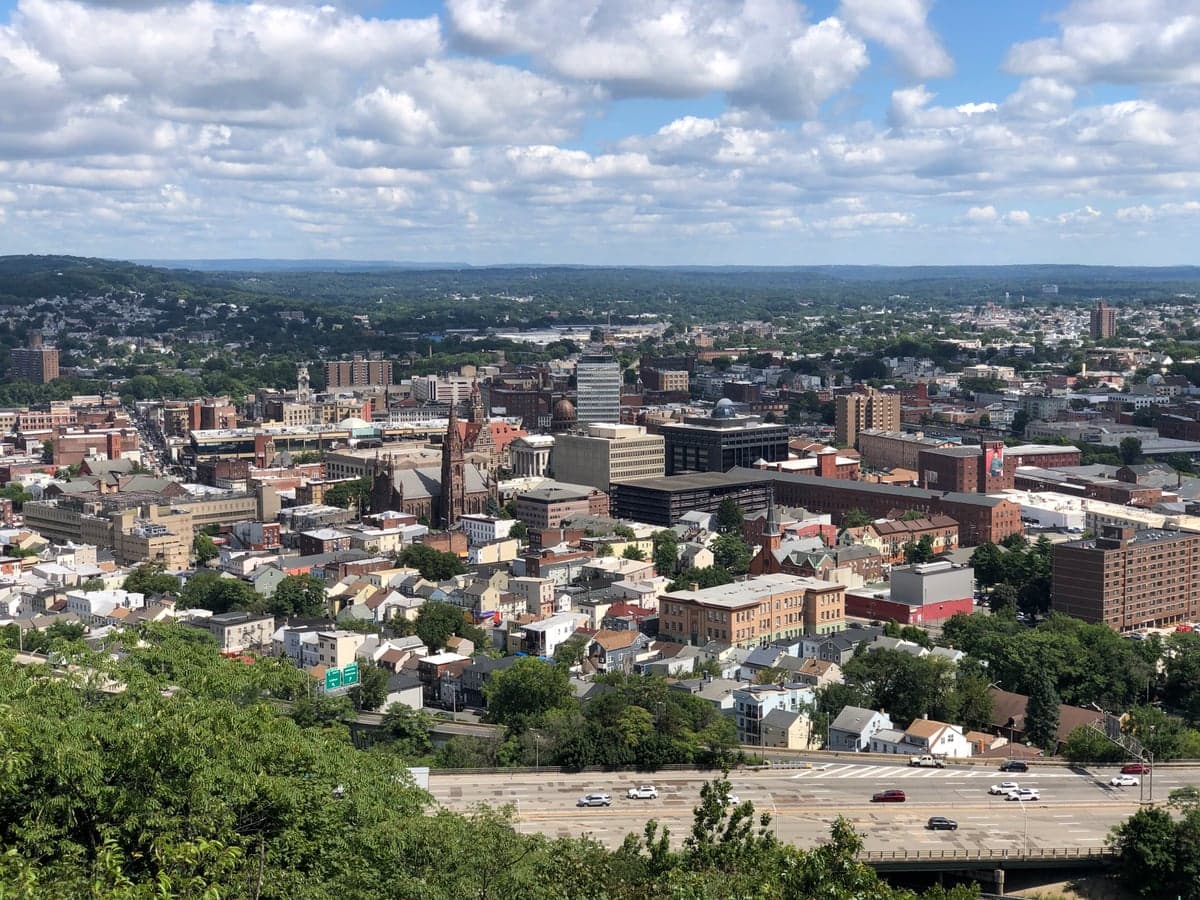
Photo: Wikipedia
Personal Sovereignty in Paterson, NJ
Viable for self-reliance. Generally workable, though some barriers may limit total independence.
What does Personal Sovereignty tell us?
Personal Sovereignty measures your capacity for self-reliance and independence with minimal government friction. Higher scores mean fewer barriers between you and the way you want to live... but it assumes you have the space you need and good neighbors.
What does this tell us?
Personal Sovereignty measures your capacity for self-reliance and independence with minimal government friction. Higher scores mean fewer barriers between you and the way you want to live... but it assumes you have the space you need and good neighbors.
State Policy
Energy independence: Importer (8% of energy produced in-state)
Personal Liberty
Homesteading

Personal Liberty Analysis
For a conservative-leaning individual or family weighing personal sovereignty, Paterson, New Jersey presents a challenging environment where state-level policies heavily constrain individual autonomy. The city itself, a dense urban center in Passaic County, operates within a broader state framework that consistently ranks among the most restrictive in the nation for gun rights, tax burdens, and regulatory oversight. While Paterson offers affordability relative to other North Jersey cities, the trade-off is a significant erosion of personal freedoms that preppers and survivalists would find difficult to navigate, particularly when compared to states like Pennsylvania or New Hampshire.
Tax burden and regulatory posture for individuals and families
New Jersey’s tax burden is the highest in the country, and Paterson residents feel this acutely. The state’s income tax rates range from 1.4% to 10.75%, with the top bracket hitting incomes over $1 million—a structure that penalizes high earners and small business owners. Property taxes in Paterson are among the highest in the nation, averaging over $8,000 annually on a median home value of roughly $250,000, according to 2024 data. This is a direct drain on household sovereignty, as a significant portion of income is forcibly redirected to state and local governments. The regulatory posture is equally aggressive: New Jersey’s state-level building codes, environmental regulations, and business licensing requirements are among the most complex in the Northeast. For a prepper or homesteader, this means any attempt to modify property—whether adding a shed, installing solar panels, or raising chickens—requires navigating a thicket of permits and inspections. The state’s strict land-use laws under the Municipal Land Use Law (MLUL) give local boards broad discretion to deny or delay projects, undermining the ability to become self-reliant on one’s own land.
Self-defense and gun law specifics in Paterson
New Jersey’s gun laws are among the most restrictive in the United States, and Paterson’s urban density amplifies the practical challenges. The state requires a Firearms Purchaser Identification Card (FPID) for handgun purchases, a process that involves fingerprinting, background checks, and a multi-month wait. Carrying a concealed handgun is effectively impossible for most residents due to the state’s “justifiable need” standard, which was only partially loosened after the 2022 Bruen decision. Even now, the state imposes a “sensitive places” ban that prohibits firearms in parks, public transit, and many private businesses unless explicitly posted. Magazine capacity is capped at 10 rounds, and “assault weapons” are banned by name, including common semi-automatic rifles like the AR-15. For a survivalist, this means self-defense options are severely limited. Paterson’s crime rate—particularly violent crime—is high, with a 2024 violent crime rate roughly 3 times the national average, per FBI data. The combination of high crime and restrictive gun laws creates a scenario where law-abiding citizens are disarmed while criminals operate with impunity. Stand-your-ground laws do not exist in New Jersey; the state imposes a duty to retreat in public spaces, further eroding the ability to defend oneself without legal jeopardy.
Self-reliance and homesteading viability in an urban setting
Paterson’s urban grid and small lot sizes make traditional homesteading nearly impossible. The typical residential lot in the city is less than 5,000 square feet, with many homes on narrow 25-foot-wide plots. Zoning laws are strict: backyard chickens are prohibited in most residential zones, and keeping goats, bees, or livestock is outright banned. The city’s soil quality is poor, often contaminated by industrial legacy, making gardening a challenge without raised beds and imported soil. Off-grid feasibility is virtually nil—New Jersey requires all homes to be connected to the municipal water and sewer system, and solar panel installations must be grid-tied under state net metering rules. Rainwater collection is restricted to 55 gallons per property without a permit, per state health codes. For a prepper seeking self-reliance, Paterson offers little. The closest viable alternative is to look at rural areas in Passaic County’s northwestern townships, like West Milford or Ringwood, where lot sizes exceed one acre and zoning is more permissive. However, even there, state-level regulations on septic systems, well water, and building setbacks remain onerous. The bottom line: Paterson is a place to work and earn, not to homestead.
Personal liberties: parental rights, medical autonomy, speech, and property
New Jersey’s state government has a history of preempting local control on issues of personal liberty. Parental rights are constrained by state mandates: the New Jersey Student Learning Standards include comprehensive sex education that parents cannot opt their children out of, and the state’s anti-bullying law (the “Anti-Bullying Bill of Rights”) gives school administrators broad authority to investigate and discipline students for speech deemed harassing, even off-campus. Medical autonomy is similarly limited. New Jersey has a mandatory childhood vaccination schedule with no philosophical exemption, only medical and religious exemptions, and the latter are increasingly challenged in court. During the COVID-19 pandemic, the state imposed some of the longest-lasting mask mandates and business restrictions in the nation, including a statewide indoor mask mandate that lasted until March 2022. Property rights are also weak: the state’s eminent domain powers are broad, as seen in the 2005 Kelo-style case of City of Paterson v. Paterson Parking Authority, where the city condemned private land for a private development project. Free speech is protected under the First Amendment, but New Jersey’s “bias intimidation” law can elevate hate speech charges to felonies, and local ordinances in Paterson restrict panhandling and public assemblies in certain zones. For a conservative concerned with government overreach, these policies represent a consistent pattern of state intrusion into family decisions, medical choices, and property rights.
Overall, Paterson ranks low on the personal sovereignty scale compared to other relocation options. The city’s affordability is its only real draw, but the cost in lost freedoms is steep. For a survivalist or prepper, the combination of high taxes, restrictive gun laws, impossible homesteading conditions, and aggressive state mandates creates an environment where self-reliance is actively discouraged. Neighboring states like Pennsylvania offer a stark contrast: lower taxes, constitutional carry, larger rural lots, and stronger parental rights. If you must live in North Jersey for work, Paterson is a place to rent cheaply and save for an exit, not a place to plant roots and build a sovereign life. The strategic move is to treat Paterson as a temporary base while positioning for a permanent relocation to a jurisdiction that respects individual autonomy.

* Values derived from national, state, county, city and local statistics and may differ in a specific area. Last updated: 2026-05-02T13:03:33.000Z
Narrative content on this page is AI-generated and may contain mistakes. Verify any details that matter before acting on them.
ReloMaps may earn a commission from affiliate links at no extra cost to you.

