Photo: Wikipedia
Demographics of Paterson, NJ
Affluence Level in Paterson, NJ
A below-average socioeconomic profile. Incomes, home values, and educational attainment trail the U.S., with higher poverty and unemployment.
People of Paterson, NJ
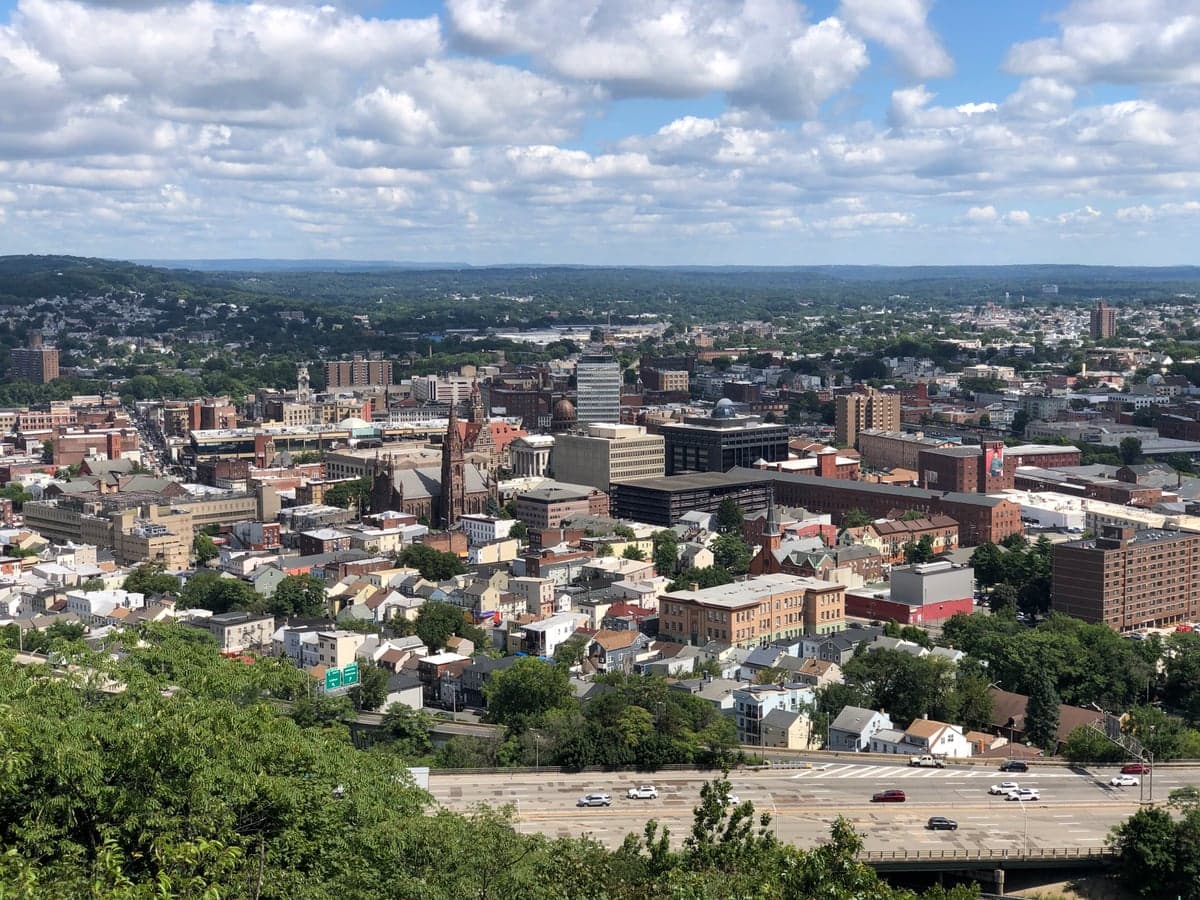
Paterson, New Jersey, is a dense, majority-Hispanic city of 157,660 residents, where just 7.8% of the population identifies as non-Hispanic White and over a third are foreign-born. It is a working-class industrial hub with a distinctive identity shaped by waves of immigration, a shrinking middle class, and a young median age. The city’s character is defined by its historic silk and locomotive factories, now largely vacant, and by the vibrant, often struggling, neighborhoods that have absorbed newcomers for over a century.
How the city was settled and grew
Paterson was founded in 1792 as the nation’s first planned industrial city, harnessing the Great Falls of the Passaic River for water power. The original population was a mix of English, Dutch, and German millwrights and laborers who settled near the falls in the Great Falls Historic District. The 19th century brought massive waves of Irish immigrants fleeing the Potato Famine, who built St. John’s Cathedral and concentrated in the Riverside neighborhood along the Passaic. By the 1880s, Italian immigrants dominated the silk mills, creating a tight-knit enclave in Little Italy (centered on Cianci Street), while Eastern European Jews arrived to work in the garment trade, settling in the Eastside near the Jewish Community Center. These groups built the city’s dense, brick-rowhouse fabric and established Paterson as a “Silk City” that attracted skilled artisans from across Europe through the 1920s.
Modern era (post-1965)
The 1965 Hart-Cellar Act and the collapse of Paterson’s manufacturing base after the 1970s reshaped the population dramatically. White flight accelerated: the non-Hispanic White share fell from roughly 60% in 1970 to under 8% today. The 1st Ward, once Italian and Jewish, became the heart of the Dominican and Puerto Rican community, now the city’s largest ethnic bloc. The 4th Ward absorbed a wave of Black migrants from the American South and later from the Caribbean, particularly Haitians and Jamaicans, who now make up much of the 23.3% Black population. A smaller but significant Indian-subcontinent community (4.4% of the population) arrived from the 1990s onward, concentrated in the Lakeview neighborhood near the city’s eastern border, where small groceries and temples serve Gujarati and Punjabi families. The East/Southeast Asian population (0.3%) is negligible, limited to a few dozen Filipino and Vietnamese families scattered across the city. The foreign-born share (23.6%) is driven overwhelmingly by Latin American immigration, with the Bunker Hill neighborhood seeing a recent influx of Peruvian and Ecuadorian arrivals.
The future
Paterson’s population is likely to remain majority Hispanic, with the Dominican and Puerto Rican communities plateauing as second- and third-generation families move to suburbs like Clifton or Wayne. The Indian-subcontinent enclave in Lakeview is growing slowly, driven by chain migration and proximity to Edison’s larger Indian hub, but it remains a small share. The Black population is aging and declining slightly, as younger Black families leave for Passaic County suburbs. The city is not homogenizing into a single culture; instead, it is tribalizing into distinct enclaves—the 1st Ward is overwhelmingly Dominican, the 4th Ward predominantly Black, and the Eastside a mix of older Italian holdouts and newer Hispanic arrivals. The college-educated share (12.5%) is among the lowest in New Jersey, and the city’s population is projected to remain flat or decline slightly over the next decade, as births are offset by out-migration of families seeking better schools and safety.
For someone moving in now, Paterson offers the lowest housing costs in Passaic County and deep-rooted immigrant communities, but it is a city where poverty, crime, and underfunded schools are persistent realities. The population is young, dense, and overwhelmingly Hispanic, with small but distinct Indian and Black enclaves. It is not a place of upward mobility for most newcomers, but rather a first-stop gateway for those willing to trade amenities for affordability and community ties.

* Values derived from national, state, county, city and local statistics and may differ in a specific area. Last updated: 2026-05-02T13:03:33.000Z
Narrative content on this page is AI-generated and may contain mistakes. Verify any details that matter before acting on them.
ReloMaps may earn a commission from affiliate links at no extra cost to you.

