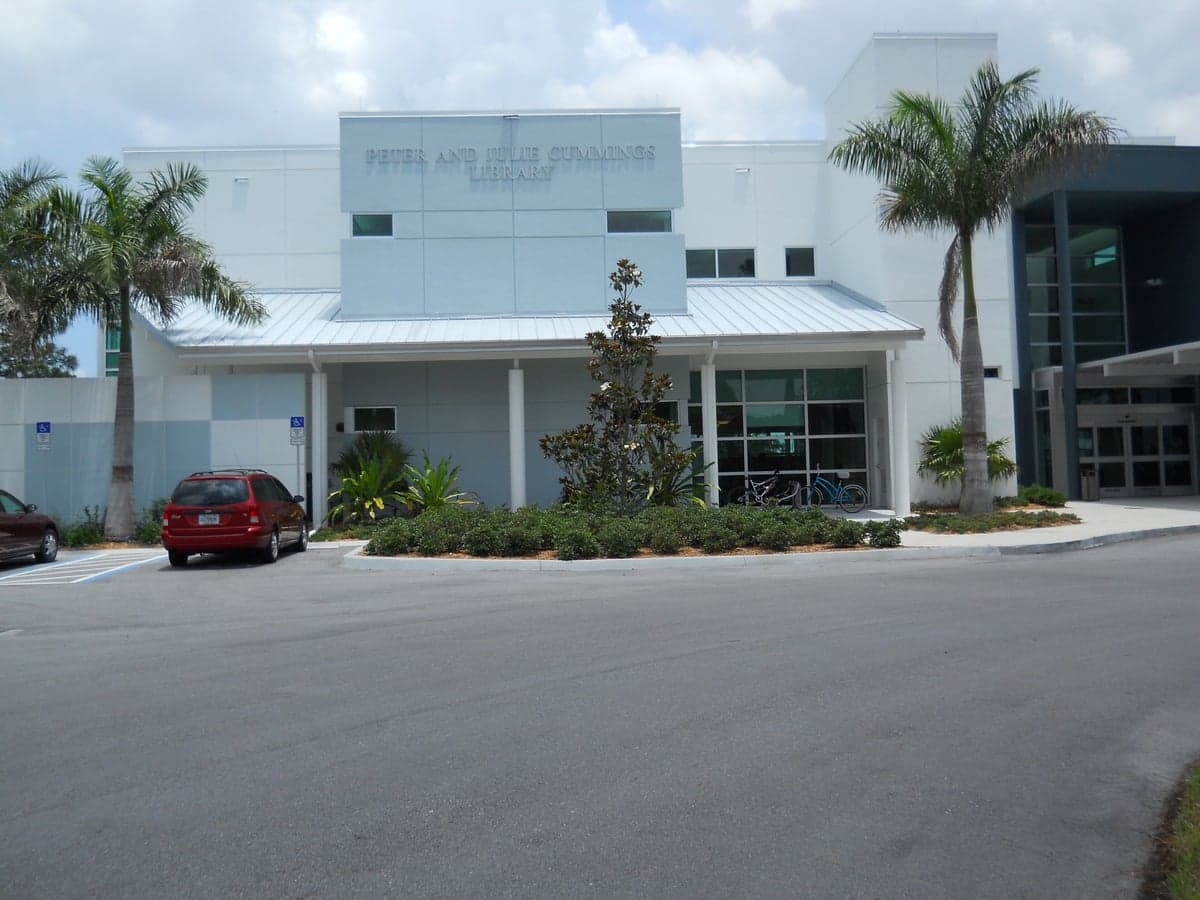
Photo: Wikipedia
Demographics of Palm City, FL
Affluence Level in Palm City, FL
An upper-middle-class area. Household wealth, education levels, and homeownership run ahead of national benchmarks.
People of Palm City, FL
Palm City, Florida, is a predominantly white, highly educated, and family-oriented unincorporated community of roughly 25,700 residents, where nearly half of adults hold a college degree and the foreign-born population is a low 2.3%. Its character is defined by a quiet, suburban feel with a strong sense of local tradition, anchored by equestrian properties, golf-course neighborhoods, and the South Fork of the St. Lucie River. The population is notably less diverse than the broader Martin County average, with a Hispanic share of 9.7% and very small Black (0.6%), East/Southeast Asian (1.9%), and Indian-subcontinent (0.6%) communities. For a relocating family or individual seeking a stable, low-crime, and predominantly white-collar environment, Palm City represents a deliberate, slower-paced alternative to the more transient coastal towns of Florida’s east coast.
How the city was settled and grew
Palm City was not a historic pioneer settlement but a planned agricultural and residential development that began in the 1910s and 1920s. The area was originally part of a large land grant known as the Hobe Sound tract, but the modern community was conceived by the Palm City Land Company, which drained wetlands and laid out a grid of streets and canals. The earliest permanent residents were Midwestern farmers and Northern retirees drawn by cheap land and the promise of a temperate climate for citrus and winter vegetables. These initial settlers clustered around what is now Martin Highway and Citrus Boulevard, building modest wood-frame homes and small packing houses. The community remained a sparsely populated farming outpost through the 1940s, with a population of only a few hundred. The post-World War II era brought a second wave: returning veterans and their families, many from the Northeast, who built ranch-style homes in the Palm City Park area, establishing the community’s enduring identity as a place for young families seeking space and safety.
Modern era (post-1965)
The passage of the 1965 Immigration and Nationality Act had a minimal direct impact on Palm City, as the community’s growth remained overwhelmingly domestic. The real transformation began in the 1970s and 1980s with the construction of the Palm City Bridge (connecting to Stuart) and the extension of I-95. This infrastructure opened the area to a wave of white-collar professionals and corporate transferees from the Northeast and Midwest, many of whom worked in finance, healthcare, or engineering in nearby Stuart, Port St. Lucie, or West Palm Beach. These newcomers settled in master-planned subdivisions such as Harbor Ridge and Marsh Island, which offered golf courses, gated entries, and waterfront lots. The Hispanic population, now 9.7%, grew modestly during this period, largely through domestic migration from other Florida counties rather than direct immigration, and is dispersed throughout the community rather than concentrated in a single barrio. The East/Southeast Asian and Indian-subcontinent communities, each under 2%, are primarily composed of professionals in medicine and technology who arrived in the 1990s and 2000s, living in newer subdivisions like Stuart West and Riverwood. The Black population remains very small (0.6%), a reflection of Palm City’s historical lack of industrial or agricultural labor demand that drew Black workers to other parts of Florida.
The future
Palm City’s population is projected to grow slowly but steadily, with the county planning for an additional 5,000–7,000 housing units over the next decade, mostly in the western portion of the community near I-95 and along the South Fork corridor. The demographic trend is toward slight diversification, driven primarily by the growth of the Hispanic population (expected to reach 12–14% by 2035) and a small increase in East/Southeast Asian residents, many of whom are second-generation professionals moving from larger metro areas. The Indian-subcontinent community is likely to remain small but stable, anchored by a handful of medical practices and tech-adjacent roles. The white, non-Hispanic share will decline gradually from its current 83% but will remain the overwhelming majority. The community’s cultural identity is evolving from a purely rural-agricultural past to a more suburban, amenity-focused present, with new retail and medical centers along Martin Highway and Gatlin Boulevard attracting younger families. However, Palm City is unlikely to become a truly diverse or urbanized place; its character will remain that of a stable, family-oriented, and predominantly white exurb with a strong emphasis on schools, low crime, and outdoor recreation.
For someone moving in now, Palm City offers a predictable, low-drama environment where the population is stable, educated, and largely homogeneous. The community is not experiencing rapid demographic upheaval or cultural conflict; instead, it is slowly absorbing modest diversity while retaining its core identity as a safe, spacious, and conservative-leaning suburb. The key trade-off is between this stability and the limited cultural and economic dynamism found in more diverse, fast-growing Florida cities.

* Values derived from national, state, county, city and local statistics and may differ in a specific area. Last updated: 2026-09-28T20:45:33.000Z
Narrative content on this page is AI-generated and may contain mistakes. Verify any details that matter before acting on them.
ReloMaps may earn a commission from affiliate links at no extra cost to you.

