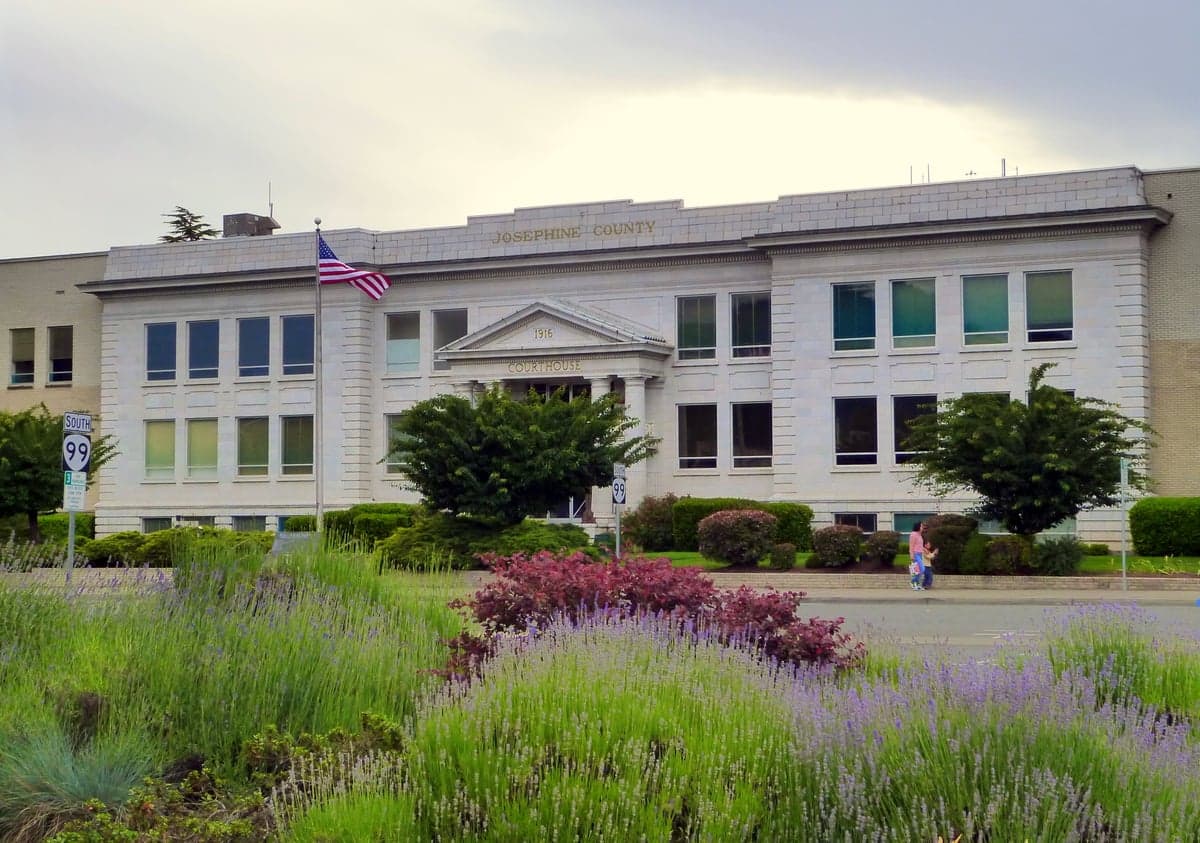
Photo: Wikipedia
Personal Sovereignty in Josephine County
Viable for self-reliance. Generally workable, though some barriers may limit total independence.
What does Personal Sovereignty tell us?
Personal Sovereignty measures your capacity for self-reliance and independence with minimal government friction. Higher scores mean fewer barriers between you and the way you want to live... but it assumes you have the space you need and good neighbors.
What does this tell us?
Personal Sovereignty measures your capacity for self-reliance and independence with minimal government friction. Higher scores mean fewer barriers between you and the way you want to live... but it assumes you have the space you need and good neighbors.
State Policy
Energy independence: Importer (35% of energy produced in-state)
Personal Liberty
Homesteading

Personal Liberty Analysis
Josephine County, Oregon, offers one of the strongest environments for personal sovereignty in the Pacific Northwest, particularly for those who prioritize limited government, self-defense, and self-reliance. Stretching from the Rogue Valley to the remote Illinois Valley, the county has a well-earned reputation as a sanctuary from Salem’s overreach, with residents in towns like Grants Pass, Cave Junction, Merlin, Wolf Creek, Selma, and Williams actively resisting state-level mandates. For single individuals and families seeking maximum personal autonomy—especially those with a conservative or survivalist mindset—Josephine County stands as a functional alternative to Portland’s regulatory climate, where state laws are often met with local defiance and enforcement is stretched thin.
Tax burden and regulatory posture across Josephine County’s towns
Oregon’s overall tax picture is mixed: no sales tax, but a progressive income tax that can reach 9.9% on high earners. Property taxes, capped by Measure 5 at roughly 1% of market value, are moderate. However, Josephine County keeps its local regulatory footprint small. The county has no comprehensive land-use plan for most unincorporated areas, deferring to state minimums. In practice, that means Grants Pass has the strictest local codes (building permits, business licenses), while rural zones near Cave Junction and Selma operate with minimal oversight. The county’s budget struggles—having defunded the sheriff’s office in the 2010s—actually fostered self-reliance, as residents learned to solve problems without depending on government. For those looking to minimize tax exposure, property in O’Brien or Wolf Creek can be had for a fraction of the cost of Portland metro, and no sales tax means big-ticket purchases are cheaper at local hardware stores. The regulatory posture is best described as “leave us alone,” with permitting delays common only in the incorporated city limits.
Self-defense laws and gun culture specific to Grants Pass and beyond
Oregon law allows concealed carry with a license (shall-issue, $65 fee) and open carry without permit in most rural areas, but recent state legislation—Measure 114 (permit-to-purchase and magazine ban) and 2023’s firearm storage law—has triggered intense local pushback. Josephine County’s Board of Commissioners voted to become a “Second Amendment Sanctuary” and the Sheriff’s Office has publicly stated it will not enforce Measure 114 unless fully funded and legally sound. In practice, gun culture is deeply ingrained. Grants Pass has multiple gun shops and ranges (e.g., Rogue Valley Shooting Center), while Cave Junction hosts regular hunting and shooting events. Magazine bans are ignored by many in rural Merlin and Williams. For the prepper mindset, home defense is straightforward: you can own NFA items (suppressors, SBRs) with federal paperwork, and local law enforcement respects the right to armed self-defense. Castle doctrine applies in Oregon, with no duty to retreat in one’s home or vehicle. The county’s low population density—under 90,000 people spread over 1,640 square miles—means armed response to threats is a personal responsibility, and neighbors often train together in Selma’s informal shooting groups.
Self-reliance and off-grid homesteading feasibility in Josephine County
Land-use regulations in unincorporated areas are among Oregon’s most permissive. Minimum lot sizes vary by zone: Exclusive Farm Use (EFU) zones require 80 acres, but Rural Residential (RR-5) allows 5-acre parcels with a dwelling, and Forest Land zones allow off-grid cabins on 40+ acres. In practice, many residents live on smaller “loophole” parcels created before 1993. Off-grid living is viable: solar panels, rainwater catchment (Oregon allows for household use with registration), and composting toilets are common. The county does not enforce state building codes for owner-built dwellings in rural areas unless you want to sell the property. Williams is a hotspot for permaculture homesteads, while O’Brien and Wolf Creek have deep-well water and timber tracts perfect for off-grid setups. Cave Junction has more affordable land (under $10,000 per acre in many listings) with less scrutiny. The catch? County fire services are limited outside Grants Pass—meaning self-reliance extends to wildfire defense, which many preppers view as an acceptable trade-off for liberty.
Parental rights, medical autonomy, and property freedom in Josephine County
On parental rights and medical autonomy, Oregon state law is progressive (e.g., no parental consent required for some minors’ medical care), but local enforcement is lax. Josephine County’s school districts—Grants Pass School District 7, Three Rivers School District—are more conservative than Portland’s, with school boards that have resisted certain state health mandates. The county has a strong homeschool community, and parental opt-out forms for vaccines and curriculum objects are routinely honored. Medical freedom is bolstered by natural medicine clinics in Selma and Williams, and the county’s few emergency rooms (Asante Grants Pass, Three Rivers Community Hospital) do not pressure patients into invasive treatments. Property rights are fiercely protected: Oregon’s Measure 49 (2007) still allows homeowners to build a home on land zoned for resource use, and Josephine County’s planning department is known for minimal interference. Eminent domain is rare, and homeowners in Merlin and Wolf Creek frequently post “No Trespassing” signs without fear of government overreach. Free speech in public forums—especially at county commission meetings—is robust, with residents routinely delivering unvarnished critiques of state policies.
Overall, Josephine County delivers a grade of personal sovereignty that towers over nearby Oregon metro areas. While state-level burdens like income tax and uncertain gun legislation remain, local culture and enforcement practices mitigate them. In towns from Grants Pass to Cave Junction, the ethos is self-reliance, not entitlement—a place where government exists to protect rights, not dictate lifestyles. For relocation-minded conservatives and preppers who want to live as free as possible in a blue state, Josephine County is arguably the top pick in Oregon.

* Values derived from national, state, county, city and local statistics and may differ in a specific area. Last updated: 2026-06-01T12:03:19.000Z
Narrative content on this page is AI-generated and may contain mistakes. Verify any details that matter before acting on them.
ReloMaps may earn a commission from affiliate links at no extra cost to you.

