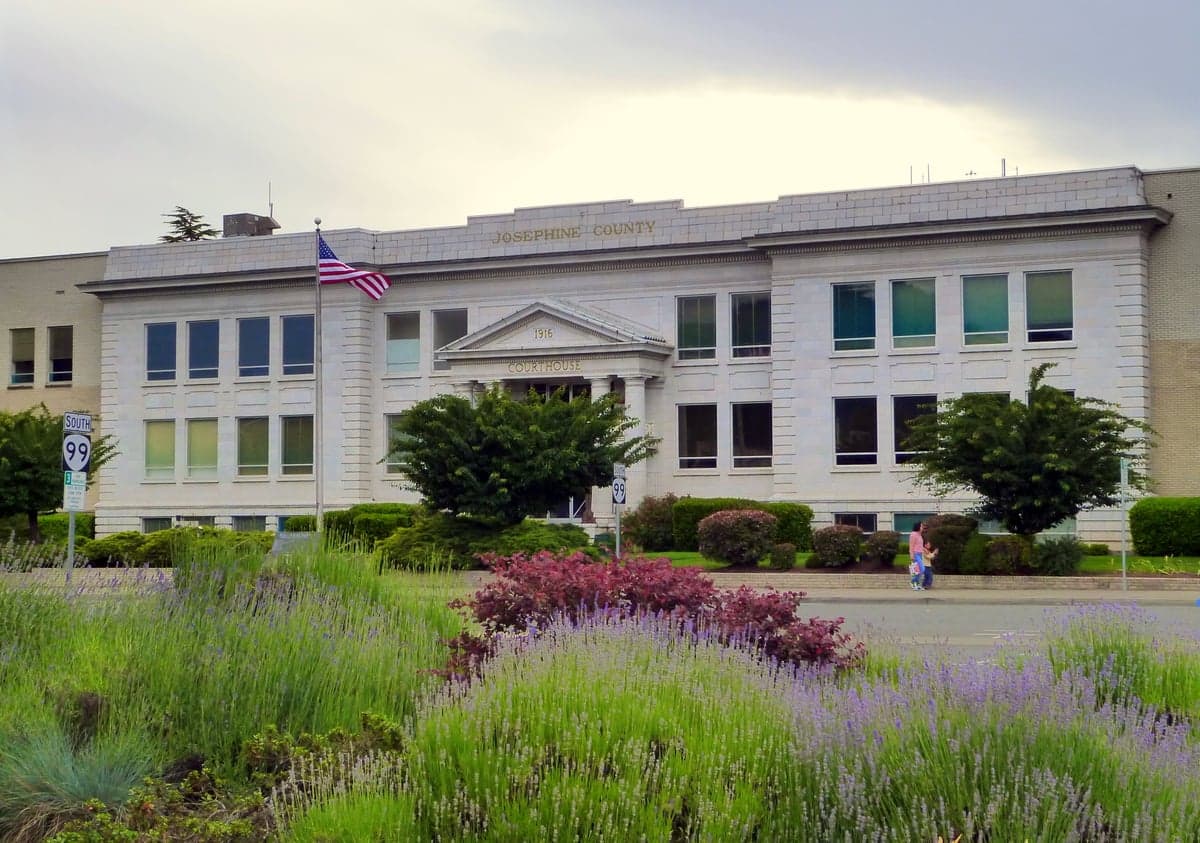
Photo: Wikipedia
Demographics of Josephine County
Affluence Level in Josephine County
A middle-class area roughly in line with national averages across income, home values, education, and employment.
People of Josephine County
Josephine County, Oregon, is home to roughly 88,000 residents, a population that remains overwhelmingly white (83.8%) and native-born (only 1.6% foreign-born), with a distinctive cultural identity rooted in 19th-century mining booms and 20th-century back-to-the-land migrations. The county’s people are notably less diverse and less college-educated (19.7%) than Oregon’s state average, and they are concentrated in small cities like Grants Pass, Cave Junction, and the unincorporated communities of Merlin, Williams, and Selma. This is a region where a libertarian, self-reliant ethos runs deep, shaped by a history of resource extraction and a steady influx of domestic migrants seeking rural isolation.
Settlement & growth (pre-1960)
Long before European contact, the area now known as Josephine County was the homeland of the Takelma people, who lived in semi-permanent villages along the Rogue and Illinois Rivers. The Takelma were forcibly removed to the Siletz and Grand Ronde reservations after the Rogue River Wars of the 1850s, a conflict that opened the region to American settlement. No Spanish, French, or Russian colonization occurred here; the first non-Native settlers were American miners and traders who arrived after the 1848 California Gold Rush, pushing north into Oregon Territory.
The defining event for Josephine County’s population was the discovery of gold in the Illinois River Valley in the early 1850s. Prospectors—mostly native-born Americans from the eastern states, along with a scattering of Cornish, Irish, and German immigrants—flooded into what would become the towns of Grants Pass (founded 1865), Kerby (1850s), and Waldo (a now-ghost town). The county was officially created in 1856, named after a local pioneer woman, and its early economy was almost entirely extractive: gold, copper, and later timber. By the 1880s, the Oregon & California Railroad reached Grants Pass, cementing the town as the county’s commercial hub and attracting a second wave of settlers—Midwestern farmers and small-town merchants who established orchards and livestock operations in the fertile Rogue River Valley.
The timber industry dominated from the 1920s through the 1970s, drawing a third major wave: Dust Bowl refugees from Oklahoma, Arkansas, and Texas, who arrived during the Great Depression and World War II. These “Okies” and “Arkies” settled in rural pockets like Wilderville, Murphy, and Wonder, working in sawmills and logging camps. They brought a conservative, evangelical Protestant culture that remains influential today. The county’s population grew steadily but modestly, reaching about 26,000 by 1950, and remained almost entirely white and native-born.
Modern era (post-1965)
The 1965 Hart-Cellar Act had almost no direct effect on Josephine County. Unlike metropolitan Oregon, the county received virtually no immigrants from Asia, Latin America, or the Indian subcontinent. The foreign-born share today—just 1.6%—is among the lowest in the state, and the East/Southeast Asian population (0.7%) and Indian subcontinent population (0.1%) are negligible. The Hispanic population, at 8.4%, is the largest minority group, but it is overwhelmingly native-born and concentrated in agricultural and service jobs in Grants Pass and Cave Junction.
The real demographic story since 1965 is domestic migration—specifically, two countervailing flows. The first was the “back-to-the-land” movement of the 1970s, when young, countercultural whites from California and the Pacific Northwest settled in rural Josephine County, especially in Williams and the Illinois Valley around Cave Junction. These newcomers were often college-educated, environmentally minded, and politically liberal, creating a cultural tension with the older, conservative timber-and-mining population. The second flow, accelerating after 2000, has been an influx of retirees and remote workers from California, Oregon’s Willamette Valley, and other high-cost states, drawn by low housing prices and a perceived “rural lifestyle.” This wave has concentrated in Grants Pass and the Merlin area, pushing up home prices and fueling a slow but steady population increase from about 75,000 in 2000 to 88,000 today.
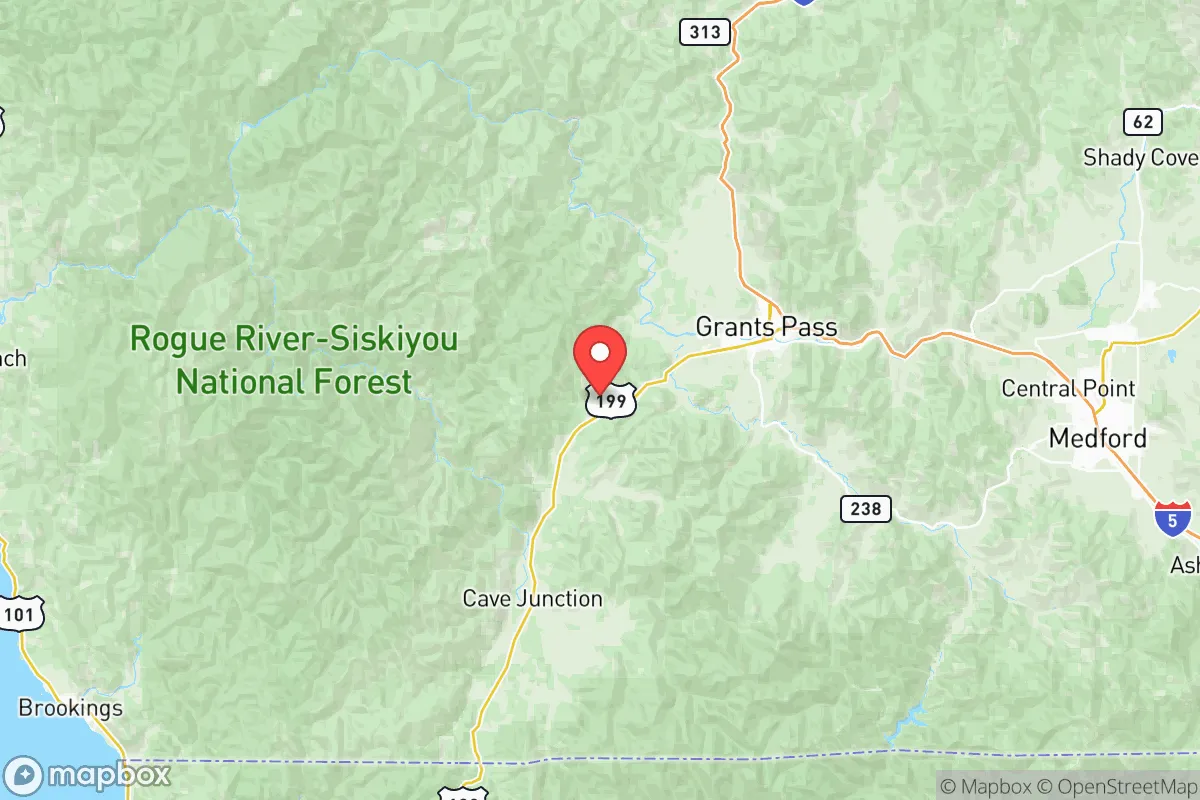
Suburbanization has been limited. Josephine County has no major suburbs; instead, growth has taken the form of low-density exurban development along Highway 199 and the Rogue River corridor. The county remains one of Oregon’s least densely populated, with a strong anti-government, property-rights political culture that resists zoning and planning. The Black population (0.5%) is tiny and scattered, with no historic enclave.
The future
Josephine County’s population is likely to continue growing slowly, driven by domestic in-migration from California and the Pacific Northwest, but it will remain overwhelmingly white and native-born. The Hispanic share may rise modestly as second-generation families age into the workforce, but the county lacks the agricultural or industrial base to attract significant new immigration. The East/Southeast Asian and Indian populations are unlikely to grow beyond trace levels, as there are no ethnic enclaves, ethnic economies, or chain migration networks to sustain them.
The cultural divide between the older conservative base and the newer liberal-leaning transplants will probably persist, but the county’s overall political character is likely to remain conservative, as the newcomers are often libertarian-leaning rather than progressive. The county is not tribalizing into distinct ethnic enclaves; rather, it is slowly homogenizing into a whiter, older, and more politically polarized version of itself. The next 10-20 years will likely see continued low-density sprawl along the Rogue River, further strain on water and wildfire resources, and a gradual aging of the population as younger residents leave for urban jobs.
For someone moving in now, Josephine County offers a deeply rural, culturally homogeneous environment where self-reliance and property rights are paramount, but where economic opportunity is limited and public services are thin. It is a place that has changed less demographically than almost any other county in Oregon, and it is likely to stay that way.

* Values derived from national, state, county, city and local statistics and may differ in a specific area. Last updated: 2026-06-01T12:03:19.000Z
Narrative content on this page is AI-generated and may contain mistakes. Verify any details that matter before acting on them.
ReloMaps may earn a commission from affiliate links at no extra cost to you.

