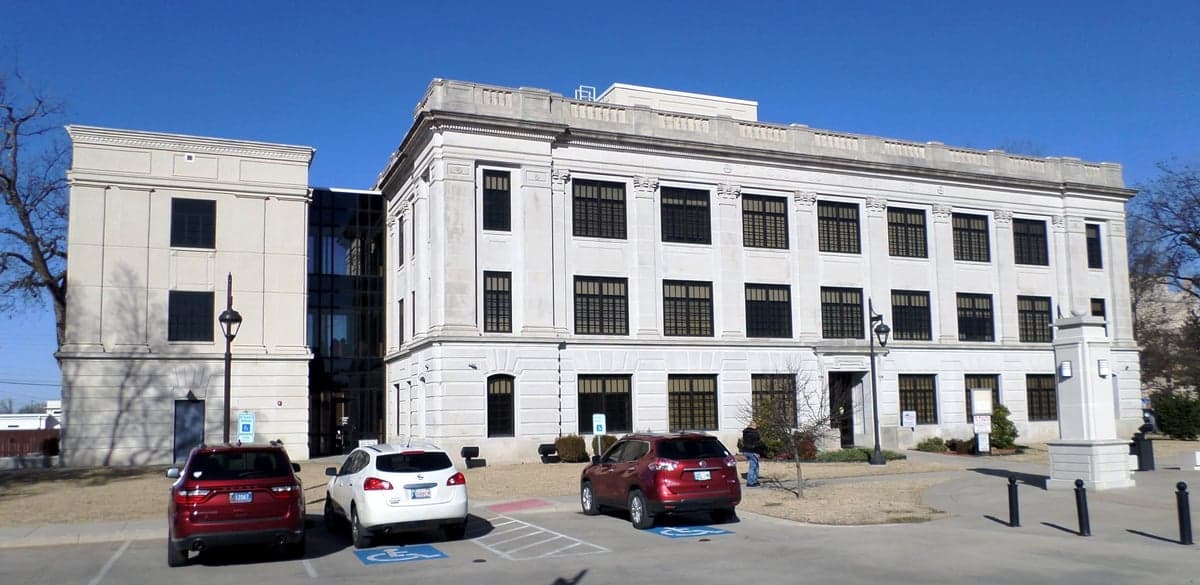
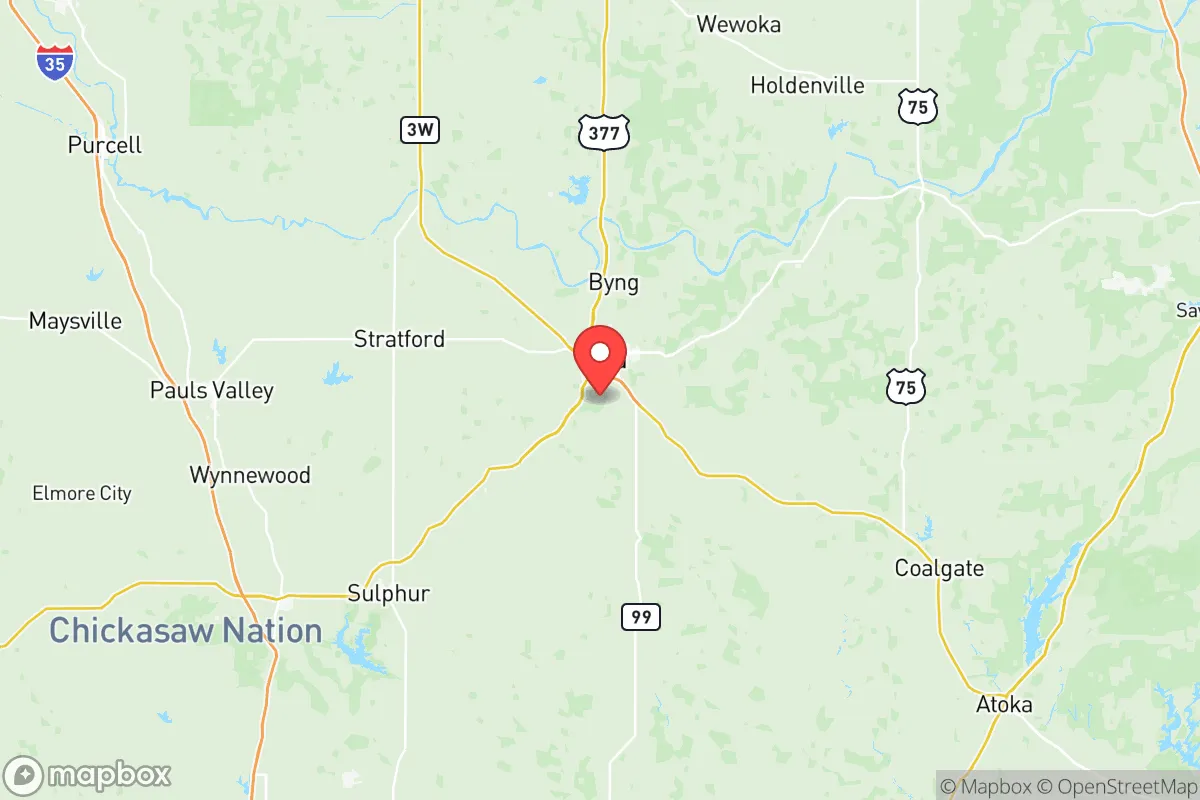
Photo: Wikipedia
Political ClimatePolitical Climate in Pontotoc County
Showing district-level results — no local-only data available.
Local Political AnalysisPolitical Analysis of Pontotoc County
Pontotoc County is a deeply conservative area, but it’s not quite as red as the rest of Oklahoma. The county’s Cook PVI of R+17 is a full point shy of the state’s R+18, and that small gap reflects a real, if subtle, political diversity you won’t find in many other parts of the state. Ada, the county seat and home to East Central University, has historically been the most moderate part of the county, with precincts around the university and downtown occasionally voting closer to the state average or even tipping blue in local races. In contrast, the rural communities like Byng, Fitzhugh, and Roff are reliably deep red, often delivering 75-80% of their votes to Republican candidates. The real swing precincts are in the newer subdivisions on the north and west edges of Ada, where a mix of young families and commuters to the oil fields have made races for county commissioner and state house seats more competitive than you’d expect in a county this conservative.
How it compares
Compared to the state as a whole, Pontotoc County is slightly less Republican, but the difference is mostly academic. Oklahoma’s R+18 PVI is driven by the massive, reliably red rural counties in the Panhandle and the Tulsa suburbs, while Pontotoc’s R+17 is pulled down by Ada’s more moderate lean. In the 2024 presidential election, the county voted about 72% Republican, while the state as a whole was closer to 66%. That means a Republican candidate here does about 6 points better than they do statewide. For a Democrat, the math is brutal: winning Pontotoc County would require a candidate to outperform the state average by a similar margin, which hasn’t happened in a presidential race since 1996. The county’s trajectory has been steadily rightward since 2008, when Obama got 34% of the vote here; by 2020, Biden only managed 26%. That trend mirrors the state’s, but Pontotoc is moving a bit slower, likely because of the university’s moderating influence.
What this means for residents
For conservative residents, this is a comfortable place to live. Local government, school boards, and county commissions are almost entirely Republican, and the policy environment reflects that: low taxes, limited regulation, and a strong emphasis on Second Amendment rights and religious freedom. Ada’s city council, for example, has not had a Democratic member since 2018. For liberal residents, the reality is more isolating. While Ada itself has a small but active Democratic club and a few progressive-leaning churches, there’s no real political infrastructure. Running for office as a Democrat is seen as a long shot, and most liberal residents focus their energy on local issues like public school funding or the opioid crisis, where they can find common ground with moderate Republicans. The county’s political culture is polite but firm—people don’t usually argue about politics at the grocery store, but the assumption that everyone is conservative is strong enough that many liberals keep their views private.
One cultural distinction that sets Pontotoc County apart from the rest of Oklahoma is its relationship with the Chickasaw Nation. The tribe is the largest employer in the county, running the Chickasaw Nation Medical Center, the Artesian Hotel, and a range of other businesses in Ada. This creates a unique political dynamic: while the county votes overwhelmingly Republican, the Chickasaw Nation’s leadership has historically been more pragmatic, working with both parties to secure funding for healthcare and education. This has made local politics less ideologically rigid than in other parts of the state, with county officials often deferring to tribal leaders on economic development issues. It’s a reminder that in Pontotoc County, even in a deep red area, the most powerful political force isn’t a party—it’s the tribe.

State Political ClimatePolitical Climate in Oklahoma
State Political AnalysisPolitical Environment in the State
Oklahoma is one of the most reliably Republican states in the country, with a Cook Partisan Voting Index of R+18, meaning it votes about 18 points more Republican than the national average. The state hasn't voted for a Democratic presidential candidate since 1964, and every statewide elected office is held by a Republican. Over the last 20 years, the shift has been dramatic — Oklahoma was already red in the 2000s, but the rural exodus from the Democratic Party accelerated after 2008, and the state legislature now holds a supermajority that makes Democratic influence nearly nonexistent at the state level.
Urban vs. rural divide
The political map of Oklahoma is a textbook case of the urban-rural split. Oklahoma City and Tulsa are the two major population centers, and both are more moderate than the rest of the state, but neither is reliably blue. Oklahoma County (Oklahoma City) has trended toward competitiveness — it voted for Trump by only 3 points in 2020, down from 12 points in 2016 — while Tulsa County remains solidly Republican but with a growing Democratic minority in the city core. The real engine of the state's deep red lean is the vast rural and exurban territory: counties like Texas County in the Panhandle, Canadian County west of OKC, and Rogers County northeast of Tulsa routinely vote 75-85% Republican. Norman, home to the University of Oklahoma, is the most reliably Democratic city of any size, regularly voting blue by double digits, but it's an island surrounded by deep red suburbs and farmland. Stillwater and Edmond lean Republican but are more moderate than rural areas, reflecting their university and suburban character respectively.
Policy environment
Oklahoma's policy environment is shaped by a conservative majority that has held power for over a decade. The state has a flat income tax of 4.75%, which was cut from 5% in 2022, and there is active discussion of further reductions. There is no state property tax on vehicles, and property taxes on real estate are among the lowest in the country, averaging about 0.9% of assessed value. The state is a "right-to-work" state, meaning union membership cannot be required as a condition of employment. Education policy has been a flashpoint: the state has one of the largest school voucher programs in the nation, the Oklahoma Parental Choice Tax Credit Act, which provides up to $7,500 per student for private school expenses. Public school funding remains below the national average, and teacher pay, while improved after the 2018 strike, still lags. Healthcare policy is notably restrictive: Oklahoma has not expanded Medicaid under the Affordable Care Act, though voters approved a ballot measure in 2020 to do so, and the state has some of the strictest abortion laws in the country, banning the procedure at fertilization with no exceptions for rape or incest. Election laws have been tightened: voter ID is required, absentee ballot applications must be notarized or accompanied by a copy of ID, and early voting is limited to three days before an election.
Recent policy direction
The last few years have seen Oklahoma move aggressively on several fronts. On gun rights, the state enacted permitless carry in 2019, allowing any adult who can legally possess a firearm to carry it openly or concealed without a license. On education and parental rights, the 2022 "Save Women's Sports Act" bans transgender girls from participating in female school sports, and the 2023 "Students' Right to Know Act" requires schools to notify parents of any curriculum involving sexual orientation or gender identity. On bodily autonomy, the state passed a near-total abortion ban in 2022 (SB 612) that took effect immediately after the Dobbs decision, with no exceptions for rape or incest. On property rights, Oklahoma has strong eminent domain protections and is a "Dillon's Rule" state, meaning local governments only have powers explicitly granted by the state — which has been used to preempt local ordinances on issues like plastic bag bans and minimum wage increases. On voting access, the state has moved to restrict ballot drop boxes and limit absentee voting, with the 2023 voter ID law requiring proof of citizenship for voter registration. On privacy and surveillance, Oklahoma has no comprehensive data privacy law, but it does have a biometric privacy law that restricts the collection of facial recognition data without consent. The overall direction is toward expanding individual liberties in areas like gun rights and school choice while restricting them in areas like abortion and transgender rights.
Civil unrest & political movements
Oklahoma has seen its share of political activism, but it rarely reaches the level of sustained civil unrest seen in larger states. The 2018 teacher walkout was the most significant protest in recent memory, with thousands of educators occupying the state capitol for two weeks, ultimately winning a $6,000 pay raise. On the right, the "Tenther" movement — which asserts state sovereignty under the Tenth Amendment — has a strong presence, and there have been recurring calls for nullification of federal gun laws and marijuana prohibition. Immigration politics are less heated than in border states, but Oklahoma has passed laws requiring state contractors to use E-Verify and banning sanctuary city policies. There have been no major election integrity controversies in Oklahoma; the state's voting systems are considered secure, and there was no significant post-2020 election fraud narrative here. The most visible flashpoint for a new resident would likely be the ongoing debate over the state's tribal compacts — Oklahoma has 38 federally recognized tribes, and disputes over gaming, taxation, and jurisdiction are a constant feature of state politics. The McGirt v. Oklahoma Supreme Court decision in 2020, which affirmed that much of eastern Oklahoma remains tribal land for criminal jurisdiction purposes, has created ongoing legal and political friction.
Projection
Over the next 5-10 years, Oklahoma is likely to remain deeply Republican, but the urban-rural divide will continue to widen. Oklahoma City and Tulsa are growing faster than the rest of the state, and both are attracting younger, more diverse populations that lean more Democratic. The suburbs — places like Edmond, Broken Arrow, and Yukon — are growing too, but they remain reliably Republican. The rural population is aging and shrinking, which will slowly erode the Republican base, but the state's partisan lean is so deep that it would take decades of demographic change to make Oklahoma competitive. The biggest wild card is the tribal compact issue: if the state and tribes cannot reach new agreements on gaming and taxation, it could create economic disruption and political realignment. For now, anyone moving to Oklahoma should expect a state that is solidly conservative, with a government that is actively pursuing school choice, tax cuts, and cultural conservative policies, and a political culture that is stable but not static.
For a new resident, the practical takeaway is straightforward: if you're conservative, you'll find a state government that largely shares your values and is actively legislating on them. If you're liberal, you'll find yourself in a clear minority, but with growing urban enclaves in Norman, Oklahoma City, and parts of Tulsa where you can find like-minded community. The state's low taxes, gun-friendly laws, and school choice options are major draws for many relocators, while the restrictive abortion laws and limited public services are dealbreakers for others. Either way, Oklahoma's politics are stable, predictable, and unlikely to surprise you — which is exactly what many people are looking for.
* Values derived from national, state, county, city and local statistics and may differ in a specific area. Last updated: 2026-07-19T02:15:45.000Z
Narrative content on this page is AI-generated and may contain mistakes. Verify any details that matter before acting on them.
ReloMaps may earn a commission from affiliate links at no extra cost to you.

