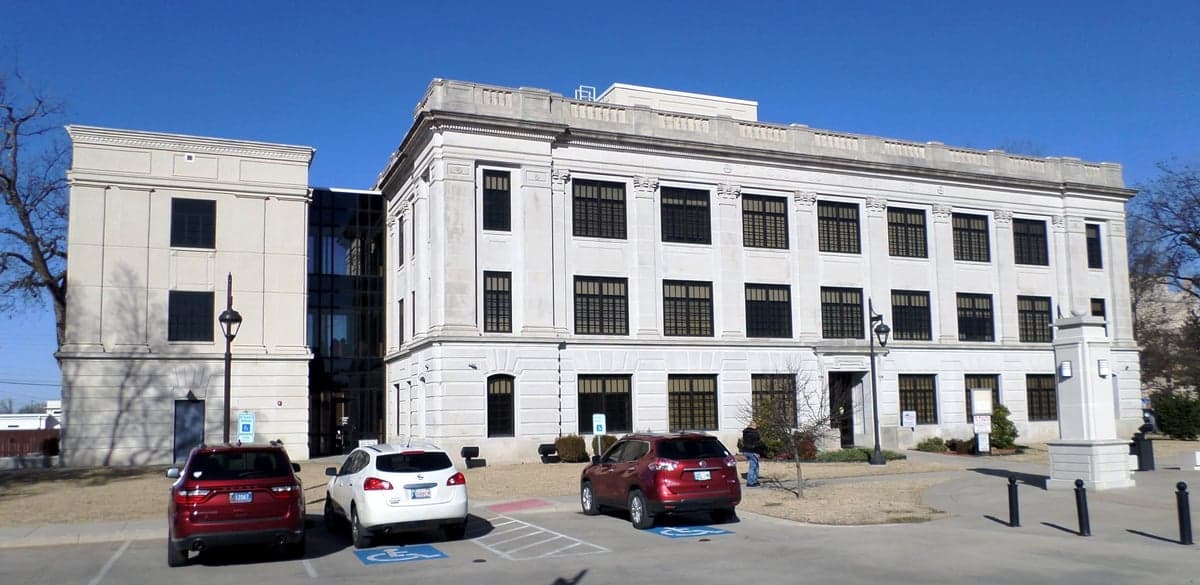
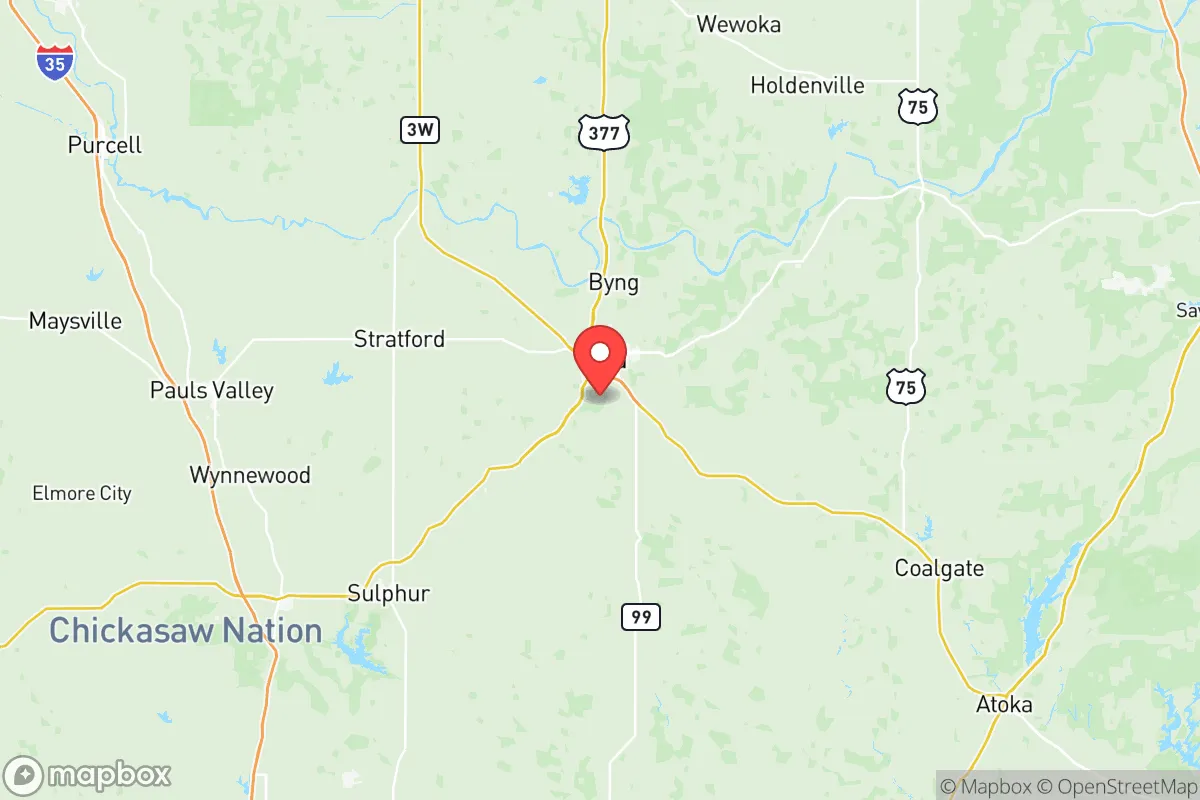
Photo: Wikipedia
Demographics of Pontotoc County
Affluence Level in Pontotoc County
A middle-class area roughly in line with national averages across income, home values, education, and employment.
People of Pontotoc County
Today, Pontotoc County, Oklahoma, is home to 38,158 residents, a population that remains predominantly white (63.3%) with a notable Native American heritage and a small but growing Hispanic community (6.3%). The county's character is defined by its rural roots, anchored by the city of Ada, the county seat and home to East Central University, which gives the area a modest college-town feel. With a foreign-born population of just 0.9%, Pontotoc County is one of the least ethnically diverse areas in Oklahoma, reflecting a history of settlement that has remained remarkably stable for over a century.
Settlement & growth (pre-1960)
Long before European settlement, the land that is now Pontotoc County was part of the traditional territory of the Chickasaw and Choctaw nations. Following the Indian Removal Act of 1830, the area was formally designated as part of the Chickasaw Nation in Indian Territory. The Chickasaw people, forcibly relocated from the Southeastern United States, established farms, schools, and a functioning government here, with settlements like Stonewall and Fitzhugh emerging as early population centers. The name "Pontotoc" itself is a Chickasaw word meaning "prairie" or "cattail prairie," a direct link to the land's original inhabitants.
The first major wave of non-Native settlement began after the Land Run of 1889 and the subsequent opening of the Chickasaw Nation to white homesteaders. The Dawes Act of 1887 and the Curtis Act of 1898 dissolved tribal land holdings, allotting parcels to individual Chickasaw citizens and opening the remainder to white settlers. This period, roughly 1890 to 1910, saw an influx of farmers, ranchers, and merchants from Texas, Arkansas, and the Deep South. The town of Ada was founded in 1890 and quickly became the commercial hub, fueled by the arrival of the Santa Fe Railroad in 1892. Nearby Roff and Allen also grew as agricultural service centers for cotton and cattle.
By 1907, when Oklahoma achieved statehood, Pontotoc County's population was overwhelmingly white and native-born, with a significant minority of Chickasaw and Choctaw citizens who had remained on their allotments. The discovery of oil in the 1920s, particularly around the Fittstown and Francis areas, brought a brief boom of transient oil workers, but the county never experienced the explosive growth seen in Tulsa or Oklahoma City. The Great Depression and Dust Bowl years of the 1930s hit hard, causing a net out-migration as families left for California and other destinations. The population stabilized after World War II, with Ada's economy diversifying into manufacturing and education, anchored by East Central State College (now East Central University).
Modern era (post-1965)
The 1965 Hart-Cellar Act, which reshaped U.S. immigration, had almost no impact on Pontotoc County. Unlike major metropolitan areas that saw waves of new arrivals from Asia and Latin America, the county's foreign-born population remains at just 0.9% in 2026, virtually unchanged from 1970. The demographic shifts that did occur were driven by domestic migration patterns, not international immigration.
Since the 1970s, Pontotoc County has experienced a slow but steady out-migration of younger residents seeking opportunities in larger cities like Oklahoma City, Dallas, and Tulsa. This has been partially offset by an influx of retirees and commuters drawn to the area's low cost of living and slower pace of life. The Hispanic population has grown from negligible levels in 1990 to 6.3% today, primarily concentrated in Ada and working in agriculture, construction, and the poultry processing industry. The Black population remains small at 2.4%, largely descendants of families who moved to the area during the post-Reconstruction era and the early 20th century, with a historic community in Ada.
The Asian population is minimal at 0.8%, and the Indian subcontinent population is 0.2%, mostly professionals associated with East Central University or the local medical community. The Native American population, while not broken out in the provided data, remains a significant cultural presence, particularly among Chickasaw families who have maintained ties to the area. The Chickasaw Nation's headquarters are in Ada, and the tribe is a major employer and economic driver, operating the Chickasaw Nation Medical Center and various businesses.
The future
Pontotoc County's population is projected to remain relatively stable over the next 10 to 20 years, with modest growth driven by domestic migration from higher-cost states and the continued expansion of the Chickasaw Nation's economic footprint. The county is likely to become slightly more diverse, with the Hispanic share of the population expected to rise to around 8-10% by 2040, while the white share will continue a slow decline. The Asian and Indian populations are expected to remain very small, with growth limited to specific professional niches.
The county's cultural identity will likely remain rooted in its rural, conservative, and Native American heritage. The Chickasaw Nation's influence will continue to grow, both economically and culturally, as the tribe invests in healthcare, education, and tourism. New residents are most likely to settle in and around Ada, with smaller numbers moving to Stonewall, Roff, and Allen for lower housing costs. The county will not become a major destination for international immigration, but it will continue to attract Americans seeking a quieter, more affordable lifestyle.
For someone moving in now, Pontotoc County offers a stable, low-cost, and culturally cohesive environment with a strong sense of place. The population is aging slightly, but the presence of East Central University and the Chickasaw Nation provides a steady anchor. The county is becoming slightly more diverse, but it remains overwhelmingly white and native-born, with a pace of change that is slow enough to preserve its traditional character. It is a place where the past is still very much present, and where the future looks much like the present.

* Values derived from national, state, county, city and local statistics and may differ in a specific area. Last updated: 2026-07-19T02:15:45.000Z
Narrative content on this page is AI-generated and may contain mistakes. Verify any details that matter before acting on them.
ReloMaps may earn a commission from affiliate links at no extra cost to you.

