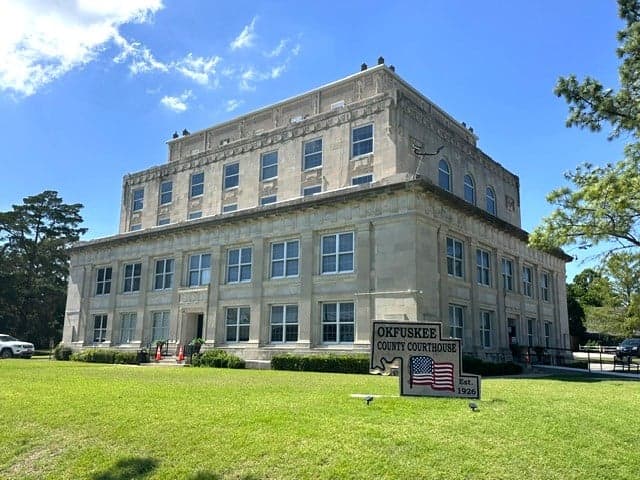
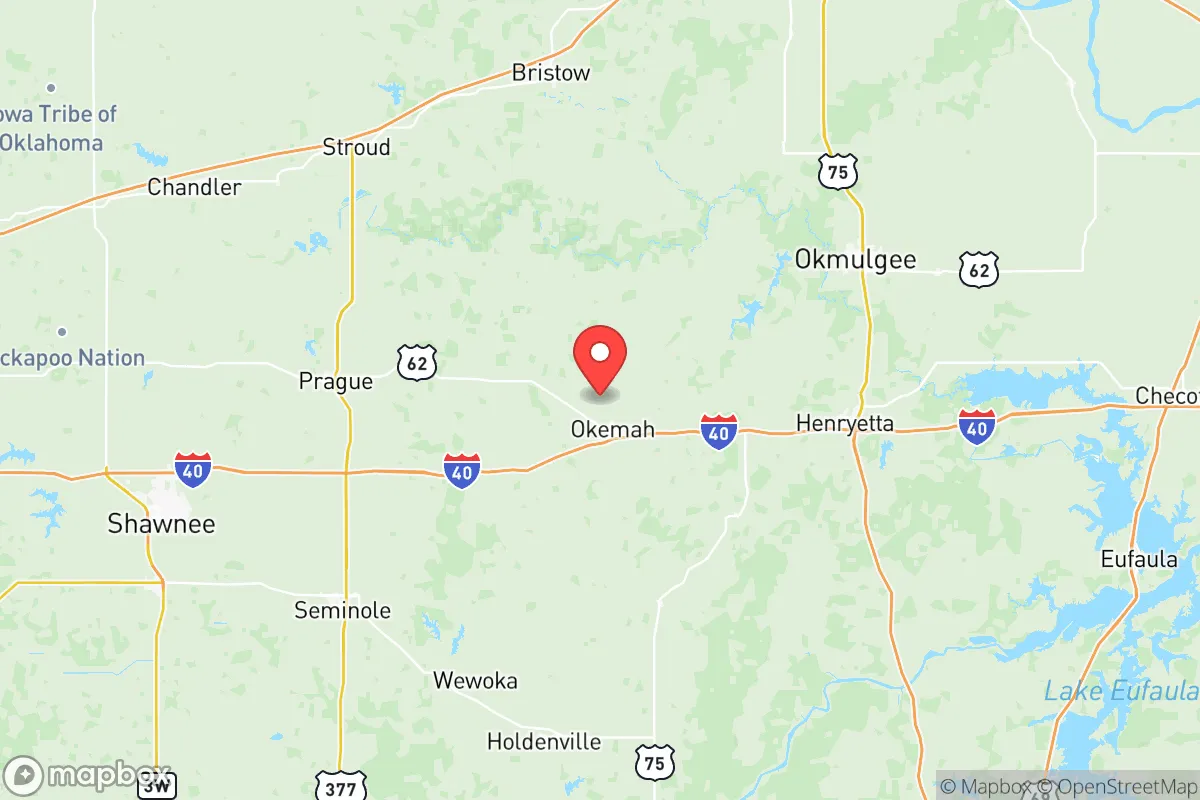
Photo: Wikipedia
Political ClimatePolitical Climate in Okfuskee County
Showing district-level results — no local-only data available.
Local Political AnalysisPolitical Analysis of Okfuskee County
Okfuskee County is one of the most reliably Republican counties in eastern Oklahoma, with a Cook Partisan Voting Index (PVI) of R+28, placing it a full ten points to the right of the state as a whole (R+18). That margin has held steady through the last three presidential cycles, with the county delivering 78-80% of its vote to the GOP candidate. The political reality here isn't just about party registration—it's a deeply ingrained cultural conservatism that shapes everything from local school board races to how people talk about taxes and land use. If you're looking for a place where the national political mood feels distant, this is it.
How it compares
Compared to Oklahoma's statewide R+18 lean, Okfuskee County's R+28 is a significant jump, but the gap isn't uniform across the county. The town of Okemah, the county seat and largest population center, is the most moderate precinct—it still votes Republican, but by a narrower 65-70% margin, and it's where you'll find the occasional Democratic candidate for county commission or state house actually getting a hearing. Boley, one of the historic all-Black towns in the region, also trends slightly less conservative than the county average, though its small population (under 1,000) means its influence on the overall numbers is minimal. On the other end, Weleetka and Paden are deep red, routinely hitting 85% Republican or higher. The rural precincts between these towns are where the R+28 number really lives—there's almost no organized Democratic presence outside of Okemah, and voter turnout in those areas is driven by gun rights, agricultural policy, and opposition to federal land management. The state-level comparison matters because Okfuskee's politics are more aligned with the Oklahoma Panhandle or far southeastern counties than with the suburban swing areas around Oklahoma City or Tulsa.
What this means for residents
For conservative residents, the political climate means their values are reflected in nearly every local decision—from the county commissioners' approach to road maintenance (low taxes, minimal borrowing) to the school districts' policies on curriculum and parental rights. There's no real pressure to moderate positions, and candidates who run on a platform of "keeping government out of rural life" tend to win easily. For liberal or moderate residents, the reality is more isolating. There's no local Democratic Party infrastructure to speak of, and progressive viewpoints are rarely voiced in public meetings or local media. That said, the county's small population (roughly 12,000) means that interpersonal relationships often override political labels—your neighbor might disagree with you on everything from the Supreme Court to school funding, but you'll still help each other with a fence repair or a hay bale. The practical effect of the R+28 lean is that federal and state policies that are unpopular locally—like renewable energy mandates or public lands restrictions—face vocal opposition, while issues like Second Amendment protections and local control over zoning are non-negotiable.
One cultural distinction worth noting: Okfuskee County has a stronger connection to the Muscogee (Creek) Nation than many neighboring counties, and tribal politics occasionally intersect with county politics in ways that don't fit the standard red-blue framework. The tribe's influence on economic development (casino revenue, health services) means that even the most conservative residents tend to support tribal sovereignty, creating a unique political dynamic where "small government" conservatives back a sovereign tribal government's expansion. That's the kind of nuance you won't see in a PVI number, but it's part of what makes living here different from the rest of Oklahoma.

State Political ClimatePolitical Climate in Oklahoma
State Political AnalysisPolitical Environment in the State
Oklahoma is one of the most reliably Republican states in the country, with a Cook Partisan Voting Index of R+18, meaning it votes about 18 points more Republican than the national average. The state hasn't voted for a Democratic presidential candidate since 1964, and over the last 20 years, the GOP has tightened its grip from a competitive two-party state in the 1990s to a deep-red lock today. The dominant coalition is a mix of rural conservatives, evangelical Christians, and oil-and-gas interests, with Democrats now largely confined to the state's two urban islands: Oklahoma City and Tulsa.
Urban vs. rural divide
The political map of Oklahoma is a textbook case of the urban-rural split. Oklahoma County, home to Oklahoma City, has been trending bluer and actually voted for Joe Biden in 2020 by a slim margin, making it the state's most populous Democratic stronghold. Tulsa County is more of a purple battleground, flipping between parties but leaning Republican in recent cycles, though the city of Tulsa itself votes reliably Democratic. The real GOP firepower comes from the vast rural expanse: counties like Texas County in the Panhandle, Custer County in the west, and Rogers County near Tulsa routinely deliver 75-85% Republican margins. A notable shift has been the suburban ring around Oklahoma City — places like Edmond and Norman — where Norman remains a liberal college town anchored by the University of Oklahoma, while Edmond is solidly conservative. The state's second-largest city, Tulsa, has a more moderate Republican tilt in its suburbs like Broken Arrow and Jenks, but the city core is increasingly Democratic.
Policy environment
Oklahoma's policy environment is aggressively conservative. The state has a flat income tax rate of 4.75%, which lawmakers are actively working to phase out entirely, and no estate tax. Sales taxes are high — often over 9% in major cities — because the state relies heavily on consumption taxes. The regulatory posture is business-friendly, especially for energy, agriculture, and aerospace. Education policy has been a flashpoint: the state legalized the nation's first publicly funded religious charter school in 2023, a move that's being challenged in court, and has a robust school choice program with tax credits for private and homeschool expenses. Healthcare is a perennial struggle — Oklahoma was one of the last states to expand Medicaid under the Affordable Care Act, finally doing so via a 2020 ballot measure, but the system remains underfunded. Election laws have tightened: voter ID is required, and in 2023 the legislature passed restrictions on absentee ballot drop boxes and shortened the absentee application window.
Recent policy direction
The last few years have seen Oklahoma push hard on cultural and liberty issues. On guns, the state enacted permitless carry in 2019, allowing any adult who can legally possess a firearm to carry it openly or concealed without a license. Parental rights in education got a major boost with the 2022 "Parental Bill of Rights," which requires schools to notify parents about curriculum changes and medical services. The state also passed one of the nation's strictest abortion bans in 2022, effectively outlawing the procedure from conception with narrow exceptions. On speech and privacy, Oklahoma banned TikTok on state devices and passed a law requiring age verification for adult websites. Property rights remain strong, with no statewide zoning mandates and low property tax rates capped at a 5% annual increase. Tax policy is trending toward elimination: in 2024, the legislature passed a bill to gradually reduce the income tax to 3.99% by 2027, with a long-term goal of zero. Voting access has tightened, but the state also expanded early voting to three days before elections in 2023.
Civil unrest & political movements
Oklahoma has seen its share of political flashpoints, but large-scale civil unrest is rare. The most visible recent movement was the 2018 teacher walkout, which shut down hundreds of schools for two weeks and forced the legislature to pass a $6,000 teacher pay raise and increased education funding. On the right, the "Ten Commandments" movement has been persistent — the state installed a monument on the Capitol grounds in 2012, and in 2024, the state Supreme Court ordered its removal, sparking renewed legislative efforts to protect religious displays. Immigration politics are less heated than in border states, but Oklahoma passed a strict anti-sanctuary city law in 2024, threatening to withhold state funds from any locality that doesn't cooperate with federal immigration enforcement. Election integrity remains a live issue: the 2020 election saw no major fraud cases in Oklahoma, but the legislature has continued to tighten voting laws, citing public concern. There's been no serious secession or nullification rhetoric, though the state has joined multi-state lawsuits challenging federal environmental and education policies.
Projection
Over the next 5-10 years, Oklahoma is likely to remain deeply Republican, but the margins may narrow slightly as Oklahoma City and Tulsa continue to grow and diversify. The state's population is aging and relatively slow-growing compared to Texas or Colorado, but in-migration from California and other high-cost states is accelerating, particularly to the Oklahoma City metro, which could introduce more moderate or libertarian-leaning voters. The income tax phase-out will likely continue, making the state even more attractive to high-earners and retirees, but it will also strain funding for schools and infrastructure. The religious charter school experiment will be a bellwether for national education policy. Culturally, expect more battles over abortion, LGBTQ rights, and classroom content, as the legislature remains one of the most conservative in the country. A new resident moving in now should expect a state that is politically stable but not static — the rural-urban divide will deepen, but the overall direction is toward lower taxes, more school choice, and continued cultural conservatism.
For a new resident, the bottom line is straightforward: if you're conservative, you'll find Oklahoma's politics broadly aligned with your values, with low taxes, strong gun rights, and a government that actively promotes traditional social policies. If you're liberal, you'll find yourself in a clear minority outside of Oklahoma City and Norman, but those urban areas offer a genuine counterweight with Democratic representation in the legislature and local governments that lean progressive. The practical takeaway is that Oklahoma delivers on its promises — low taxes, light regulation, and cultural conservatism — but the trade-offs include underfunded public services and a political environment that can feel one-party dominant. It's a state where your vote matters less in statewide races but where local politics in the cities can still swing elections.
* Values derived from national, state, county, city and local statistics and may differ in a specific area. Last updated: 2026-08-08T15:59:20.000Z
Narrative content on this page is AI-generated and may contain mistakes. Verify any details that matter before acting on them.
ReloMaps may earn a commission from affiliate links at no extra cost to you.

