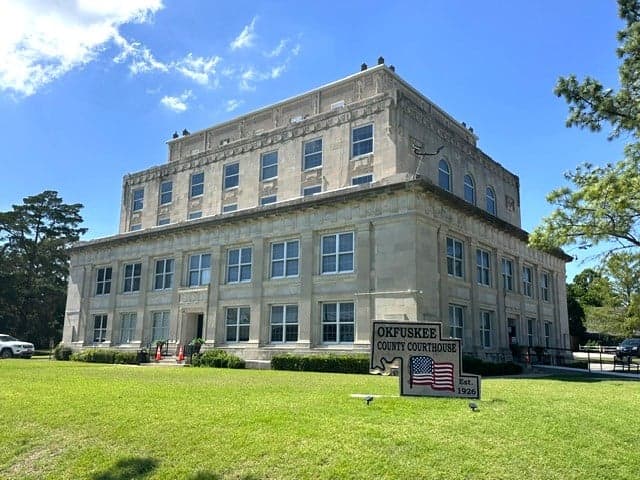
Photo: Wikipedia
Demographics of Okfuskee County
Affluence Level in Okfuskee County
A low-income area with significant economic hardship. Household wealth and educational attainment are well below national averages.
People of Okfuskee County
Okfuskee County, Oklahoma, is a rural, sparsely populated area where the population has steadily declined for decades, now home to just over 11,300 residents. The county's identity is rooted in its Native American heritage—primarily the Muscogee (Creek) Nation—and a history of early 20th-century oil booms that drew a diverse but temporary workforce. Today, it is overwhelmingly white (60.4%) with a significant Black minority (6.5%) and a very small Hispanic (3.6%) and East/Southeast Asian (0.8%) presence, while the foreign-born population is negligible at 1.1%. The county seat, Okemah, and the town of Boley anchor distinct cultural narratives: Okemah as the birthplace of folk legend Woody Guthrie and a center of Creek Nation governance, and Boley as one of the most historically significant all-Black towns of the post-Reconstruction era.
Settlement & growth (pre-1960)
Before American settlement, the area that became Okfuskee County was part of the Muscogee (Creek) Nation's domain in Indian Territory, following the forced removal of the Creek people from the Southeast along the Trail of Tears in the 1830s. The county's name itself derives from a Creek tribal town, "Okfuskee," meaning "a place of water." Unlike much of Oklahoma, there was no significant Spanish, French, or British colonial presence here; the land was exclusively Creek territory until the post-Civil War era.
The first major non-Native wave arrived after the Dawes Act of 1887 and the subsequent allotment of tribal lands to individual Native households, which opened up "surplus" land to white homesteaders. The 1890s and early 1900s saw a rush of white settlers, primarily of Scots-Irish and English stock from the South and Midwest, drawn by cheap land and the promise of farming. These settlers founded the county's early towns, including Okemah (established 1902 as the county seat), Boley (1903), Paden, and Weleetka. The discovery of oil in the Cushing-Drumright field just north of the county in 1912 triggered a secondary boom, bringing a transient workforce of roughnecks and speculators to towns like Okemah and Castle, though the county never saw the scale of oil wealth that transformed Tulsa or Oklahoma City.
A uniquely significant chapter was the founding of Boley in 1903 as an all-Black town, part of a wave of more than 50 such settlements established across Oklahoma by African Americans seeking self-governance and escape from Jim Crow laws. Boley grew rapidly, peaking at around 4,000 residents in the 1910s, and became a national symbol of Black economic independence, hosting the annual Boley Rodeo and attracting figures like Booker T. Washington. The Great Depression and the Dust Bowl of the 1930s hit the county hard, accelerating outmigration as farm families—both white and Black—left for California and urban centers. The county's population peaked at around 25,000 in 1930 and has declined nearly every decade since.
Modern era (post-1965)
The post-1965 era, shaped by the Hart-Cellar Act, had almost no impact on Okfuskee County's demographics. The foreign-born population remains minuscule at 1.1%, and there are no immigrant enclaves or recent ethnic communities. Instead, the county's modern story is one of sustained domestic outmigration and aging. The Black population, once concentrated in Boley and Okemah, has shrunk dramatically as younger African Americans moved to larger cities like Tulsa, Oklahoma City, and Dallas for jobs and education. Boley's population today is under 1,000, and its historic Black majority has faded, though the town remains a cultural landmark and hosts the annual Boley Rodeo and Black History Month events.
The white population has also declined, though less sharply, as the agricultural and oil economies contracted. The county's college-educated share is just 13.1%, well below state and national averages, reflecting limited white-collar employment. The largest employer is the Muscogee (Creek) Nation, which operates health clinics, a casino in Okemah, and administrative offices, providing stable jobs for both Native and non-Native residents. The Native American population—primarily Creek—is not separately tracked in the provided data but is a significant presence, with the county falling within the Muscogee Nation's jurisdiction. The Hispanic population, at 3.6%, is small but growing slightly, driven by a few families working in agriculture and construction, though no distinct Hispanic enclave has formed.
Suburbanization has largely bypassed Okfuskee County. It is not part of any major metropolitan area's commuter shed; the nearest large city, Tulsa, is about 60 miles north. Young adults continue to leave for college and urban jobs, leaving an aging population. The county's population fell from 11,814 in 2000 to 11,304 in 2020, a decline of about 4.3%.
The future
Okfuskee County's population is projected to continue its slow decline over the next 10-20 years, with the trend most pronounced among younger cohorts. The county is becoming slightly more diverse, but only marginally: the Hispanic share may rise to 5-6% as a few families settle in Okemah and Weleetka, and the East/Southeast Asian population may grow from near-zero to 1-2% if a handful of immigrant-owned businesses open, but no large wave is expected. The Black population is likely to stabilize at around 5-6% as Boley's historic community maintains a cultural anchor, but continued outmigration of young African Americans is probable. The Native American population, already a core part of the county's identity, may grow slightly as the Muscogee (Creek) Nation expands its governmental and health services footprint.
Culturally, the county will remain a deeply rural, conservative, and Native-influenced area. The Woody Guthrie Folk Festival in Okemah each July and the Boley Rodeo will continue to draw visitors, but the county's economic base is unlikely to attract significant in-migration. The lack of college-educated workers and limited job diversity will keep the county's demographic profile stable but stagnant.
For someone moving in now, Okfuskee County offers a quiet, low-cost, and historically rich rural life, but it is not a place of demographic dynamism or growth. The population is aging, shrinking, and slowly diversifying at a glacial pace. New residents will find a community shaped by Creek Nation governance, a fading but proud Black town legacy, and a white rural culture that prizes self-reliance and tradition. The county is best suited for those seeking affordable land, a slower pace, and a connection to Oklahoma's Native and frontier history, rather than for those looking for job growth, ethnic diversity, or urban amenities.

* Values derived from national, state, county, city and local statistics and may differ in a specific area. Last updated: 2026-08-08T15:59:20.000Z
Narrative content on this page is AI-generated and may contain mistakes. Verify any details that matter before acting on them.
ReloMaps may earn a commission from affiliate links at no extra cost to you.

