Photo: Wikipedia
Political ClimatePolitical Climate in Kay County
Showing district-level results — no local-only data available.
Local Political AnalysisPolitical Analysis of Kay County
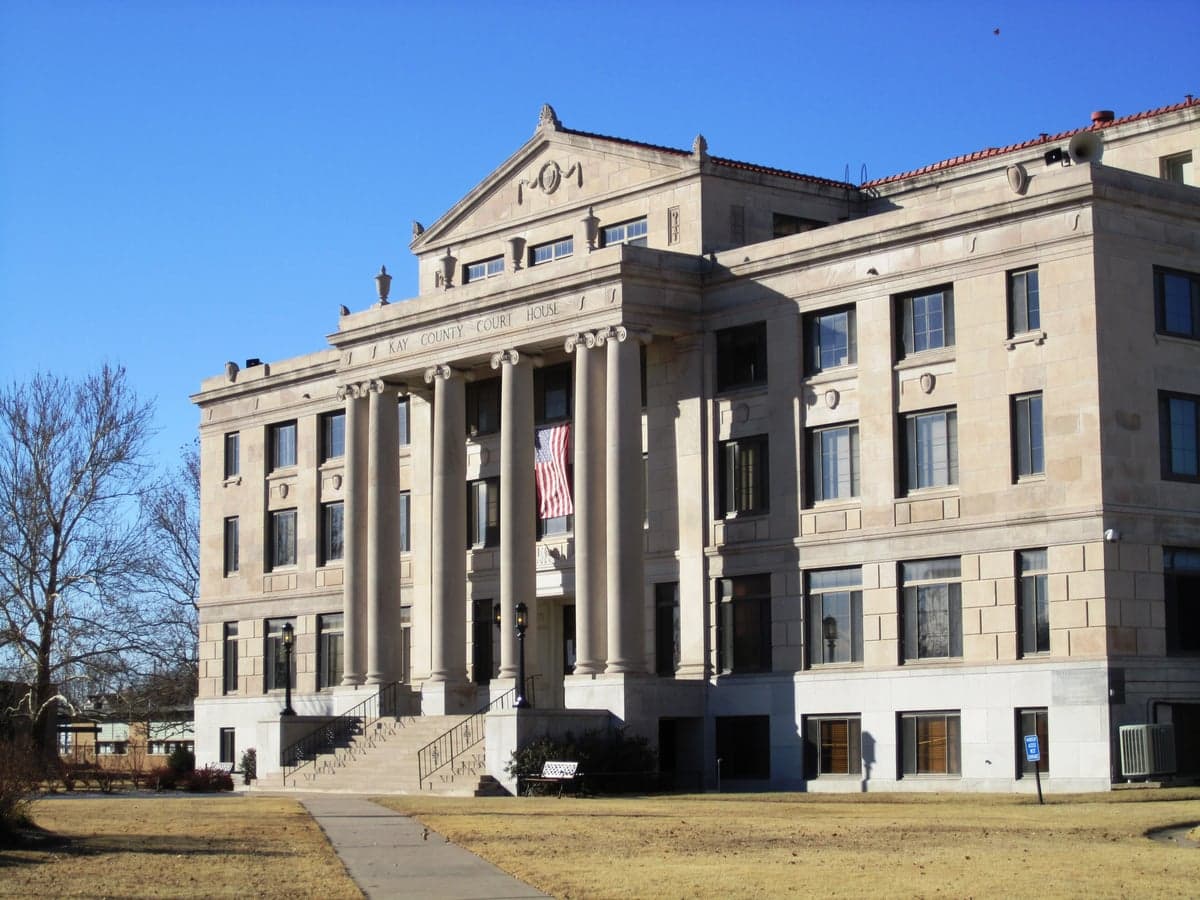
Kay County is a reliably Republican stronghold, with a Cook Partisan Voting Index (PVI) of R+23 that makes it significantly more conservative than the state of Oklahoma as a whole (R+18). This isn't a recent shift; the county has been trending red for decades, though the margins have widened in the last two presidential cycles. The real story isn't whether Kay County is conservative — it's how that conservatism plays out differently from town to town, and what it means for the people who live there.
How it compares
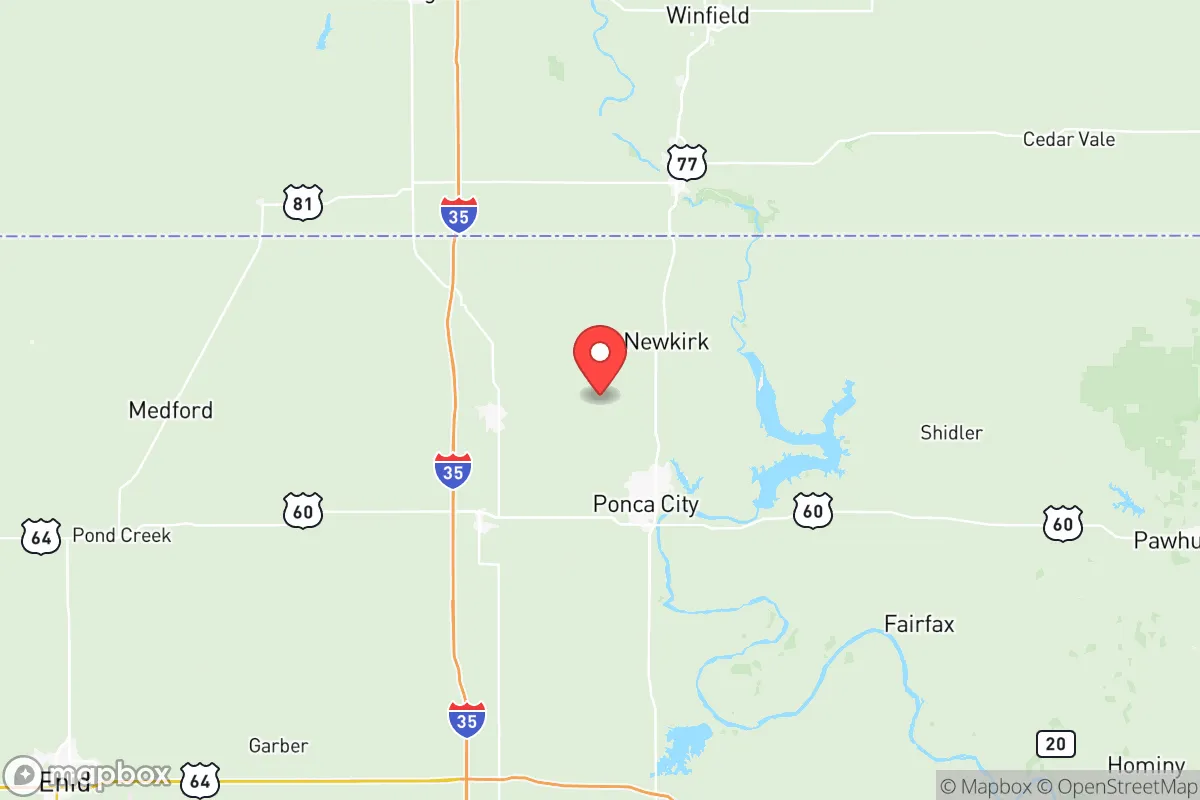
The R+23 PVI puts Kay County in the top 15% of the most Republican counties in Oklahoma, but it's not a monolith. Ponca City, the county seat and largest city, is the political anchor. It votes reliably red, but its precincts near the ConocoPhillips refinery and the Pioneer Technology Center tend to be more moderate — think split-ticket voters who back local Democrats for county commission or sheriff. Blackwell, the second-largest town, is even more conservative, often running 10-15 points redder than Ponca City in statewide races. Tonkawa, home to Northern Oklahoma College, is the county's most interesting outlier. The college precincts and the area around the Tonkawa Tribal Casino have a younger, more transient population that occasionally votes Democratic, making it the closest thing to a swing precinct in the county. Newkirk and Kaw City lean heavily Republican, with Kaw City's small electorate often producing the most lopsided margins in the county. The rural precincts between these towns — the farm and ranch country along the Arkansas River — are deep red, often voting 80%+ Republican. Compared to Oklahoma's R+18 average, Kay County's R+23 means it's roughly 5 points more conservative than the state as a whole, a gap that has widened slightly since 2020 as rural areas have shifted right faster than suburban and urban ones.
What this means for residents
For conservative residents, Kay County's political climate means their values are reflected in local governance — the county commission, school boards, and law enforcement are overwhelmingly Republican, and policy debates tend to focus on tax cuts, Second Amendment rights, and limited government. For liberal residents, the reality is more nuanced. They are a clear minority, but they are not invisible. The Ponca City Democratic Party maintains an active presence, and progressive candidates occasionally win city council seats in Ponca City's more moderate wards. The practical impact is that liberal residents often find their political voice in nonpartisan local issues — school funding, infrastructure, and economic development — where party labels matter less. The county's strong Republican lean also means that national political debates (abortion, immigration, gun control) rarely translate into local policy changes; the county's elected officials are already aligned with conservative positions, so there is little internal conflict on those fronts. What does generate real political heat is local economic policy — tax incentives for industrial recruitment, the future of the ConocoPhillips refinery, and water rights along the Arkansas River — issues that cut across party lines and produce genuine debate.
One cultural distinction worth noting: Kay County's politics are shaped by its industrial and agricultural heritage in a way that sets it apart from Oklahoma's more purely rural or purely suburban counties. The presence of the ConocoPhillips refinery and the associated oil and gas workforce gives the county a pragmatic, blue-collar conservatism that is less focused on cultural wars and more on economic stability. The Tonkawa Tribe's sovereignty and economic influence also introduce a unique dynamic — tribal-state relations are a recurring political issue that doesn't fit neatly into the Republican-Democrat framework. Looking ahead, the county's political trajectory seems stable. The R+23 lean is likely to persist, though the margin could narrow slightly if Ponca City's moderate precincts continue to grow or if the college population in Tonkawa expands. For now, Kay County remains a place where the political conversation is less about red vs. blue and more about how to keep the local economy running in a state that is, on the whole, already deeply conservative.

State Political ClimatePolitical Climate in Oklahoma
State Political AnalysisPolitical Environment in the State
Oklahoma is one of the most reliably Republican states in the country, with a Cook Partisan Voting Index of R+18, meaning it votes about 18 points more Republican than the national average. The dominant coalition is a mix of rural conservatives, evangelical Christians, and energy-sector workers, with Democrats largely confined to a few urban pockets and the eastern tribal nations. Over the last 20 years, the state has shifted sharply rightward — in 2004, George W. Bush won it by 31 points, but by 2024, Donald Trump carried it by 34, even as the state’s population grew modestly and suburban areas around Oklahoma City and Tulsa became more polarized.
Urban vs. rural divide
The political map of Oklahoma is a study in contrasts. Oklahoma City and Tulsa are the two blue-ish anchors, but even they are not uniformly liberal. Oklahoma County (Oklahoma City) voted for Trump by about 10 points in 2024, while Tulsa County went for him by about 15 — both are competitive by state standards, but still solidly red. The real Democratic strongholds are the rural eastern counties in the old “Little Dixie” region, like Pushmataha and McCurtain, which have historically voted blue due to a legacy of New Deal Democrats, though they are trending redder. The western half of the state, from the Panhandle down to Lawton, is deeply conservative, with counties like Texas County and Cimarron County routinely giving Republicans 80% or more. The suburbs are the battleground: places like Edmond, Norman, and Broken Arrow are growing fast and are politically mixed — Edmond leans right but is more moderate than rural areas, while Norman, home to the University of Oklahoma, is the most liberal city in the state outside of the core urban centers. The key takeaway is that Oklahoma’s R+18 lean is driven by overwhelming rural turnout, not by monolithic urban conservatism.
Policy environment
Oklahoma’s policy environment is aggressively conservative, with a low-tax, low-regulation posture that attracts businesses but limits public services. The state has a flat income tax of 4.75% (down from 5% in 2022), no estate tax, and a sales tax that averages around 8.9% when local levies are included. Property taxes are among the lowest in the nation, typically under 1% of assessed value, thanks to a constitutional cap. Education policy is a flashpoint: the state has one of the lowest per-pupil spending levels in the country, and in 2023 it passed a universal school voucher program (the Oklahoma Parental Choice Tax Credit Act) that allows families to use public funds for private or homeschool expenses. Healthcare is limited — Oklahoma did not expand Medicaid until 2021 via a ballot initiative, and the state has some of the strictest abortion laws in the nation, with a near-total ban in effect since 2022 (SB 612). Election laws are restrictive: voter ID is required, early voting is limited to three days, and absentee ballots require a notary or witness. The state also has a “constitutional carry” law for firearms, meaning no permit is needed to carry a concealed handgun.
Recent policy direction
Over the last five years, Oklahoma has moved decisively toward a maximalist version of conservative governance. On gun rights, the state passed permitless carry in 2019 (SB 1212) and in 2023 enacted a law prohibiting local governments from enforcing federal gun regulations (the “Second Amendment Sanctuary” act). On education, the 2023 voucher law is the most expansive in the nation, and the state has banned critical race theory and certain LGBTQ+ topics in public schools (HB 1775, 2021; SB 615, 2023). On bodily autonomy, abortion is banned from conception with no exceptions for rape or incest, only for medical emergencies (SB 612, 2022). On speech and privacy, the state passed a law in 2024 requiring age verification for adult websites (HB 3056) and has a broad ban on “discriminatory” speech in public schools that critics say chills classroom discussion. On property rights, Oklahoma is a “right-to-work” state and has strong eminent domain protections for landowners. On voting, the state tightened absentee ballot rules in 2021 (SB 440) and has resisted no-excuse mail voting. The overall direction is toward more individual liberty in economic and gun matters, but less in social and educational spheres — a trade-off that matters deeply depending on your priorities.
Civil unrest & political movements
Oklahoma has a history of populist and anti-government sentiment, but large-scale civil unrest is rare. The most visible flashpoint in recent years was the 2023 teacher walkout, when educators protested low pay and funding cuts — it was the largest labor action in state history, drawing tens of thousands to the Capitol, but it resulted in only modest raises. On the right, the “Oklahoma Freedom Caucus” has been a powerful force in the legislature, pushing for voucher expansion, anti-immigration bills, and election integrity measures. Immigration politics are heated but not violent: the state passed a law in 2024 (HB 4156) requiring local law enforcement to cooperate with federal immigration authorities, and there are no sanctuary cities. Secession and nullification rhetoric is present but fringe — a 2021 resolution calling for a “convention of states” to amend the U.S. Constitution passed the legislature but has no practical effect. Election integrity controversies flared after 2020, with the state auditor conducting a widely publicized review of voting machines that found no evidence of fraud, though some activists remain skeptical. A new resident would notice the political polarization mostly in yard signs and social media, not in street protests — Oklahoma is a place where politics is serious but not chaotic.
Projection
Over the next 5-10 years, Oklahoma will likely become even more Republican, but with a growing urban-rural split. In-migration is modest but steady, driven by retirees from California and Texas seeking lower taxes, and by energy-sector workers moving to the Permian Basin region in the west. The suburbs of Oklahoma City and Tulsa are growing fastest, and they are becoming more politically mixed — places like Edmond and Broken Arrow may shift slightly left as they densify and attract younger, more educated residents. However, the rural vote is not shrinking fast enough to flip any statewide office, and the legislature’s gerrymandered districts ensure Republican supermajorities for the foreseeable future. The biggest wildcard is education: if the voucher program leads to a collapse of rural public schools, it could accelerate depopulation in those areas, potentially shifting the balance of power toward the suburbs. For a new resident, the Oklahoma of 2035 will likely look much like today — deeply conservative, low-tax, and culturally traditional — but with a more visible progressive minority in Norman, Tulsa, and parts of OKC.
For someone moving to Oklahoma, the bottom line is that you’ll be living in a state where conservative values dominate policy and daily life, but where the urban centers offer a more moderate or even liberal alternative. If you’re a conservative, you’ll find a government that aligns with your views on taxes, guns, and education, and a culture that values self-reliance and community. If you’re a liberal, you’ll find a small but active community in places like Norman or the Plaza District in OKC, but you’ll need to accept that state-level politics will rarely go your way. The practical takeaway is to choose your city carefully — Edmond and Broken Arrow are safe bets for conservatives, while Norman and midtown Tulsa offer more diversity of thought. Either way, Oklahoma is a place where politics is present but not overwhelming, and where the low cost of living and strong sense of place can outweigh the partisan friction.
* Values derived from national, state, county, city and local statistics and may differ in a specific area. Last updated: 2026-06-21T13:27:48.000Z
Narrative content on this page is AI-generated and may contain mistakes. Verify any details that matter before acting on them.
ReloMaps may earn a commission from affiliate links at no extra cost to you.

