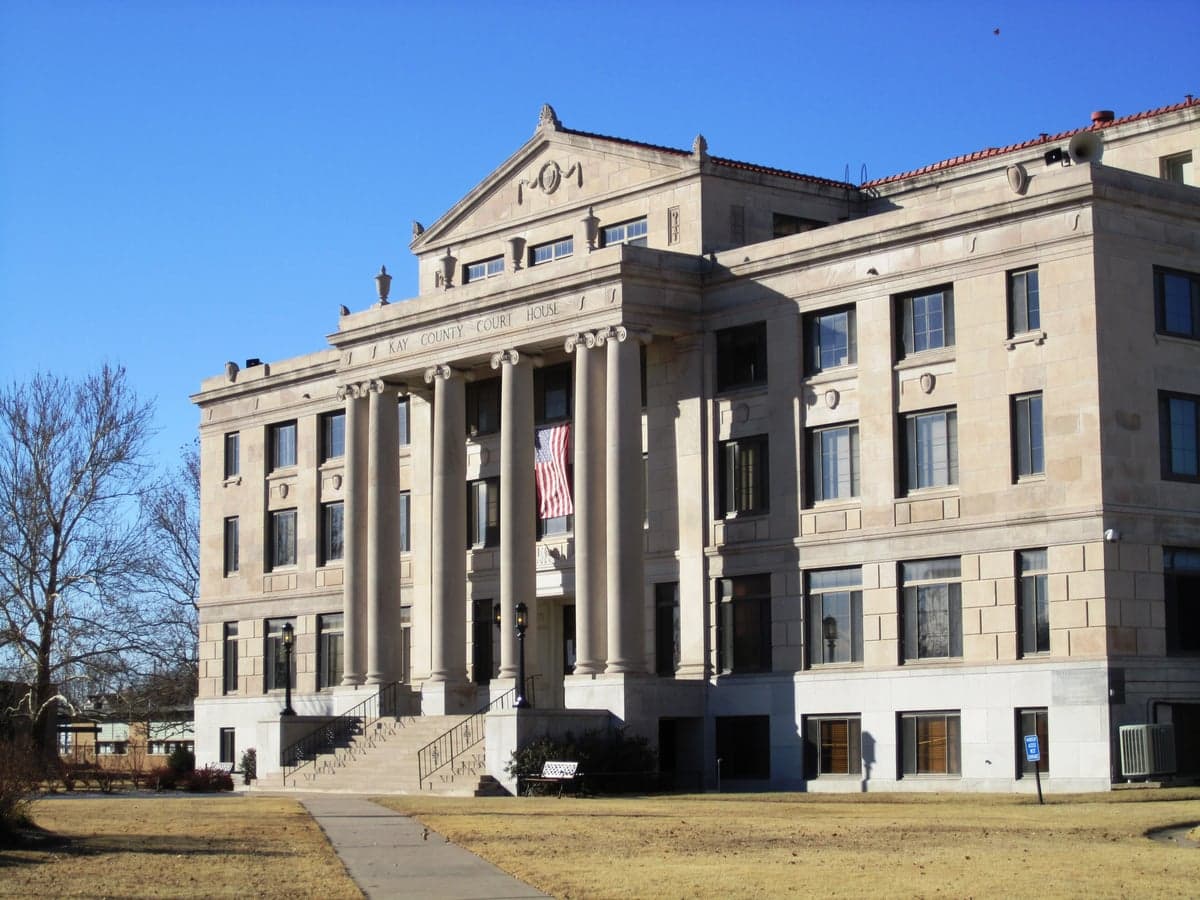
Photo: Wikipedia
Demographics of Kay County
Affluence Level in Kay County
A below-average socioeconomic profile. Incomes, home values, and educational attainment trail the U.S., with higher poverty and unemployment.
People of Kay County
The people of Kay County, Oklahoma today number 43,731, forming a predominantly white (71.3%) and politically conservative population spread across a largely rural landscape anchored by the twin cities of Ponca City and Blackwell. With only 1.5% foreign-born residents and a modest 18.5% college-educated rate, the county retains a distinctly native-born, working-class character rooted in its oil, agriculture, and manufacturing heritage. The population is notably older than the state average, and the county has experienced gradual decline since its mid-20th-century peak, giving it a quiet, stable identity shaped more by continuity than by new arrivals.
Settlement & growth (pre-1960)
Long before European settlement, the land that became Kay County was home to the Osage and Kaw (Kansa) nations, who controlled the vast tallgrass prairie and cross-timbers region. The Osage in particular dominated the area through the 18th and early 19th centuries, using the Arkansas River and Salt Fork valleys for hunting and seasonal camps. The United States forcibly removed the Kaw to a reservation in what is now southern Kay County in the 1840s, and the tribe's reservation headquarters were established near present-day Newkirk, the county seat. The Kaw Nation's presence remains a defining historical marker, though their population today is small relative to the county's total.
American settlement began in earnest after the Cherokee Outlet Opening of 1893, one of the largest land runs in American history. On September 16, 1893, tens of thousands of homesteaders surged into the 6.5-million-acre strip of land that includes all of Kay County. The opening drew a diverse mix of white settlers from the Midwest and Upper South — primarily of Scots-Irish, English, and German stock — along with a smaller number of African American homesteaders who established communities such as Braman and Blackwell. The town of Ponca City was founded immediately after the run, named for the Ponca tribe whose reservation lay just to the west. Within a decade, the county's population had exploded from near zero to over 25,000.
The discovery of oil in the Ponca City area in the 1910s transformed the county's economy and demographics. The Marland Oil Company (later Conoco) established its headquarters in Ponca City, drawing thousands of workers from across the country. This boom brought a wave of Midwestern and Appalachian migrants — many of them experienced oil-field hands from Pennsylvania, Ohio, and West Virginia — along with a smaller number of Mexican laborers who worked in the refineries and on the railroads. The Mexican population, though never large, established a lasting presence in Ponca City's south side. The oil boom also attracted Italian and Polish immigrants to skilled trades and refinery work, though foreign-born numbers remained low compared to industrial cities further east. By 1930, Kay County's population had peaked at roughly 50,000, with Ponca City and Blackwell as the dominant urban centers.
The Dust Bowl and Great Depression hit Kay County hard, particularly its agricultural communities. Tonkawa, Kaw City, and Deer Creek lost population as farm families abandoned the drought-stricken land for California and other destinations. The post-World War II era brought modest recovery, driven by Conoco's continued expansion and the growth of manufacturing in Blackwell — known for its zinc smelter and later for the production of farm implements. However, the county never regained its 1930 population peak, and the trend of rural depopulation accelerated after 1960 as younger residents left for Oklahoma City, Tulsa, and out-of-state opportunities.
Modern era (post-1965)
The 1965 Hart-Cellar Act had minimal direct impact on Kay County, given its already low foreign-born share. Unlike the booming Sun Belt metros that saw waves of new immigration from Asia and Latin America, Kay County remained overwhelmingly native-born. The most significant demographic shift since 1965 has been domestic out-migration — the county lost roughly 15% of its population between 1960 and 2020, with the decline concentrated in rural townships and small farm communities. Ponca City has held relatively steady, while Blackwell and Newkirk have seen more pronounced shrinkage.
The Hispanic population has grown gradually, rising from under 2% in 1990 to 8.8% today. This growth is driven primarily by Mexican and Central American families working in agriculture, meatpacking, and construction. The Hispanic community is most visible in Ponca City, where a small but established barrio exists near the old refinery district, and in Blackwell, where a growing number of Latino families have settled in the city's east side. The Black population, at 2.0%, has remained stable and is concentrated in Ponca City and the historic rural enclave of Braman. The East/Southeast Asian community (0.5%) is tiny and consists largely of professionals employed by ConocoPhillips and the Ponca City school system, with no distinct ethnic enclave.
The most notable modern development has been the suburbanization of Ponca City. Since the 1980s, higher-income families have moved from the city's older core to newer subdivisions on the north and west sides, while the historic downtown has struggled with vacancy. The construction of U.S. Highway 77 and the proximity to Interstate 35 have made the county more accessible to commuters working in Arkansas City, Kansas and the northern Oklahoma City suburbs, though Kay County remains far enough from a major metro to retain its independent identity. The Kaw Nation has also reasserted its presence, operating the Kaw Casino in Newkirk and investing in tribal housing and health services, which has brought a modest influx of Native American residents from other parts of Oklahoma.
The future
Kay County's population is projected to continue its slow decline over the next 10-20 years, driven by an aging demographic profile and limited economic diversification. The county's median age is above 40, and the 18.5% college-educated rate is well below the national average, making it difficult to attract knowledge-economy employers. The Hispanic share is likely to grow gradually, potentially reaching 12-15% by 2040, as younger Latino families have higher birth rates and fill labor gaps in agriculture and manufacturing. The white population will continue to shrink in absolute numbers, but the county will remain overwhelmingly white and native-born for the foreseeable future.
The most dynamic growth area is likely to be the Ponca City-Tonkawa corridor, where industrial parks and the presence of ConocoPhillips' technology center provide a base for stable employment. Smaller towns such as Kaw City and Deer Creek will continue to lose population, while Newkirk may stabilize due to tribal government employment and casino revenue. The county is not becoming more diverse in the way that urban Oklahoma is; instead, it is becoming slightly more Hispanic while remaining culturally conservative and rooted in its oil-and-agriculture heritage. For someone moving in now, Kay County offers low housing costs, a slow pace of life, and strong community ties — but limited career opportunities outside of energy, education, and healthcare, and little of the demographic dynamism found in growing Sun Belt metros.
Kay County is becoming a quieter, older, and slightly more Hispanic version of its mid-20th-century self — a place where the population is shrinking but the identity remains deeply Oklahoman, conservative, and tied to the land and the oil patch. For families seeking affordable rural living with a strong sense of local history, it offers stability; for those seeking rapid growth, diversity, or urban amenities, it will likely disappoint.

* Values derived from national, state, county, city and local statistics and may differ in a specific area. Last updated: 2026-06-21T13:27:48.000Z
Narrative content on this page is AI-generated and may contain mistakes. Verify any details that matter before acting on them.
ReloMaps may earn a commission from affiliate links at no extra cost to you.

