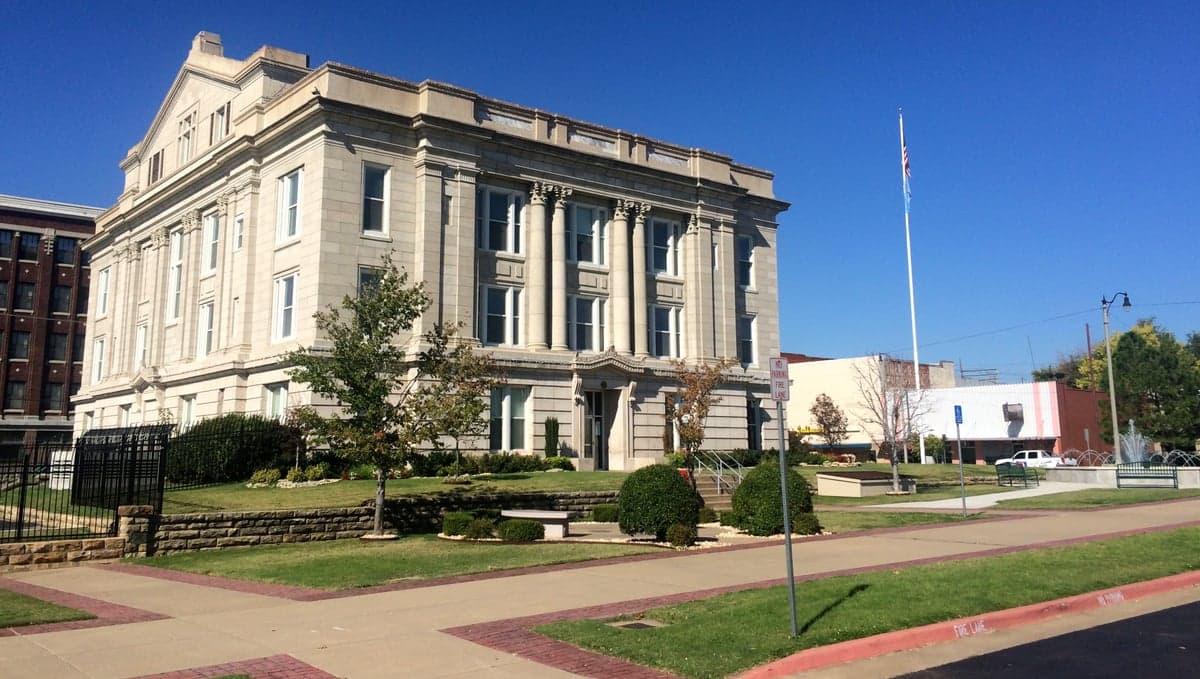
Photo: Wikipedia
Political ClimatePolitical Climate in Creek County
Showing district-level results — no local-only data available.
Local Political AnalysisPolitical Analysis of Creek County
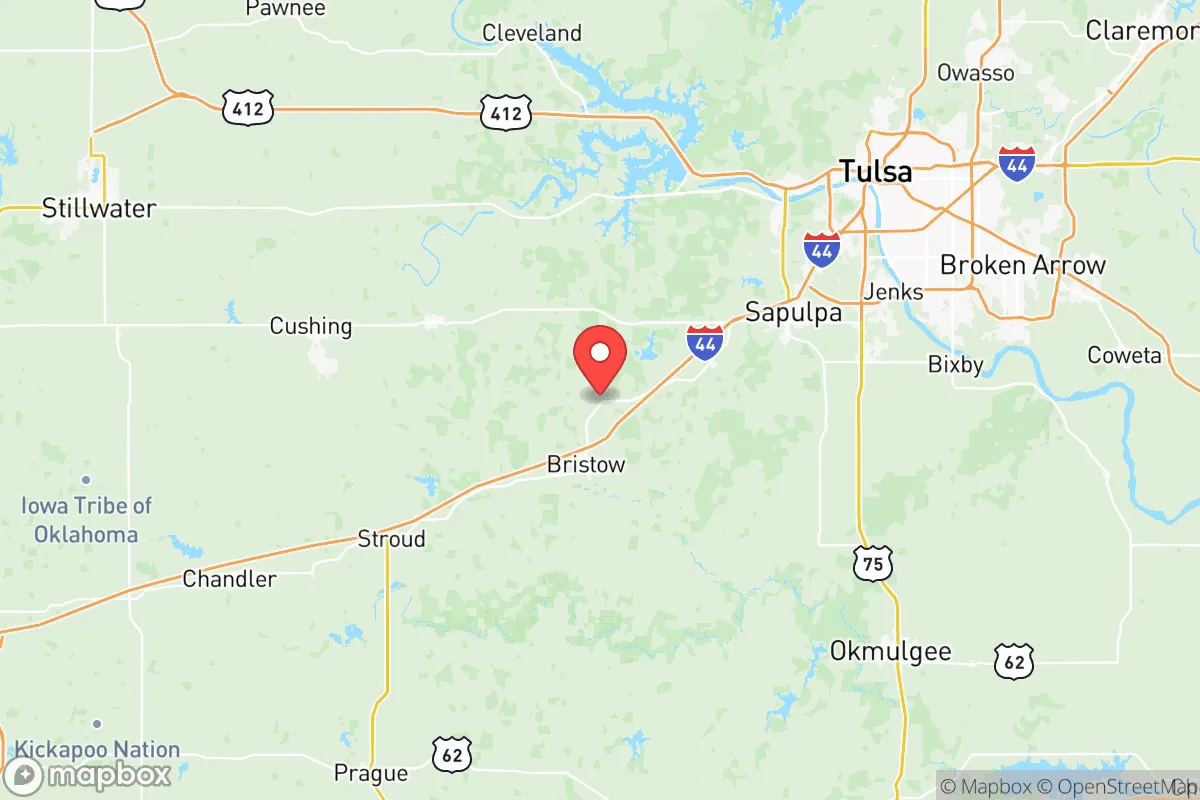
Creek County, Oklahoma, is a reliably Republican stronghold with a Cook PVI of R+23, making it significantly more conservative than the state of Oklahoma as a whole, which sits at R+18. This isn't a new development; the county has been trending red for decades, but the shift has accelerated since the early 2000s. While the entire county votes Republican in most races, there are noticeable variations between its towns and precincts that tell a more nuanced story.
How it compares
The R+23 rating means Creek County is about five points more Republican than the statewide average. In practice, that translates to a county where Democratic candidates rarely break 35% of the vote in presidential elections. The biggest contrast within the county is between the more rural, oil-and-agriculture communities and the bedroom suburbs of Tulsa. Towns like Mannford and Kellyville are deeply conservative, often voting 80% or more Republican. In contrast, Sapulpa, the county seat, is the most politically moderate area. Its precincts near downtown and along the Route 66 corridor occasionally show a slight Democratic lean, particularly in local races, though it still votes Republican overall. Bristow and Drumright are more mixed, with Bristow having a small but persistent Democratic base tied to its historic oil labor unions, while Drumright's older population leans heavily Republican. The swing precincts are almost entirely in Sapulpa's newer subdivisions, where younger families moving from Tulsa for cheaper housing sometimes bring more moderate or libertarian-leaning views.
What this means for residents
For conservative residents, Creek County is a comfortable environment where their values are reflected in local policy, from low taxes to Second Amendment protections. The county commission and school boards are reliably conservative, and there is little political friction in daily life. For liberal residents, the reality is more isolating. They are a clear minority, and while they are not openly hostile, they often find themselves politically out of step with neighbors and local government. Socially, liberal-leaning residents tend to cluster in Sapulpa's historic district or in the more artsy pockets of Bristow, where a small creative community exists. Politically active liberals often focus on local issues like public school funding or infrastructure, where they can find common ground with moderate Republicans, rather than on national partisan battles. The county's strong Republican lean means that Democratic candidates rarely invest resources here, so liberal residents have limited influence in local elections.
Culturally, Creek County is distinct from the more urbanized parts of Oklahoma. There is a stronger emphasis on rural self-reliance, hunting, and outdoor recreation. The county's policy distinctions include a more aggressive approach to limiting zoning regulations, which appeals to libertarian-leaning conservatives but frustrates those who want more planned development. The local economy is heavily tied to oil and gas, which reinforces the conservative political culture. Unlike the more diverse and rapidly growing Oklahoma City metro, Creek County's population is older, whiter, and more resistant to demographic change. This creates a political climate that is stable and predictable for conservatives but can feel stagnant and insular for liberals. The long-term trajectory suggests the county will remain deeply Republican, though the continued suburbanization of Sapulpa may slowly introduce more moderate voices over the next decade.

State Political ClimatePolitical Climate in Oklahoma
State Political AnalysisPolitical Environment in the State
Oklahoma is one of the most reliably Republican states in the country, with a Cook Partisan Voting Index of R+18, meaning it votes about 18 points more Republican than the national average in presidential elections. The state hasn't voted for a Democratic presidential candidate since 1964, and over the last 20 years, the GOP has consolidated power at every level—from the governor's mansion to supermajorities in both legislative chambers. The shift has been driven by the collapse of the old Democratic "Blue Dog" coalition in rural areas, the rapid suburbanization of the Oklahoma City and Tulsa metros, and a cultural alignment with national conservative populism that has only deepened since 2016.
Urban vs. rural divide
The political map of Oklahoma is a classic story of deep red rural expanses surrounding two blue-leaning urban islands. Oklahoma City and Tulsa are the only real Democratic strongholds, and even they are not solidly blue—Oklahoma County (Oklahoma City) voted for Trump by a narrow 51-46 margin in 2020, while Tulsa County went 55-43 for Trump. The real Democratic votes are concentrated in the core of Oklahoma City (downtown, the Paseo, and the Asian District) and in Tulsa's midtown and Kendall-Whittier neighborhoods. Suburbs like Edmond, Norman, and Broken Arrow are reliably Republican, though Norman—home to the University of Oklahoma—has a noticeable progressive student and faculty presence that makes it the most competitive large suburb. The rural stretches—places like Woodward, Guymon, and McAlester—routinely deliver 80%+ margins for the GOP. The divide is stark: a drive from downtown Oklahoma City to the Panhandle is a journey from a mixed-race, college-educated, service-economy city to a homogenous, agricultural, deeply conservative landscape where the local radio station still plays "God Bless the USA" every hour.
Policy environment
Oklahoma's policy environment is aggressively conservative by design. The state has a flat income tax of 4.75% (down from 5% in 2022, with a trigger to drop to 3.99% if revenue targets are met), no estate tax, and a sales tax that averages around 8.9% when local add-ons are included. Property taxes are among the lowest in the nation, capped by a constitutional amendment at 1% of fair cash value for most residential property. The regulatory posture is business-friendly: Oklahoma is a right-to-work state, has no statewide zoning mandates, and has aggressively courted oil and gas, aerospace, and data center industries. Education policy is a flashpoint: the state has one of the nation's most expansive school voucher programs (the Oklahoma Parental Choice Tax Credit Act, passed in 2023), which provides up to $7,500 per student for private school tuition, but public school funding per pupil remains near the bottom nationally. Healthcare is a mixed bag: the state expanded Medicaid in 2021 via a ballot initiative (State Question 802), but the legislature has since added work requirements and premiums for able-bodied adults. Election laws are restrictive: voter ID is required, absentee ballot drop boxes are banned, and the state purged over 100,000 inactive voters in 2023. Abortion is banned from conception with narrow exceptions for rape, incest, and medical emergency, following the trigger law (SB 612) that took effect after Dobbs.
Recent policy direction
The last five years have seen Oklahoma lurch further right on nearly every axis a relocator might care about. On gun and self-defense law, the state enacted permitless carry (SB 1080) in 2019, allowing any adult who can legally possess a firearm to carry openly or concealed without a license. On parental and education rights, the 2023 "Save Women's Sports Act" (SB 200) bans transgender girls from female school sports, and the "Students' Right to Know Act" (HB 1028) requires schools to notify parents of any curriculum changes related to sexuality or gender identity. On speech and privacy, the state passed a law (HB 1775) in 2021 that restricts the teaching of certain concepts about race and sex in public schools, and a 2024 law (SB 101) bans TikTok and WeChat on state-issued devices. On medical and bodily autonomy, the near-total abortion ban is the headline, but the state also passed a law (HB 1108) in 2023 that requires parental consent for minors to receive any gender-affirming care. On property rights, the state has strong eminent domain protections for landowners, and a 2022 law (SB 1050) prohibits local governments from banning natural gas hookups in new construction. On taxation, the legislature passed a series of income tax cuts in 2022 and 2023, with a trigger mechanism that could bring the rate to 3.99% by 2027. On voting and ballot access, the state passed a law (SB 440) in 2023 that requires absentee ballots to be notarized or accompanied by a copy of a photo ID, and another (HB 2663) that shortens the early voting window from three days to two.
Civil unrest & political movements
Oklahoma's political activism is less about street protests and more about organized, institutional movements. The most visible flashpoint in recent years has been the Walters-OSDE controversy: State Superintendent Ryan Walters, a Trump-aligned firebrand, has repeatedly clashed with school boards and teachers' unions over curriculum, library books, and the use of federal funds. His 2024 proposal to require the Bible in every public school classroom sparked protests in Oklahoma City and Tulsa, but also energized his base in rural counties. On the left, the 2023 teacher walkout (a repeat of the 2018 "Red for Ed" movement) drew thousands to the state capitol, but failed to secure a significant funding increase. Immigration politics are less heated than in border states, but Guymon in the Panhandle has seen tensions over the growing Hispanic population in the meatpacking industry, with local law enforcement cooperating with ICE. There is no serious secession or nullification movement, though a 2023 resolution (HCR 1002) affirming the state's "sovereignty" under the Tenth Amendment passed along party lines. Election integrity controversies have been minimal compared to states like Arizona or Georgia, but the 2022 audit of the 2020 election in Canadian County (a GOP stronghold) found no irregularities, which was used by both sides as evidence for their narrative.
Projection
Over the next 5-10 years, Oklahoma is likely to become more Republican, not less. The demographic trends are clear: the state's population is growing fastest in the exurbs of Oklahoma City (places like Mustang and Piedmont) and Tulsa (Bixby and Jenks), which are overwhelmingly white, married, and conservative. The in-migration from California and Texas is real—Oklahoma gained about 50,000 net new residents from those states between 2020 and 2024—but these newcomers are disproportionately retirees and remote workers drawn by low taxes and housing costs, not progressive activists. The Democratic base in Oklahoma City and Tulsa is aging and not being replaced by young voters at the same rate as in other states. The only wild card is the growing Hispanic population, which is now about 12% of the state and concentrated in Oklahoma City, Tulsa, and the Panhandle. If that bloc shifts leftward as it has nationally, it could make Oklahoma County and Tulsa County more competitive, but it won't flip the state. Expect the GOP to maintain supermajorities in the legislature through 2030, and for the state's policy direction—tax cuts, school choice expansion, and cultural conservatism—to continue unabated.
For a new resident, the bottom line is this: if you are a conservative, you will find Oklahoma deeply aligned with your values on taxes, guns, education, and social issues, and you will have little friction in daily life. If you are a liberal, you will find a state where your vote in statewide elections is effectively meaningless, where your local school board may be at war with the state superintendent, and where your access to abortion and gender-affirming care is severely restricted. The practical takeaway is that Oklahoma is a state that rewards those who fit its political mold and challenges those who don't—but the challenges are mostly political, not personal. Most Oklahomans are neighborly and live-and-let-live in their day-to-day interactions, regardless of party registration. The politics are intense at the capitol, but on the ground, life moves at a slower, more civil pace.
* Values derived from national, state, county, city and local statistics and may differ in a specific area. Last updated: 2026-06-15T23:14:11.000Z
Narrative content on this page is AI-generated and may contain mistakes. Verify any details that matter before acting on them.
ReloMaps may earn a commission from affiliate links at no extra cost to you.

