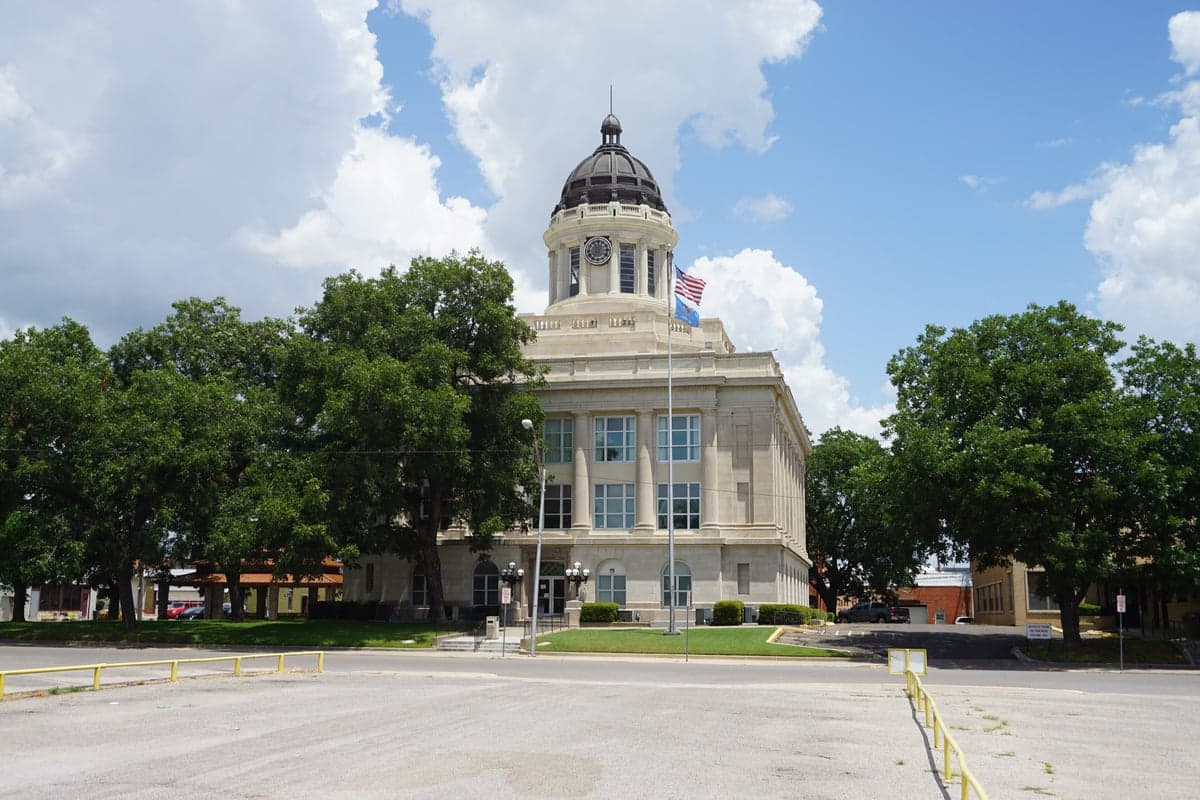
Photo: Wikipedia
Political ClimatePolitical Climate in Carter County
Showing district-level results — no local-only data available.
State Political ClimatePolitical Climate in Oklahoma
State Political AnalysisPolitical Environment in the State
Oklahoma sits firmly in the deep-red column with a Cook PVI of R+18, meaning it is one of the most reliably Republican states in the country. The dominant coalition is a blend of rural conservatives, evangelical Christians, and fiscally minded suburbanites, with the GOP holding supermajorities in both legislative chambers and occupying every statewide office. Over the last two decades, this lean has actually intensified: Democrats controlled the governorship as recently as 2010, but the state has shifted rightward in every subsequent cycle, especially after the 2020 election.
Urban vs. rural divide
The political map breaks down along classic lines, but with some notable quirks. Oklahoma City and Tulsa are the two blue-tinted islands in a sea of red, but even they are more purple than deep blue. In 2024, Oklahoma County (OKC) was competitive, while Tulsa County has leaned Republican in recent cycles. Norman, home to the University of Oklahoma, is the state’s most reliably liberal city, regularly electing Democrats to local office and sending progressive representatives to the statehouse. Edmond, a northern suburb of OKC, is largely conservative but with a growing number of moderate professionals. Broken Arrow and Jenks, suburbs of Tulsa, are deeply red and have been trending even redder as families flee leftward city policies elsewhere. Rural counties like Texas County in the panhandle and Kay County in the north vote 80%+ Republican. The divide is stark: the state’s political power flows from the small towns and rural precincts, which consistently outvote the urban centers in statewide primaries and general elections.
Policy environment
Oklahoma’s policy environment is built around limited government and cultural conservatism. Personal income tax is a flat 4.75%, and there are persistent efforts to reduce it further. The state has no estate or inheritance tax, and property taxes are among the lowest in the nation, averaging around 0.9% of assessed value. Education policy has seen a major shift toward school choice: the Oklahoma Parental Choice Tax Credit Act (HB 1935), passed in 2023, provides up to $7,500 per child for private school or homeschooling expenses, making it one of the most expansive school choice programs in the country. On healthcare, Oklahoma expanded Medicaid under the state question 802 in 2020, a rare progressive victory that passed by ballot initiative over legislative opposition. Election laws are strict but straightforward: in-person voter ID is required, absentee ballot applications must be notarized (with some exceptions for military and overseas voters), and same-day registration is not permitted. There is no widespread push to change these rules.
Trajectory & freedom
Oklahoma has moved decisively in the direction of personal freedom on most fronts, especially since 2020. Constitutional carry (HB 2597) was enacted in 2019, allowing anyone over 21 who can legally possess a firearm to carry without a permit, and preemption laws prevent local governments from passing stricter gun ordinances. Parental rights were recently codified through the Parental Bill of Rights (HB 1646), which affirms parents’ authority over their children’s education, medical decisions, and moral upbringing. On medical freedom, the state passed SB 3 in 2023, prohibiting medical mandates related to COVID-19 by both public and private entities. However, there are areas where freedom is being restricted: abortion is fully banned from conception (no exceptions for rape or incest), enforced through civil enforcement mechanisms that allow private citizens to sue anyone who performs or aids an abortion. This has made Oklahoma one of the most restrictive states in the country, a point of pride for some and a deterrent for others. On the whole, the trajectory is toward expanding Second Amendment rights, educational choice, and medical autonomy, while cracking down on cultural and moral issues like abortion and gender transition procedures for minors.
Civil unrest & political movements
Civil unrest has been relatively muted compared to coastal states, but not nonexistent. The 2020 George Floyd protests in Oklahoma City and Tulsa saw both peaceful marches and some property damage, particularly in the Bricktown and Deep Deuce districts. The state has seen a significant rise in activist organizing on the right, particularly around parental rights and school board meetings. The Moms for Liberty movement has a strong presence in places like Edmond and Owasso, and has successfully campaigned to remove books and curriculum they view as inappropriate. Immigration politics are less front-burner here than in border states, but Oklahoma was one of the first states to pass an anti-sanctuary city law (HB 1804 in 2007), which bans sanctuary policies and requires cooperation with federal immigration enforcement. There has been no serious secession or nullification rhetoric in recent years, but the state legislature has passed multiple resolutions affirming sovereignty under the Tenth Amendment. Election integrity controversies have been few; Oklahoma uses paper ballots, has a clean voter roll, and has not seen the kinds of disputes that have divided other states. A newcomer would find the atmosphere generally stable and law-abiding, with political activism focused on school board meetings, church events, and property rights issues rather than street-level confrontation.
Projection
Over the next five to ten years, Oklahoma is likely to become even more conservative in its policy output, but potentially more contested at the local level as in-migration continues. The state is attracting a steady flow of people from California, Colorado, and Illinois, many of whom are fiscally and culturally conservative families looking for lower housing costs and a friendlier regulatory environment. Tulsa’s remote worker initiative, which pays people to move to the city, has brought in a mix of political views, but the program’s data suggests most relocates are conservative or libertarian. The danger from a conservative perspective is that Norman and the inner city of Oklahoma City could slowly trend bluer as younger, more progressive professionals move in, but the rural and suburban exurbs are growing even faster. The GOP supermajority is not going anywhere, and with the legislature aggressively preempting local ordinances on issues like firearms, labor, and housing, the state will continue to feel more red than blue regardless of urban trends. A resident moving in now should expect that the state will remain culturally traditional, fiscally restrained, and increasingly protective of parental rights and Second Amendment freedoms for the next decade.
For someone considering relocation here, the bottom line is that Oklahoma offers a deeply conservative policy environment with genuine legal protections for personal freedom on most fronts—especially gun rights, school choice, and medical autonomy—but with a near-total ban on abortion and a heavy cultural emphasis on traditional values. If you want a state where your rights as a parent and a gun owner are explicitly protected by law, where taxes are low and falling, and where the political leadership shares your worldview, Oklahoma is one of the safest bets in the country. Just be prepared for the summer heat and the fact that your nearest Target might be 45 minutes away if you choose a truly rural area.

* Values derived from national, state, county, city and local statistics and may differ in a specific area. Last updated: 2026-06-01T23:31:28.000Z
Narrative content on this page is AI-generated and may contain mistakes. Verify any details that matter before acting on them.
ReloMaps may earn a commission from affiliate links at no extra cost to you.

