
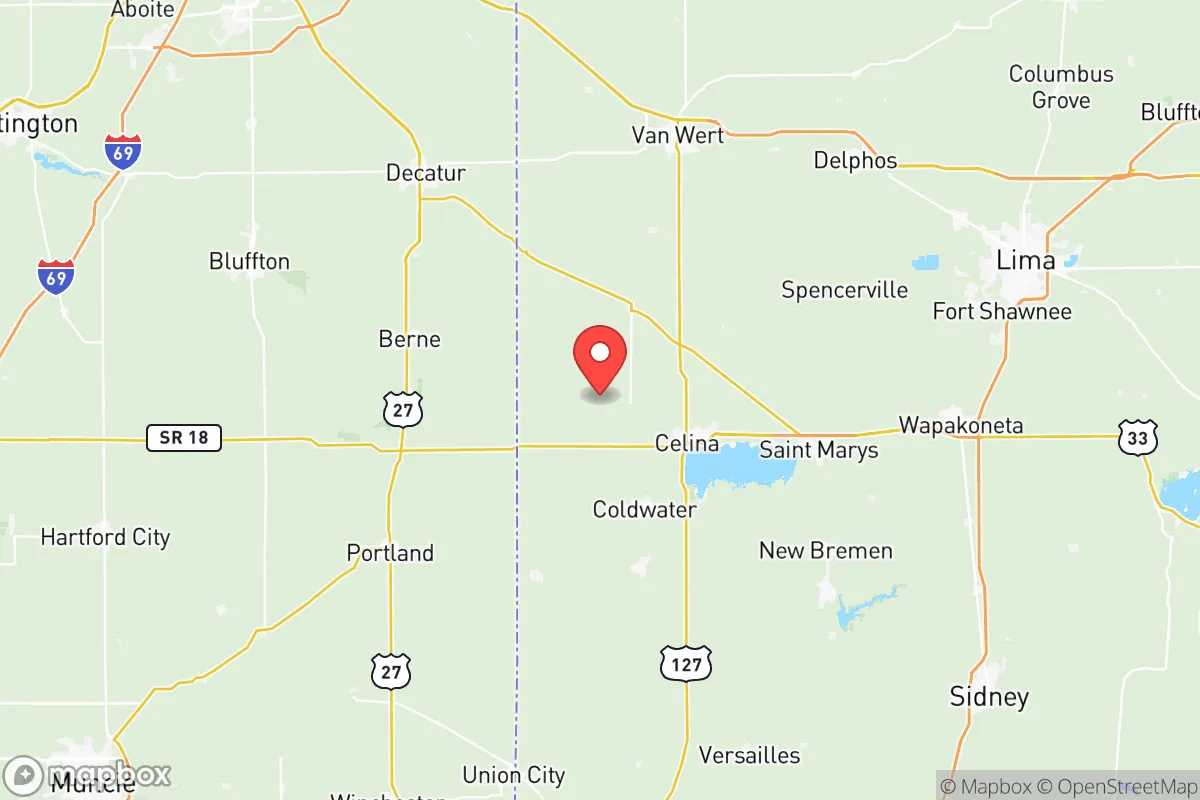
Photo: Wikipedia
Political ClimatePolitical Climate in Mercer County
Showing district-level results — no local-only data available.
Local Political AnalysisPolitical Analysis of Mercer County
Mercer County is one of the most reliably Republican counties in Ohio, with a Cook Partisan Voting Index (PVI) of R+18, meaning it votes about 18 points more Republican than the national average. That’s a full 13 points redder than the state of Ohio as a whole, which sits at R+5. This isn’t a recent shift—Mercer County has been a GOP stronghold for decades, and the trend has only hardened since 2016. In 2024, Donald Trump carried the county by roughly 75% of the vote, a margin that has become the new normal. The county’s political identity is deeply tied to its rural, agricultural character and strong Catholic and conservative Protestant traditions, especially in the larger towns like Celina and Coldwater.
How it compares
Compared to Ohio’s overall R+5 lean, Mercer County is a political outlier even within a red state. While Ohio’s swing counties—like Delaware, Warren, and parts of the Columbus suburbs—have drifted right, Mercer County has been solidly red for generations. The biggest contrast is with Ohio’s urban centers: Cuyahoga County (Cleveland) votes D+30, and Franklin County (Columbus) votes D+20. Mercer County’s R+18 is the mirror image of those blue strongholds. Within the county itself, there’s little variation. Celina, the county seat and largest town (population ~10,000), is reliably Republican but slightly less so than the rural townships. Coldwater and St. Henry are deeply red, with precincts regularly hitting 80%+ for GOP candidates. The only precincts that ever show a hint of blue are in a few small pockets around the Celina city limits, where a handful of union households and public-sector workers occasionally vote Democratic in local races. But even those precincts haven’t gone blue in a presidential election since the 1990s. The county’s political trajectory is stable: no signs of flipping, and if anything, the margin has widened slightly since 2020 as national polarization deepens.
What this means for residents
For conservative residents, Mercer County is about as comfortable as it gets politically. Local government, school boards, and county commissions are uniformly Republican. The county’s strong rightward lean means conservative policies on taxes, gun rights, and social issues are the default. Property taxes are low, and the county has resisted many state-level mandates on renewable energy and land use. For liberal residents, the reality is more isolating. There’s no organized Democratic Party presence to speak of—the county party is essentially a volunteer operation that struggles to field candidates. Socially, being openly progressive can be a challenge, especially in smaller towns like Fort Recovery or Rockford, where community life revolves around church and conservative civic groups. That said, most residents report that political disagreements are handled civilly in day-to-day life—it’s not a place where people argue politics at the grocery store. The main practical effect is that liberal residents often drive to Celina or even to Lima or Dayton for events, services, or social circles that align with their views.
Culturally, Mercer County stands apart from much of Ohio due to its strong German Catholic heritage, which influences everything from local festivals (like the Coldwater Oktoberfest) to the county’s stance on alcohol sales—the county is “moist,” meaning some towns allow beer and wine sales while others remain dry. This local-option approach to alcohol is a classic example of the county’s preference for local control over state or federal mandates. The county also has a notable Amish and Mennonite population, particularly in the northern townships, which adds a layer of cultural conservatism that’s distinct from the evangelical Protestantism found in other parts of Ohio. For anyone moving here, the key takeaway is that Mercer County is not a political battleground—it’s a place where the conservative consensus is so deep that it shapes daily life, from the local newspaper’s editorial page to the topics discussed at community events. It’s a stable, predictable environment for those who share its values, and a quiet, respectful challenge for those who don’t.

State Political ClimatePolitical Climate in Ohio
State Political AnalysisPolitical Environment in the State
Ohio is a classic swing state that has shifted decisively rightward over the past decade, now carrying a Cook PVI of R+5 after voting for Donald Trump by 8 points in both 2016 and 2020 and by 11 points in 2024. The state’s political center of gravity has moved from the old Reagan Democrat strongholds of the Mahoning Valley and Southeast Ohio to the fast-growing exurbs of Columbus and Cincinnati, while the Democratic coalition has become increasingly concentrated in the urban cores of Columbus, Cleveland, and Cincinnati and a handful of college towns like Athens and Oberlin. For a conservative relocator, Ohio offers a reliably Republican state government that has enacted a broad conservative agenda on taxes, education, and gun rights, but the state’s political geography means you’ll find deep-blue pockets in the cities and a live-and-let-live attitude in most suburbs.
Urban vs. rural divide
The political map of Ohio is a textbook case of the urban-rural split. The three major metros—Columbus (Franklin County), Cleveland (Cuyahoga County), and Cincinnati (Hamilton County)—are Democratic strongholds that together cast roughly 40% of the state’s vote. Franklin County went for Biden by 21 points in 2020, while Cuyahoga County voted for him by 34 points. But the rest of the state is overwhelmingly red: the rural counties of western Ohio, like Mercer and Auglaize, routinely vote 75-80% Republican, and the Appalachian counties in the southeast, once reliably Democratic, have flipped hard to the GOP. The real story is the exurbs: Delaware County (north of Columbus) and Warren County (north of Cincinnati) are now among the most Republican counties in the state, with Delaware voting +27 R in 2024 and Warren +35 R. These are the areas where conservative families are moving for good schools and lower taxes, and they’re driving the state’s rightward tilt. The old Democratic strongholds in the Mahoning Valley—Youngstown and Warren—have also shifted right, with Mahoning County going from Obama +18 in 2012 to Trump +4 in 2024.
Policy environment
Ohio’s policy environment is solidly conservative, shaped by a Republican trifecta that has held the governorship and both legislative chambers since 2011. The state has a flat income tax of 3.5% (down from 4.8% in 2020) and is on a path to eliminate it entirely, with Governor Mike DeWine signing a 2023 budget that accelerates cuts. Property taxes are moderate, with an effective rate around 1.5% of home value, but recent reappraisals in fast-growing counties like Delaware and Warren have sparked complaints. The regulatory posture is business-friendly: Ohio is a right-to-work state in practice (though not by statute), and the state has preempted local minimum wage and paid leave ordinances. On education, Ohio has one of the nation’s most robust school choice programs, with universal EdChoice vouchers available to any family regardless of income, and a growing network of charter schools. The state also passed a 2023 law requiring schools to adopt a “parents’ bill of rights” that mandates parental notification on health and counseling services. Healthcare policy is mixed: Ohio expanded Medicaid under the Affordable Care Act in 2014, but the state has also enacted abortion restrictions, including a 2022 heartbeat ban that was later blocked by a court challenge. Election laws have tightened: the 2023 omnibus bill requires voter ID with a photo, limits drop boxes to one per county, and shortens the absentee ballot application window.
Recent policy direction
The last three years have seen a flurry of legislation that signals where Ohio is headed. On gun rights, Ohio became a permitless carry state in 2022, allowing any adult who can legally possess a firearm to carry it concealed without a license. The state also passed a “stand your ground” law in 2021 and preempted local gun ordinances, so cities like Columbus and Cleveland cannot enact their own restrictions. On education and parental rights, the 2023 “Parents’ Bill of Rights” (HB 8) requires schools to notify parents if a student requests counseling or changes their name or pronouns, and it bans classroom instruction on sexual orientation and gender identity in grades K-3. On medical and bodily autonomy, Ohio voters approved a constitutional amendment in 2023 to protect abortion access, but the legislature has since passed a law requiring parental consent for minors and mandating that abortion facilities meet ambulatory surgical center standards. On property rights, the state has expanded oil and gas drilling on private land through forced pooling laws, which has been controversial in rural areas. On privacy and surveillance, Ohio has no comprehensive data privacy law, but it did pass a 2024 bill banning TikTok on state devices. On voting, the 2023 election law (SB 117) shortened the early voting period from 28 to 21 days and required that absentee ballot applications be notarized or include a copy of ID. The overall direction is toward a more conservative, more regulated social environment, but with a strong emphasis on school choice and tax cuts that appeals to many relocating families.
Civil unrest & political movements
Ohio has seen its share of political flashpoints. The 2020 protests in Columbus and Cleveland over George Floyd’s death were large but largely peaceful, though there were isolated incidents of property damage. The state has a visible and organized conservative movement, with groups like the Ohio Freedom Alliance and the Buckeye Firearms Association wielding significant influence in the legislature. Immigration politics are less heated than in border states, but there have been controversies over the resettlement of refugees in cities like Columbus and Dayton, and the state passed a 2024 law requiring local law enforcement to cooperate with ICE. There is no sanctuary city policy in Ohio; in fact, the state has preempted any local “sanctuary” ordinances. Election integrity has been a major issue since 2020, with Republican Secretary of State Frank LaRose conducting a review of the 2020 election that found no widespread fraud but still led to the 2023 voting restrictions. The most visible flashpoint for a new resident might be the ongoing debate over the 2023 abortion rights amendment, which passed with 57% of the vote but has been met with legislative pushback. You’ll see yard signs and bumper stickers on both sides, but the overall political temperature is moderate compared to states like Florida or Texas.
Projection
Over the next 5-10 years, Ohio is likely to become more Republican, not less. The demographic trends are clear: the urban cores are aging and losing population, while the exurbs and rural areas are growing. The in-migration pattern is dominated by conservative-leaning families from blue states like California and Illinois, who are drawn to Ohio’s lower cost of living and conservative policies. The state’s Republican majority in the legislature is likely to hold or expand, and the path to eliminating the income tax entirely seems plausible within a decade. However, the 2023 abortion rights amendment shows that voters are willing to buck the legislature on specific issues, so the political environment may remain more moderate on social questions than the legislature’s agenda suggests. For a conservative relocator, the outlook is favorable: expect continued tax cuts, expanded school choice, and a business-friendly regulatory climate. For a liberal relocator, the state will feel increasingly out of step on social issues, but the cities will remain blue havens with strong cultural institutions and progressive local governments.
For a new resident, the bottom line is that Ohio offers a stable, increasingly conservative political environment with a low cost of living and a strong economy. You’ll find that your vote matters more in state and local elections than in the presidential race, which is now reliably red. The practical takeaway: if you’re a conservative family looking for good schools, low taxes, and a welcoming environment for gun owners, Ohio is a strong choice. If you’re a liberal, you’ll find your community in the cities and college towns, but you’ll need to accept that state policy will often run against your preferences. Either way, the state’s political climate is less volatile than many of its neighbors, and the pace of change is steady rather than abrupt.
* Values derived from national, state, county, city and local statistics and may differ in a specific area. Last updated: 2026-10-15T00:58:47.000Z
Narrative content on this page is AI-generated and may contain mistakes. Verify any details that matter before acting on them.
ReloMaps may earn a commission from affiliate links at no extra cost to you.

