
Photo: Wikipedia
Political ClimatePolitical Climate in Fairfield County
Showing district-level results — no local-only data available.
Local Political AnalysisPolitical Analysis of Fairfield County
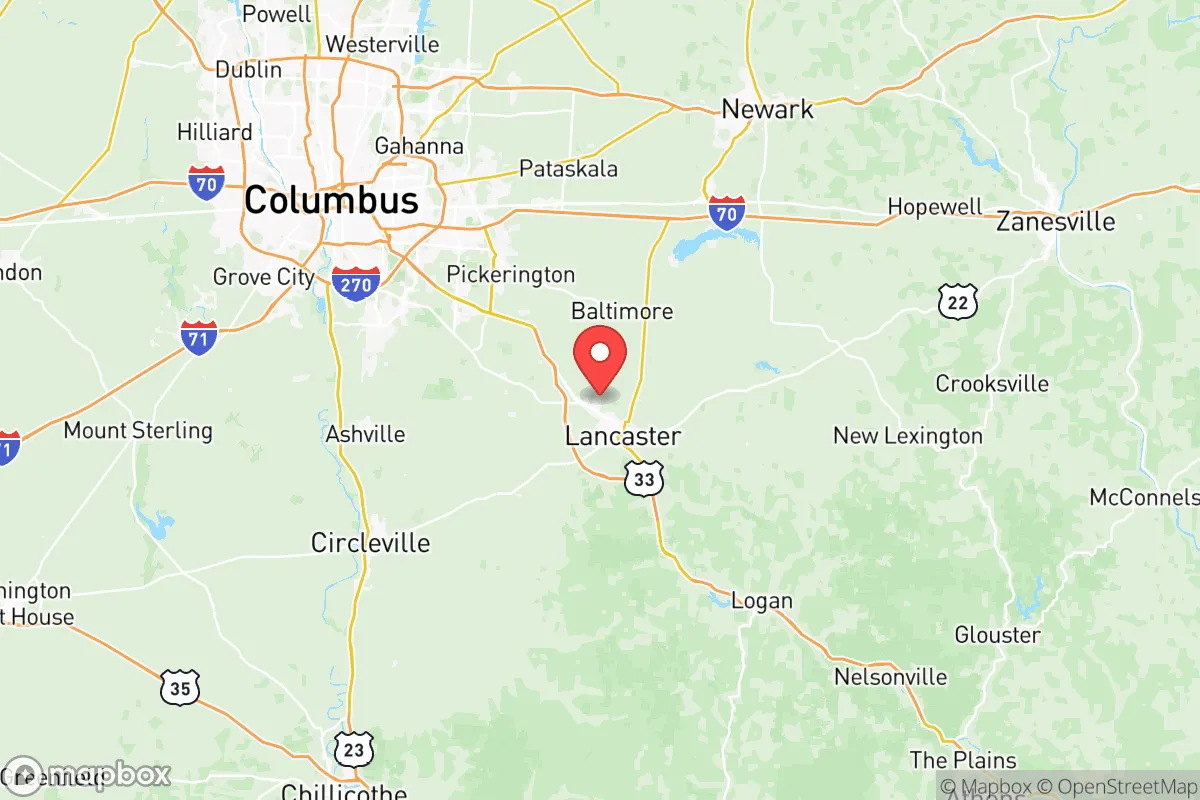
Fairfield County, Ohio, is a solidly Republican stronghold with a Cook Partisan Voting Index of R+16, making it significantly more conservative than the state of Ohio as a whole, which sits at R+5. This isn't a new development; the county has been reliably red for decades, but the margin has widened in recent cycles as the rural and exurban precincts have pulled further right while the more moderate suburbs around Lancaster have held steady. If you're moving here, you're coming into an area where GOP candidates routinely win by double digits, though the intensity of that support varies noticeably depending on which part of the county you're in.
How it compares
Ohio's R+5 rating reflects a state that is still a competitive battleground at the presidential level, with a mix of urban blue islands (Cleveland, Columbus, Cincinnati) and vast red rural and suburban expanses. Fairfield County, by contrast, is more uniformly conservative. The county's R+16 score is closer to what you'd see in deeply red southeastern Ohio than in the Columbus suburbs just to its west. The biggest internal divide is between the city of Lancaster, the county seat and largest municipality, and the surrounding townships. Lancaster itself is a bit of a purple island: its downtown and older neighborhoods near Ohio University Lancaster tend to lean more Democratic, while the fast-growing outer edges of the city and the newer subdivisions vote heavily Republican. Meanwhile, towns like Pickerington (which straddles Fairfield and Franklin counties) are more moderate and swingy, reflecting their status as exurbs of Columbus. Further out, communities like Baltimore, Millersport, and Carroll are deeply red, with Republican margins often exceeding 70% in local elections. The swing precincts are almost entirely in the western part of the county, closest to Columbus, where new residents are bringing a mix of suburban and urban voting habits.
What this means for residents
For conservative residents, Fairfield County is a comfortable place to live politically. Local offices — from county commissioners to judges to school board seats — are overwhelmingly held by Republicans, and the county's GOP apparatus is well-organized and active. Conservative voters will find their views reflected in local policy, from tax levies to land-use decisions. For liberal residents, the reality is more about finding your niche. Lancaster's core and the Ohio University campus area provide some blue-friendly spaces, and the western edge of the county near Pickerington offers a more moderate environment. But in practical terms, Democratic candidates rarely win countywide races, and progressive policy proposals face an uphill battle. That said, the county is not a monolith: there are active Democratic and independent groups, and local issues like school funding, infrastructure, and economic development often transcend party lines. The political climate here is more about quiet consensus than loud confrontation — most people just get on with their lives, and political conversations tend to stay civil, especially outside of election season.
Culturally, Fairfield County's conservatism is of the practical, small-government variety rather than the fire-breathing sort. The county has a strong agricultural and manufacturing heritage, and that shapes the local political conversation. You'll hear more about property taxes, road maintenance, and school levies than about national culture wars. The county's proximity to Columbus means that many residents commute to the city for work, which has brought some suburbanization and a slow drift toward moderation in the western townships. But the eastern half of the county remains deeply rural and traditional. One notable policy distinction: Fairfield County has been more aggressive than some neighboring counties in opposing state-level mandates on land use and zoning, reflecting a strong local-control ethos. For newcomers, the key takeaway is that the county is reliably red but not insular — it's connected to the Columbus metro area, and that keeps the political culture from becoming too isolated or extreme.

State Political ClimatePolitical Climate in Ohio
State Political AnalysisPolitical Environment in the State
Ohio is a classic swing state that has shifted decisively rightward over the past decade, now carrying a Cook Partisan Voting Index of R+5. The state voted for Donald Trump by 8 points in both 2016 and 2020, and by a wider margin in 2024, cementing a trajectory that began with the collapse of the old "Blue Wall" in the industrial northeast and the rapid growth of conservative exurbs around Columbus and Cincinnati. Twenty years ago, Ohio was the ultimate bellwether—voting for the winner in every presidential election from 1964 to 2020—but today it is a reliably Republican state at the presidential level, even as it retains competitive down-ballot races and a handful of Democratic strongholds in its major cities.
Urban vs. rural divide
The political map of Ohio is a textbook study in the urban-rural split. The three major metros—Cleveland, Columbus, and Cincinnati—anchor the Democratic vote, with Cuyahoga County (Cleveland) delivering margins of 60-70% for Democrats. Franklin County (Columbus) has become the state's most reliable Democratic stronghold, growing fast with a young, diverse population that pushed it to a 20-point Biden win in 2020. Hamilton County (Cincinnati) is more competitive but trending blue in its urban core. Outside these islands, the story is overwhelmingly Republican. The rural counties of southeast Ohio (Athens County excepted) and the northwest farmland vote 70-80% Republican. The real action is in the exurbs and smaller cities: Delaware County (north of Columbus) is now one of the most Republican counties in the state, while Warren County (north of Cincinnati) votes like a deep-red rural county despite being suburban. Mahoning County (Youngstown) is a fascinating exception—historically Democratic, it flipped hard for Trump in 2016 and has stayed red, reflecting the broader realignment of working-class white voters. The political geography is simple: the three C's plus a few college towns (Athens, Oberlin) vote blue; everything else votes red, and the red is getting redder.
Policy environment
Ohio's policy environment reflects its Republican trifecta—the governor's office, state House, and state Senate have all been under GOP control since 2011. The state has a flat income tax rate of 3.5% (down from over 5% a decade ago) and is phasing it out entirely, with a goal of elimination by 2030. Sales tax is 5.75% at the state level, with local add-ons. Property taxes are moderate but vary wildly by district. The regulatory posture is business-friendly: Ohio is a right-to-work state in practice (though not by statute), and workers' compensation costs are among the lowest in the Midwest. Education policy is a battleground: the state has a robust school voucher program (the EdChoice system) that has expanded significantly under Governor Mike DeWine, and charter schools are widespread. Higher education is dominated by Ohio State University, but the state has seen a push to limit diversity, equity, and inclusion (DEI) initiatives at public universities, with legislation pending to ban them outright. Healthcare is mixed: Ohio expanded Medicaid under the Affordable Care Act in 2014, but the state has also imposed work requirements for able-bodied adults (currently tied up in court). Election laws have tightened: voter ID is now required (with a limited list of acceptable IDs), drop boxes are restricted to one per county, and early voting hours have been reduced. The state purges inactive voters regularly, a practice upheld by the Supreme Court in 2018.
Recent policy direction
The last three years have seen a sharp conservative turn in Ohio law. On guns and self-defense, Ohio became a permitless carry state in 2022, meaning any adult who can legally possess a firearm may carry it concealed without a license. The "Stand Your Ground" law was also strengthened, removing the duty to retreat in any place where a person is lawfully present. On parental and education rights, the state passed the "Parents' Bill of Rights" in 2023, requiring schools to notify parents of any changes to a student's health or well-being and banning instruction on sexual orientation and gender identity in grades K-3 (the "Don't Say Gay" law). On speech and privacy, Ohio has no broad surveillance law, but local police use of automated license plate readers is widespread and largely unregulated. On medical and bodily autonomy, abortion is banned after six weeks (the "Heartbeat Bill"), with no exceptions for rape or incest, though a 2023 ballot initiative to enshrine abortion rights in the state constitution passed with 57% of the vote—a clear sign that public opinion is more moderate than the legislature. On property rights, Ohio has no statewide rent control and allows local governments to regulate short-term rentals (Airbnb) as they see fit. On taxation, the income tax phase-out is the dominant story, with the state relying more on sales and consumption taxes. On voting and ballot access, the 2023 law requiring photo ID and limiting drop boxes has been controversial, but turnout in 2024 remained high, suggesting the changes haven't suppressed participation as critics feared.
Civil unrest & political movements
Ohio has seen its share of political flashpoints. The 2020 protests in Columbus and Cincinnati following the murder of George Floyd were large but largely peaceful, though Columbus saw property damage and a controversial police response. The state has a robust activist scene on both sides: on the left, the Ohio Organizing Collaborative and local groups in Cleveland and Columbus push for criminal justice reform and voting rights; on the right, the Buckeye Firearms Association and Ohio Right to Life are powerful lobbying forces. Immigration politics are less heated than in border states, but Springfield made national headlines in 2024 when a surge of Haitian immigrants (estimated at 15,000-20,000) strained local resources and sparked a political firestorm, with Trump and Vance amplifying claims about crime and housing costs. There are no sanctuary cities in Ohio; several municipalities have passed ordinances limiting cooperation with ICE, but state law prohibits them from being true sanctuaries. Election integrity controversies have been muted compared to states like Arizona or Georgia, but the 2020 election saw Trump's legal team file lawsuits in Ohio that were quickly dismissed. The "Ohio Election Integrity Network" remains active, pushing for hand-counting of ballots and other changes. Secession or nullification rhetoric is virtually nonexistent; Ohio is a solidly institutional state that works within the system.
Projection
Over the next 5-10 years, Ohio will likely become more Republican at the state level, but the margin of that shift may narrow as Columbus continues to grow and diversify. The in-migration pattern is interesting: Ohio is gaining population from other Midwest states (Michigan, Illinois) and from the Northeast, but those movers tend to be older and more conservative, settling in exurbs and retirement communities. The younger, more liberal cohort is concentrated in Columbus and, to a lesser extent, Cincinnati's Over-the-Rhine neighborhood. The income tax phase-out will continue, shifting the tax burden to sales and property taxes, which may benefit high earners but could squeeze lower-income residents. The abortion rights ballot initiative shows that direct democracy can override the legislature, so expect more ballot fights on issues like marijuana legalization (already passed in 2023) and minimum wage. The wild card is the state's aging population: Ohio has one of the oldest median ages in the Midwest, and older voters lean Republican, but the state's slow population growth means the electorate will shift only gradually. A new resident moving in now should expect a state that is reliably Republican in presidential elections, with a legislature that is more conservative than the electorate, but with enough Democratic strongholds in the cities to keep down-ballot races competitive.
For a new resident, the bottom line is this: Ohio is a politically comfortable place for conservatives, with low taxes, strong gun rights, and a legislature that reflects their values. For liberals, it's a state where your vote in state-level races may feel futile, but where city life in Columbus or Cleveland offers a blue bubble with all the amenities of a major metro. The practical takeaway is that Ohio's politics are stable and predictable—no wild swings, no existential crises—and the state's trajectory is toward a more solidly Republican, low-tax, culturally conservative future, tempered by the growing influence of Columbus and the occasional ballot initiative that reminds the legislature it doesn't have total control.
* Values derived from national, state, county, city and local statistics and may differ in a specific area. Last updated: 2026-08-08T16:54:13.000Z
Narrative content on this page is AI-generated and may contain mistakes. Verify any details that matter before acting on them.
ReloMaps may earn a commission from affiliate links at no extra cost to you.

